{"title":"Comparative Assessment of Antibiotics and Probiotics: Adjuvants in Nonsurgical Periodontal Treatment for Smokers With Generalized Periodontitis.","authors":"Sujay Shah, Kinjal S Engineer, Rutu Shah, Hiral Shah, Shreya Gajjar, Santosh Kumar, Mainul Haque","doi":"10.7759/cureus.78394","DOIUrl":null,"url":null,"abstract":"<p><p>Introduction Humankind is suffering from the misuse and overuse of antibiotics, leading to antibiotic resistance. At this point, probiotics, if found effective, can lead to a better future. Probiotics are nothing but a colony of living-friendly bacteria. <i>Lactobacillus reuteri</i> is essential for use as a probiotic among many healthy bacteria. This study aims to compare the effectiveness of probiotics in periodontal treatment. Methods One hundred smokers diagnosed with chronic generalized periodontitis were randomly assigned into two groups. Group A received a seven-day course of amoxicillin 500 mg three a day and metronidazole 500 mg twice daily, followed by 30 days of probiotics, while Group B received a placebo antibiotic for seven days and 30 days of <i>L. reuteri</i> probiotics (2×10⁸ CFU daily). Periodontal parameters, including plaque index (PI), gingival index (GI), probing depth (PD), attachment loss (AL), and bleeding on probing (BOP), were utilized to asses at baseline, month one, and month one. Baseline differences were adjusted using the generalized estimating equation (GEE) model. Results At month three, Group B (probiotics) showed a significantly lower PI (0.52±0.49 vs. 0.88±0.52, p<0.001) and a 23% greater reduction in PD (p=0.004) compared to Group A (antibiotics + probiotics). These findings highlight the effectiveness of probiotics alone in improving periodontal health in smokers. Conclusions Both groups showed equal effectiveness in improving periodontal health. Hence, probiotics should be preferred over antibiotics.</p>","PeriodicalId":93960,"journal":{"name":"Cureus","volume":"17 2","pages":"e78394"},"PeriodicalIF":1.3000,"publicationDate":"2025-02-02","publicationTypes":"Journal Article","fieldsOfStudy":null,"isOpenAccess":false,"openAccessPdf":"https://www.ncbi.nlm.nih.gov/pmc/articles/PMC11788449/pdf/","citationCount":"0","resultStr":null,"platform":"Semanticscholar","paperid":null,"PeriodicalName":"Cureus","FirstCategoryId":"1085","ListUrlMain":"https://doi.org/10.7759/cureus.78394","RegionNum":0,"RegionCategory":null,"ArticlePicture":[],"TitleCN":null,"AbstractTextCN":null,"PMCID":null,"EPubDate":"2025/2/1 0:00:00","PubModel":"eCollection","JCR":"Q3","JCRName":"MEDICINE, GENERAL & INTERNAL","Score":null,"Total":0}
引用次数: 0
Abstract
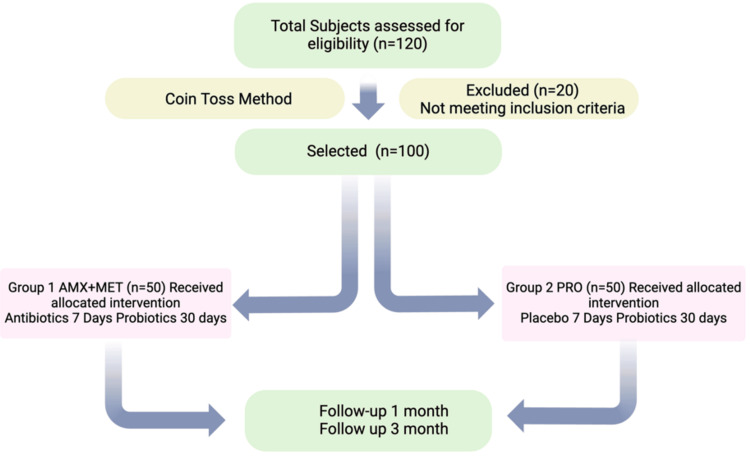
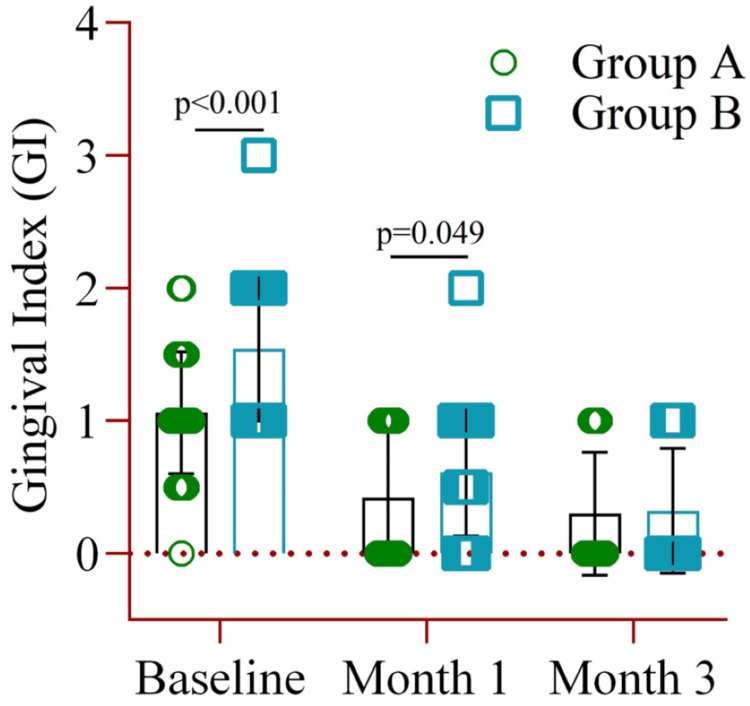
Introduction Humankind is suffering from the misuse and overuse of antibiotics, leading to antibiotic resistance. At this point, probiotics, if found effective, can lead to a better future. Probiotics are nothing but a colony of living-friendly bacteria. Lactobacillus reuteri is essential for use as a probiotic among many healthy bacteria. This study aims to compare the effectiveness of probiotics in periodontal treatment. Methods One hundred smokers diagnosed with chronic generalized periodontitis were randomly assigned into two groups. Group A received a seven-day course of amoxicillin 500 mg three a day and metronidazole 500 mg twice daily, followed by 30 days of probiotics, while Group B received a placebo antibiotic for seven days and 30 days of L. reuteri probiotics (2×10⁸ CFU daily). Periodontal parameters, including plaque index (PI), gingival index (GI), probing depth (PD), attachment loss (AL), and bleeding on probing (BOP), were utilized to asses at baseline, month one, and month one. Baseline differences were adjusted using the generalized estimating equation (GEE) model. Results At month three, Group B (probiotics) showed a significantly lower PI (0.52±0.49 vs. 0.88±0.52, p<0.001) and a 23% greater reduction in PD (p=0.004) compared to Group A (antibiotics + probiotics). These findings highlight the effectiveness of probiotics alone in improving periodontal health in smokers. Conclusions Both groups showed equal effectiveness in improving periodontal health. Hence, probiotics should be preferred over antibiotics.
人类正在遭受抗生素的滥用和过度使用,导致抗生素耐药性。在这一点上,如果发现益生菌有效,可以带来更美好的未来。益生菌只不过是一群对生物友好的细菌。罗伊氏乳杆菌是许多健康细菌中必不可少的益生菌。本研究旨在比较益生菌在牙周治疗中的效果。方法将100例诊断为慢性广泛性牙周炎的吸烟者随机分为两组。A组接受为期7天的疗程,阿莫西林500毫克,每天3次,甲硝唑500毫克,每天2次,随后服用益生菌30天,而B组接受安慰剂抗生素7天,30天服用罗伊氏乳杆菌益生菌(2×10⁸CFU,每天)。牙周参数,包括菌斑指数(PI)、牙龈指数(GI)、探诊深度(PD)、附着丧失(AL)和探诊出血(BOP),用于基线、第一个月和第一个月的评估。采用广义估计方程(GEE)模型调整基线差异。结果在第3个月时,B组(益生菌)的PI明显低于对照组(0.52±0.49 vs. 0.88±0.52,p




 京公网安备 11010802042870号
京ICP备2023020795号-1
京公网安备 11010802042870号
京ICP备2023020795号-1

 分享
分享

 求助内容:
求助内容: 应助结果提醒方式:
 扫码关注我们
