Christian Iffelsberger , Katarina A. Novčić , Eva Kolíbalová , Frank-Michael Matysik , Martin Pumera
{"title":"High-entropy alloys: Electrochemical Nanoarchitectonics toward high-performance Water splitting","authors":"Christian Iffelsberger , Katarina A. Novčić , Eva Kolíbalová , Frank-Michael Matysik , Martin Pumera","doi":"10.1016/j.elecom.2025.107879","DOIUrl":null,"url":null,"abstract":"<div><div>High-entropy alloys (HEAs) offer unprecedented catalytic properties over single-composition nanoparticles or single atom engineered materials. Traditionally, the Hume–Rothery rule suggests that only size-and-structure similar elements can be mixed in conventional alloying, which limits the possible combinations of alloying elements. Here we propose an electrochemical approach as an innovative and alternative synthetic method for preparation of HEAs. Upon an electric arch by applying voltage drop of about 2 MV/m with high current densities and using ultra-thin Pt wire in glass, whose movement, in the aqueous solution containing the salt of the elements to be incorporated to the HEAs, is controlled by the scanning electrochemical microscope (SECM), the HEAs, consisting of doped silica nanobeads are produced. The composition of such HEAs depends on the materials and solution used in their preparation and thus it contains Pt, Si, Al, Ca, K, Cl, Mn, Zn, Na, N, Mo, and S. This new approach is compatible with ambient air and aqueous solution processes and is not limited by material selection, presenting a significant advancement in the synthesis of functional nanomaterials. The findings underline the potential of these high-entropy nanostructured materials in advancing the efficiency of industrial processes, particularly in the realm of green hydrogen production through water splitting. This simple, low-voltage, room temperature process is suitable for fabrication of HEAs of various composition and has the applicability to wide spectra of catalytic reactions.</div></div>","PeriodicalId":304,"journal":{"name":"Electrochemistry Communications","volume":"173 ","pages":"Article 107879"},"PeriodicalIF":4.2000,"publicationDate":"2025-04-01","publicationTypes":"Journal Article","fieldsOfStudy":null,"isOpenAccess":false,"openAccessPdf":"","citationCount":"0","resultStr":null,"platform":"Semanticscholar","paperid":null,"PeriodicalName":"Electrochemistry Communications","FirstCategoryId":"5","ListUrlMain":"https://www.sciencedirect.com/science/article/pii/S1388248125000189","RegionNum":3,"RegionCategory":"工程技术","ArticlePicture":[],"TitleCN":null,"AbstractTextCN":null,"PMCID":null,"EPubDate":"2025/1/24 0:00:00","PubModel":"Epub","JCR":"Q2","JCRName":"ELECTROCHEMISTRY","Score":null,"Total":0}
引用次数: 0
Abstract
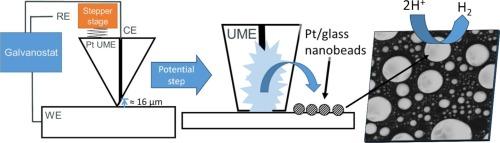
High-entropy alloys (HEAs) offer unprecedented catalytic properties over single-composition nanoparticles or single atom engineered materials. Traditionally, the Hume–Rothery rule suggests that only size-and-structure similar elements can be mixed in conventional alloying, which limits the possible combinations of alloying elements. Here we propose an electrochemical approach as an innovative and alternative synthetic method for preparation of HEAs. Upon an electric arch by applying voltage drop of about 2 MV/m with high current densities and using ultra-thin Pt wire in glass, whose movement, in the aqueous solution containing the salt of the elements to be incorporated to the HEAs, is controlled by the scanning electrochemical microscope (SECM), the HEAs, consisting of doped silica nanobeads are produced. The composition of such HEAs depends on the materials and solution used in their preparation and thus it contains Pt, Si, Al, Ca, K, Cl, Mn, Zn, Na, N, Mo, and S. This new approach is compatible with ambient air and aqueous solution processes and is not limited by material selection, presenting a significant advancement in the synthesis of functional nanomaterials. The findings underline the potential of these high-entropy nanostructured materials in advancing the efficiency of industrial processes, particularly in the realm of green hydrogen production through water splitting. This simple, low-voltage, room temperature process is suitable for fabrication of HEAs of various composition and has the applicability to wide spectra of catalytic reactions.
期刊介绍:
Electrochemistry Communications is an open access journal providing fast dissemination of short communications, full communications and mini reviews covering the whole field of electrochemistry which merit urgent publication. Short communications are limited to a maximum of 20,000 characters (including spaces) while full communications and mini reviews are limited to 25,000 characters (including spaces). Supplementary information is permitted for full communications and mini reviews but not for short communications. We aim to be the fastest journal in electrochemistry for these types of papers.



 京公网安备 11010802042870号
京ICP备2023020795号-1
京公网安备 11010802042870号
京ICP备2023020795号-1

 分享
分享
 求助内容:
求助内容: 应助结果提醒方式:
 扫码关注我们
