{"title":"Point cloud semantic segmentation network based on graph convolution and attention mechanism","authors":"Nan Yang, Yong Wang, Lei Zhang, Bin Jiang","doi":"10.1016/j.engappai.2024.109790","DOIUrl":null,"url":null,"abstract":"<div><div>Point cloud data provides rich three-dimensional spatial information. Accurate three-dimensional point cloud semantic segmentation algorithms enhance environmental understanding and perception, with wide-ranging applications in autonomous driving and scene analysis. However, Graph Neural Networks often struggle to retain semantic relationships among neighboring points during feature extraction, potentially leading to the omission of critical features during aggregation. To address these challenges, we propose a novel network, the Feature-Enhanced Residual Attention Network. This network includes an innovative graph convolution module, the Neighborhood-Enhanced Convolutional Aggregation Module, which utilizes K-Nearest Neighbor and Dilated K-Nearest Neighbor techniques to construct diverse dynamic graphs and aggregate features, thereby prioritizing essential information. This approach significantly enhances the expressiveness and generalization capabilities of the network. Additionally, we introduce a new spatial attention module designed to capture semantic relationships among points. Experimental results demonstrate that the Feature-Enhanced Residual Attention Network outperforms benchmark models, achieving an average intersection ratio of 61.3% and an overall accuracy of 86.7% on the Stanford Large-Scale Three-dimensional Indoor Spaces dataset, thereby significantly improving semantic segmentation performance.</div></div>","PeriodicalId":50523,"journal":{"name":"Engineering Applications of Artificial Intelligence","volume":"141 ","pages":"Article 109790"},"PeriodicalIF":8.0000,"publicationDate":"2025-02-01","publicationTypes":"Journal Article","fieldsOfStudy":null,"isOpenAccess":false,"openAccessPdf":"","citationCount":"0","resultStr":null,"platform":"Semanticscholar","paperid":null,"PeriodicalName":"Engineering Applications of Artificial Intelligence","FirstCategoryId":"94","ListUrlMain":"https://www.sciencedirect.com/science/article/pii/S0952197624019493","RegionNum":2,"RegionCategory":"计算机科学","ArticlePicture":[],"TitleCN":null,"AbstractTextCN":null,"PMCID":null,"EPubDate":"2024/12/10 0:00:00","PubModel":"Epub","JCR":"Q1","JCRName":"AUTOMATION & CONTROL SYSTEMS","Score":null,"Total":0}
引用次数: 0
Abstract
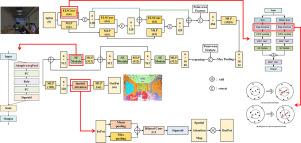
Point cloud data provides rich three-dimensional spatial information. Accurate three-dimensional point cloud semantic segmentation algorithms enhance environmental understanding and perception, with wide-ranging applications in autonomous driving and scene analysis. However, Graph Neural Networks often struggle to retain semantic relationships among neighboring points during feature extraction, potentially leading to the omission of critical features during aggregation. To address these challenges, we propose a novel network, the Feature-Enhanced Residual Attention Network. This network includes an innovative graph convolution module, the Neighborhood-Enhanced Convolutional Aggregation Module, which utilizes K-Nearest Neighbor and Dilated K-Nearest Neighbor techniques to construct diverse dynamic graphs and aggregate features, thereby prioritizing essential information. This approach significantly enhances the expressiveness and generalization capabilities of the network. Additionally, we introduce a new spatial attention module designed to capture semantic relationships among points. Experimental results demonstrate that the Feature-Enhanced Residual Attention Network outperforms benchmark models, achieving an average intersection ratio of 61.3% and an overall accuracy of 86.7% on the Stanford Large-Scale Three-dimensional Indoor Spaces dataset, thereby significantly improving semantic segmentation performance.
期刊介绍:
Artificial Intelligence (AI) is pivotal in driving the fourth industrial revolution, witnessing remarkable advancements across various machine learning methodologies. AI techniques have become indispensable tools for practicing engineers, enabling them to tackle previously insurmountable challenges. Engineering Applications of Artificial Intelligence serves as a global platform for the swift dissemination of research elucidating the practical application of AI methods across all engineering disciplines. Submitted papers are expected to present novel aspects of AI utilized in real-world engineering applications, validated using publicly available datasets to ensure the replicability of research outcomes. Join us in exploring the transformative potential of AI in engineering.



 京公网安备 11010802042870号
京ICP备2023020795号-1
京公网安备 11010802042870号
京ICP备2023020795号-1

 分享
分享
 求助内容:
求助内容: 应助结果提醒方式:
 扫码关注我们
