{"title":"Childhood wasting and associated factors in Africa: evidence from standard demographic and health surveys from 35 countries.","authors":"Tadesse Tarik Tamir, Alebachew Ferede Zegeye, Belayneh Shetie Workneh, Mohammed Seid Ali, Almaz Tefera Gonete, Masresha Asmare Techane, Mulugeta Wassie, Alemneh Tadesse Kassie, Medina Abdela Ahmed, Sintayehu Simie Tsega, Yilkal Abebaw Wassie, Berhan Tekeba, Enyew Getaneh Mekonen","doi":"10.1186/s12889-025-21673-z","DOIUrl":null,"url":null,"abstract":"<p><strong>Introduction: </strong>Child malnutrition remains a critical public health challenge globally. Childhood wasting, a severe form of malnutrition, indicates acute undernutrition, leading to significant loss of muscle and fat tissue. The World Health Organization's Global Nutrition Target aims to reduce childhood wasting to less than 5% in over half of low- and middle-income countries by 2025. The enduring hunger crisis in Africa is a complex issue that demands our continuous commitment, innovative solutions, and coordinated efforts. This study aims to assess the prevalence and associated factors of childhood wasting in Africa.</p><p><strong>Method: </strong>This study conducted a secondary analysis of demographic and health survey datasets from 2010 to 2022 in 35 African countries. A total of 212,715 children under the age of 5 years were included, using a weighted sample. We employed a mixed-effects model to evaluate the factors associated with childhood wasting. The significance of the fixed effects was assessed using the adjusted odds ratio (AOR) and the corresponding 95% confidence interval.</p><p><strong>Result: </strong>The prevalence of childhood wasting in Africa was estimated to be 7.16% (95% CI: 7.05-7.27). Several factors were significantly associated with childhood wasting, including the child's age, male gender, birth weight, maternal education level, wealth index, lack of antenatal care (ANC) visits, home delivery, multiple gestational births, and rural residence.</p><p><strong>Conclusion: </strong>Childhood wasting in Africa exceeds the global target set for 2025, which aims to reduce it to less than 5%. To address this critical issue, educating mothers without formal education and rural residents about antenatal care visits, institutional delivery, and proper child feeding practices is essential. Moreover, a renewed focus on tackling the multifaceted factors of undernutrition, strengthening health systems, and implementing evidence-based interventions tailored to the local context is crucial for achieving meaningful and sustained reductions in wasting prevalence across the region.</p>","PeriodicalId":9039,"journal":{"name":"BMC Public Health","volume":"25 1","pages":"454"},"PeriodicalIF":3.6000,"publicationDate":"2025-02-04","publicationTypes":"Journal Article","fieldsOfStudy":null,"isOpenAccess":false,"openAccessPdf":"https://www.ncbi.nlm.nih.gov/pmc/articles/PMC11796205/pdf/","citationCount":"0","resultStr":null,"platform":"Semanticscholar","paperid":null,"PeriodicalName":"BMC Public Health","FirstCategoryId":"3","ListUrlMain":"https://doi.org/10.1186/s12889-025-21673-z","RegionNum":2,"RegionCategory":"医学","ArticlePicture":[],"TitleCN":null,"AbstractTextCN":null,"PMCID":null,"EPubDate":"","PubModel":"","JCR":"Q1","JCRName":"PUBLIC, ENVIRONMENTAL & OCCUPATIONAL HEALTH","Score":null,"Total":0}
引用次数: 0
Abstract
Introduction: Child malnutrition remains a critical public health challenge globally. Childhood wasting, a severe form of malnutrition, indicates acute undernutrition, leading to significant loss of muscle and fat tissue. The World Health Organization's Global Nutrition Target aims to reduce childhood wasting to less than 5% in over half of low- and middle-income countries by 2025. The enduring hunger crisis in Africa is a complex issue that demands our continuous commitment, innovative solutions, and coordinated efforts. This study aims to assess the prevalence and associated factors of childhood wasting in Africa.
Method: This study conducted a secondary analysis of demographic and health survey datasets from 2010 to 2022 in 35 African countries. A total of 212,715 children under the age of 5 years were included, using a weighted sample. We employed a mixed-effects model to evaluate the factors associated with childhood wasting. The significance of the fixed effects was assessed using the adjusted odds ratio (AOR) and the corresponding 95% confidence interval.
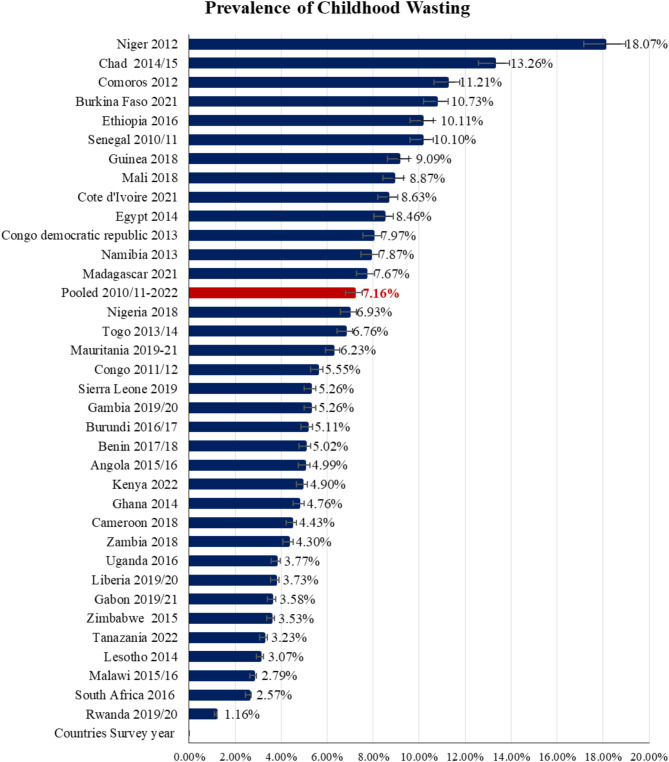
Result: The prevalence of childhood wasting in Africa was estimated to be 7.16% (95% CI: 7.05-7.27). Several factors were significantly associated with childhood wasting, including the child's age, male gender, birth weight, maternal education level, wealth index, lack of antenatal care (ANC) visits, home delivery, multiple gestational births, and rural residence.
Conclusion: Childhood wasting in Africa exceeds the global target set for 2025, which aims to reduce it to less than 5%. To address this critical issue, educating mothers without formal education and rural residents about antenatal care visits, institutional delivery, and proper child feeding practices is essential. Moreover, a renewed focus on tackling the multifaceted factors of undernutrition, strengthening health systems, and implementing evidence-based interventions tailored to the local context is crucial for achieving meaningful and sustained reductions in wasting prevalence across the region.
期刊介绍:
BMC Public Health is an open access, peer-reviewed journal that considers articles on the epidemiology of disease and the understanding of all aspects of public health. The journal has a special focus on the social determinants of health, the environmental, behavioral, and occupational correlates of health and disease, and the impact of health policies, practices and interventions on the community.




 京公网安备 11010802042870号
京ICP备2023020795号-1
京公网安备 11010802042870号
京ICP备2023020795号-1

 分享
分享
 求助内容:
求助内容: 应助结果提醒方式:
 扫码关注我们
