Tan Van Nguyen, Hang Thi Thuy Nguyen, Dung Ngoc Truong, Viet Quoc Nguyen, Huy Quang Nguyen, Huy Quoc Nguyen, Trinh Thi Kim Ngo, Erkihun Amsalu, Wei Jin Wong, Tu Ngoc Nguyen
{"title":"Medication adherence and hospitalizations in older patients with coronary heart disease in Vietnam","authors":"Tan Van Nguyen, Hang Thi Thuy Nguyen, Dung Ngoc Truong, Viet Quoc Nguyen, Huy Quang Nguyen, Huy Quoc Nguyen, Trinh Thi Kim Ngo, Erkihun Amsalu, Wei Jin Wong, Tu Ngoc Nguyen","doi":"10.1111/bcp.16405","DOIUrl":null,"url":null,"abstract":"<div>\n \n \n <section>\n \n <h3> Aims</h3>\n \n <p>This study aimed to assess medication adherence among older people with coronary heart disease and its relationship with hospitalizations.</p>\n </section>\n \n <section>\n \n <h3> Methods</h3>\n \n <p>This is a prospective cohort study conducted at the outpatient clinics of a major hospital in Vietnam from November 2022 to June 2023. Consecutive older patients with coronary heart disease were recruited and followed for 6 months. Medication adherence was defined using the five-item Medication Adherence Report Scale (MARS-5). Multivariable logistic regression models were applied to examine the impact of medication adherence on hospitalization due to cardiovascular disease (CVD) and all-cause hospitalization.</p>\n </section>\n \n <section>\n \n <h3> Results</h3>\n \n <p>There were 643 participants, mean age 73 ± 8 years, 74.3% were male. Overall, 76.4% (491/643) were classified as ‘adherent’. Over 6 months follow-up, 23.3% of the participants were admitted to hospital and of these hospitalizations, 9.2% were due to CVD. The CVD-related hospitalization rate was significantly higher in the non-adherent group compared to the adherent group (13.8% <i>vs</i>. 7.7%, <i>P</i> = 0.023, respectively). In logistic regression models, medication adherence was associated with significantly reduced odds of CVD-related hospitalization (adjusted odds ratio [OR] 0.48, 95% confidence interval [CI] 0.27–0.86). Medication adherence was also associated with a trend of reduced all-cause hospitalization (adjusted OR 0.75, 95% CI 0.49–1.15).</p>\n </section>\n \n <section>\n \n <h3> Conclusions</h3>\n \n <p>This study showed a positive relationship between medication adherence and reduced risk of CVD-related hospitalization in older people with coronary heart disease. Healthcare providers should consider incorporating adherence assessment into the long-term care for older patients with coronary heart disease.</p>\n </section>\n </div>","PeriodicalId":9251,"journal":{"name":"British journal of clinical pharmacology","volume":"91 6","pages":"1771-1779"},"PeriodicalIF":3.0000,"publicationDate":"2025-02-05","publicationTypes":"Journal Article","fieldsOfStudy":null,"isOpenAccess":false,"openAccessPdf":"https://onlinelibrary.wiley.com/doi/epdf/10.1111/bcp.16405","citationCount":"0","resultStr":null,"platform":"Semanticscholar","paperid":null,"PeriodicalName":"British journal of clinical pharmacology","FirstCategoryId":"3","ListUrlMain":"https://bpspubs.onlinelibrary.wiley.com/doi/10.1111/bcp.16405","RegionNum":3,"RegionCategory":"医学","ArticlePicture":[],"TitleCN":null,"AbstractTextCN":null,"PMCID":null,"EPubDate":"","PubModel":"","JCR":"Q2","JCRName":"PHARMACOLOGY & PHARMACY","Score":null,"Total":0}
引用次数: 0
Abstract
Aims
This study aimed to assess medication adherence among older people with coronary heart disease and its relationship with hospitalizations.
Methods
This is a prospective cohort study conducted at the outpatient clinics of a major hospital in Vietnam from November 2022 to June 2023. Consecutive older patients with coronary heart disease were recruited and followed for 6 months. Medication adherence was defined using the five-item Medication Adherence Report Scale (MARS-5). Multivariable logistic regression models were applied to examine the impact of medication adherence on hospitalization due to cardiovascular disease (CVD) and all-cause hospitalization.
Results
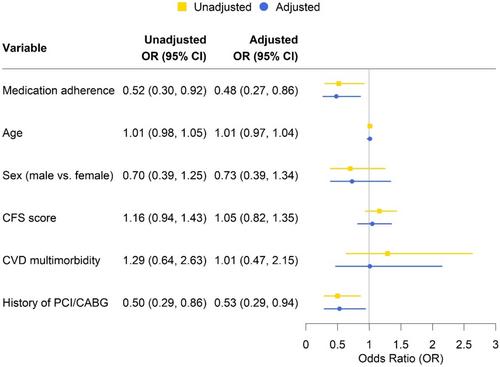
There were 643 participants, mean age 73 ± 8 years, 74.3% were male. Overall, 76.4% (491/643) were classified as ‘adherent’. Over 6 months follow-up, 23.3% of the participants were admitted to hospital and of these hospitalizations, 9.2% were due to CVD. The CVD-related hospitalization rate was significantly higher in the non-adherent group compared to the adherent group (13.8% vs. 7.7%, P = 0.023, respectively). In logistic regression models, medication adherence was associated with significantly reduced odds of CVD-related hospitalization (adjusted odds ratio [OR] 0.48, 95% confidence interval [CI] 0.27–0.86). Medication adherence was also associated with a trend of reduced all-cause hospitalization (adjusted OR 0.75, 95% CI 0.49–1.15).
Conclusions
This study showed a positive relationship between medication adherence and reduced risk of CVD-related hospitalization in older people with coronary heart disease. Healthcare providers should consider incorporating adherence assessment into the long-term care for older patients with coronary heart disease.
目的:本研究旨在评估老年冠心病患者的药物依从性及其与住院治疗的关系。方法:这是一项前瞻性队列研究,于2022年11月至2023年6月在越南一家大医院的门诊进行。连续招募老年冠心病患者,随访6个月。用药依从性采用5项用药依从性报告量表(MARS-5)进行定义。采用多变量logistic回归模型检验药物依从性对心血管疾病(CVD)住院和全因住院的影响。结果:参与者643人,平均年龄73±8岁,男性74.3%。总体而言,76.4%(491/643)被归类为“粘附”。在6个月的随访中,23.3%的参与者住院,其中9.2%是由于心血管疾病。非依从组cvd相关住院率明显高于依从组(13.8% vs. 7.7%, P = 0.023)。在logistic回归模型中,药物依从性与cvd相关住院的几率显著降低相关(校正优势比[OR] 0.48, 95%可信区间[CI] 0.27-0.86)。药物依从性也与全因住院减少的趋势相关(调整OR 0.75, 95% CI 0.49-1.15)。结论:本研究显示,老年冠心病患者服药依从性与心血管疾病相关住院风险降低呈正相关。医疗保健提供者应考虑将依从性评估纳入老年冠心病患者的长期护理。
期刊介绍:
Published on behalf of the British Pharmacological Society, the British Journal of Clinical Pharmacology features papers and reports on all aspects of drug action in humans: review articles, mini review articles, original papers, commentaries, editorials and letters. The Journal enjoys a wide readership, bridging the gap between the medical profession, clinical research and the pharmaceutical industry. It also publishes research on new methods, new drugs and new approaches to treatment. The Journal is recognised as one of the leading publications in its field. It is online only, publishes open access research through its OnlineOpen programme and is published monthly.