Doreen Zhu, Parminder K Judge, Natalie Staplin, Richard Haynes, William G Herrington
{"title":"Design considerations for future renoprotection trials in the era of multiple therapies for chronic kidney disease.","authors":"Doreen Zhu, Parminder K Judge, Natalie Staplin, Richard Haynes, William G Herrington","doi":"10.1093/ndt/gfae210","DOIUrl":null,"url":null,"abstract":"<p><p>In the last 5-10 years, several large high-quality research trials testing new treatments versus a dummy treatment in patients with kidney disease have provided new discoveries, particularly among people with diabetes. Some of these trials included patients with a wide variety of kidney diseases and therefore provided important information on how effective the treatment is, and whether it is safe to use for many people (and not just those with a specific type of kidney disease). The findings are particularly important as they suggest that, once established, kidney disease progresses in similar ways regardless of the initiating cause. These new treatments importantly slow kidney disease progression but, even when used together, do not arrest the loss of kidney function. New research is still needed to test new potential treatments. Now that we have several drugs that can be used to treat kidney disease, there are new challenges when designing and conducting new trials. These include the reduced risk of kidney disease progression and heart disease (because of the new treatments available). Future research trials need to include a sufficiently large number of patients to be able to answer research questions reliably. In addition, different types of people and diseases should be included. In an age of increasing regulation and bureaucracy, conducting such trials is challenging. Simplifying the design and conduct of future trials by focusing only on the necessary components needed to answer the research key question(s) is important. Such trials reduce the burden of participation for patients and busy clinical staff, whilst still ensuring careful focus on patient safety and data quality. We hope more high-quality trials that are sufficiently large, inclusive and simple will be conducted in the future, so that kidney teams can offer better care to their patients.</p><p><strong>Abstract: </strong>Nephrology has benefited from conducting increasingly large high-quality trials in the last 5-10 years. In addition to the long-standing known benefits of renin-angiotensin system inhibitors, we now have multiple pharmacotherapies that provide kidney and/or cardiovascular protection for certain types of patient with chronic kidney disease (CKD). These include sodium-glucose co-transporter 2 inhibitors (SGLT2i), a non-steroidal mineralocorticoid receptor antagonist and a glucagon-like peptide-1 receptor agonist. Trials of SGLT2i have had particularly important impact, as wide eligibility criteria in pivotal trials have enabled safety and efficacy across a wide range of causes of CKD to be demonstrated. These findings support the concept of final common pathways of CKD progression and should encourage similar trial designs recruiting broad ranges of patients at risk of CKD progression. This is important as these new drugs do not completely arrest CKD progression nor do they mitigate the full excess of cardiovascular disease. In the current era of multiple therapies to manage risk of CKD progression, trial design and conduct also need to consider new challenges. These include falling event rates, establishing standard of care for participants pre-randomization and improving the inclusion of trial participants understudied in previous trials. Streamlining trial design and conduct and reducing participation burden for patients and clinicians is increasingly important to facilitate larger sample sizes and to optimize adherence to study interventions and follow-up. Potential other solutions include maintaining a focus on wide generalizability (to include understudied patient groups) and empowering patients to volunteer for trials (through public and patient involvement and large-scale invitation methods), as well as innovations in trial design (including use of pre-randomization run-in periods to implement standard of care and factorial or platform trials to assess multiple treatments simultaneously).</p>","PeriodicalId":19078,"journal":{"name":"Nephrology Dialysis Transplantation","volume":"40 Supplement_1","pages":"i70-i79"},"PeriodicalIF":5.6000,"publicationDate":"2025-02-05","publicationTypes":"Journal Article","fieldsOfStudy":null,"isOpenAccess":false,"openAccessPdf":"https://www.ncbi.nlm.nih.gov/pmc/articles/PMC11852343/pdf/","citationCount":"0","resultStr":null,"platform":"Semanticscholar","paperid":null,"PeriodicalName":"Nephrology Dialysis Transplantation","FirstCategoryId":"3","ListUrlMain":"https://doi.org/10.1093/ndt/gfae210","RegionNum":2,"RegionCategory":"医学","ArticlePicture":[],"TitleCN":null,"AbstractTextCN":null,"PMCID":null,"EPubDate":"","PubModel":"","JCR":"Q1","JCRName":"TRANSPLANTATION","Score":null,"Total":0}
引用次数: 0
Abstract
In the last 5-10 years, several large high-quality research trials testing new treatments versus a dummy treatment in patients with kidney disease have provided new discoveries, particularly among people with diabetes. Some of these trials included patients with a wide variety of kidney diseases and therefore provided important information on how effective the treatment is, and whether it is safe to use for many people (and not just those with a specific type of kidney disease). The findings are particularly important as they suggest that, once established, kidney disease progresses in similar ways regardless of the initiating cause. These new treatments importantly slow kidney disease progression but, even when used together, do not arrest the loss of kidney function. New research is still needed to test new potential treatments. Now that we have several drugs that can be used to treat kidney disease, there are new challenges when designing and conducting new trials. These include the reduced risk of kidney disease progression and heart disease (because of the new treatments available). Future research trials need to include a sufficiently large number of patients to be able to answer research questions reliably. In addition, different types of people and diseases should be included. In an age of increasing regulation and bureaucracy, conducting such trials is challenging. Simplifying the design and conduct of future trials by focusing only on the necessary components needed to answer the research key question(s) is important. Such trials reduce the burden of participation for patients and busy clinical staff, whilst still ensuring careful focus on patient safety and data quality. We hope more high-quality trials that are sufficiently large, inclusive and simple will be conducted in the future, so that kidney teams can offer better care to their patients.
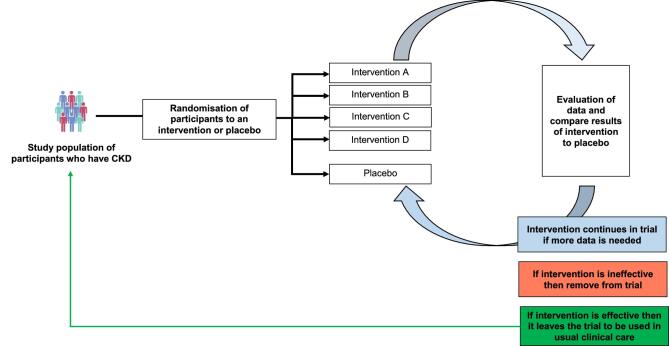
Abstract: Nephrology has benefited from conducting increasingly large high-quality trials in the last 5-10 years. In addition to the long-standing known benefits of renin-angiotensin system inhibitors, we now have multiple pharmacotherapies that provide kidney and/or cardiovascular protection for certain types of patient with chronic kidney disease (CKD). These include sodium-glucose co-transporter 2 inhibitors (SGLT2i), a non-steroidal mineralocorticoid receptor antagonist and a glucagon-like peptide-1 receptor agonist. Trials of SGLT2i have had particularly important impact, as wide eligibility criteria in pivotal trials have enabled safety and efficacy across a wide range of causes of CKD to be demonstrated. These findings support the concept of final common pathways of CKD progression and should encourage similar trial designs recruiting broad ranges of patients at risk of CKD progression. This is important as these new drugs do not completely arrest CKD progression nor do they mitigate the full excess of cardiovascular disease. In the current era of multiple therapies to manage risk of CKD progression, trial design and conduct also need to consider new challenges. These include falling event rates, establishing standard of care for participants pre-randomization and improving the inclusion of trial participants understudied in previous trials. Streamlining trial design and conduct and reducing participation burden for patients and clinicians is increasingly important to facilitate larger sample sizes and to optimize adherence to study interventions and follow-up. Potential other solutions include maintaining a focus on wide generalizability (to include understudied patient groups) and empowering patients to volunteer for trials (through public and patient involvement and large-scale invitation methods), as well as innovations in trial design (including use of pre-randomization run-in periods to implement standard of care and factorial or platform trials to assess multiple treatments simultaneously).
期刊介绍:
Nephrology Dialysis Transplantation (ndt) is the leading nephrology journal in Europe and renowned worldwide, devoted to original clinical and laboratory research in nephrology, dialysis and transplantation. ndt is an official journal of the [ERA-EDTA](http://www.era-edta.org/) (European Renal Association-European Dialysis and Transplant Association). Published monthly, the journal provides an essential resource for researchers and clinicians throughout the world. All research articles in this journal have undergone peer review.
Print ISSN: 0931-0509.





 京公网安备 11010802042870号
京ICP备2023020795号-1
京公网安备 11010802042870号
京ICP备2023020795号-1

 分享
分享
 求助内容:
求助内容: 应助结果提醒方式:
 扫码关注我们
