{"title":"Mineralocorticoid receptor antagonism for non-diabetic kidney disease.","authors":"Frédéric Jaisser, Jonatan Barrera-Chimal","doi":"10.1093/ndt/gfae241","DOIUrl":null,"url":null,"abstract":"<p><p>The use of mineralocorticoid receptor antagonists (MRAs) in preclinical models of non-diabetic chronic kidney disease (CKD) has consistently shown a beneficial effect by preventing renal structural injury, reducing albuminuria and preserving renal function. In this context, MR activation in non-epithelial cells contributes to renal injury through the activation of inflammatory and fibrotic pathways, increasing oxidative stress and modulating renal hemodynamics. The protective effects of MRAs in animal models of CKD are not restricted to the kidney. Cardiovascular benefits, such as the prevention of cardiac fibrosis, hypoperfusion and vascular calcification, have also been observed. The translation of these preclinical findings into clinical practice has been difficult, mainly due to the lack of clinical studies testing the efficacy of steroidal MRAs in CKD patients due to their contraindication because of an increased risk of hyperkalemia in these patients. Here, we review the latest preclinical evidence showing new mechanisms by which MR inhibition results in beneficial effects against cardiorenal damage in non-diabetic kidney disease. Moreover, we summarize the clinical trials testing the safety and efficacy of steroidal and non-steroidal MRAs in patients with advanced non-diabetic CKD.</p><p><strong>Plain english summary: </strong>The mineralocorticoid receptor (MR) is known for its role in the regulation of sodium and potassium balance in the distal tubules of the kidney. However, under pathological conditions the activation of the MR in other renal cell types (including the vasculature and immune cells) leads to harmful effects, damaging the main structural components of the kidney, and ultimately causing renal dysfunction. Over the past 20 years, several studies performed in mouse and rat models of non-diabetic kidney disease have shown that using a specific drug class that inhibits the MR (MR antagonists: MRAs) positively impacts the preservation of the kidney structure and helps to prevent the decline of renal function, thus positioning MRAs as a good therapeutic option against kidney diseases from non-diabetic origin. In addition, the use of MRAs also benefited the cardiovascular system health as shown by improved cardiac structural and functional parameters as well as preventing the calcification of blood vessels. Nevertheless, an important barrier to translating these findings into clinical practice is that the use of MRAs could lead to increased serum potassium levels, particularly in kidney disease patients, an adverse effect that could lead to life-threatening cardiac arrhythmias. In this review, we summarize the latest data in animal models showing new evidences of MR benefits in non-diabetic kidney disease. In addition, we review the clinical trials that evaluated the safety and efficacy of MRAs in patients with advanced non-diabetic kidney disease including those that tested a new generation of MRAs (non-steroidal MRAs) and are expected to reduce the frequency of adverse effects while retaining their renal and cardiovascular benefits.</p>","PeriodicalId":19078,"journal":{"name":"Nephrology Dialysis Transplantation","volume":"40 Supplement_1","pages":"i29-i36"},"PeriodicalIF":5.6000,"publicationDate":"2025-02-05","publicationTypes":"Journal Article","fieldsOfStudy":null,"isOpenAccess":false,"openAccessPdf":"https://www.ncbi.nlm.nih.gov/pmc/articles/PMC11795674/pdf/","citationCount":"0","resultStr":null,"platform":"Semanticscholar","paperid":null,"PeriodicalName":"Nephrology Dialysis Transplantation","FirstCategoryId":"3","ListUrlMain":"https://doi.org/10.1093/ndt/gfae241","RegionNum":2,"RegionCategory":"医学","ArticlePicture":[],"TitleCN":null,"AbstractTextCN":null,"PMCID":null,"EPubDate":"","PubModel":"","JCR":"Q1","JCRName":"TRANSPLANTATION","Score":null,"Total":0}
引用次数: 0
Abstract
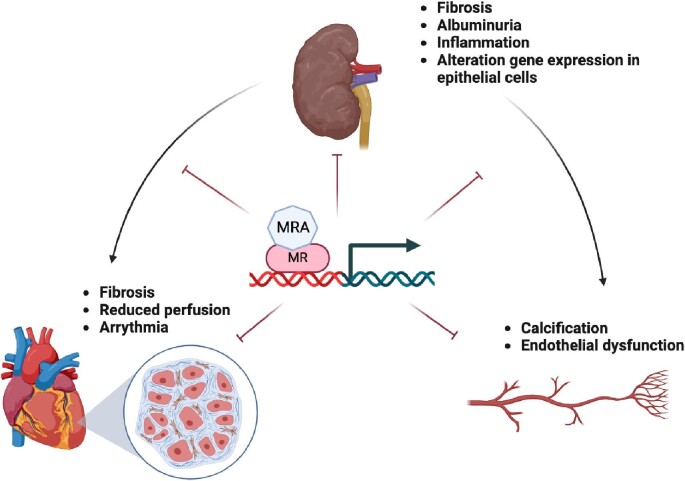
The use of mineralocorticoid receptor antagonists (MRAs) in preclinical models of non-diabetic chronic kidney disease (CKD) has consistently shown a beneficial effect by preventing renal structural injury, reducing albuminuria and preserving renal function. In this context, MR activation in non-epithelial cells contributes to renal injury through the activation of inflammatory and fibrotic pathways, increasing oxidative stress and modulating renal hemodynamics. The protective effects of MRAs in animal models of CKD are not restricted to the kidney. Cardiovascular benefits, such as the prevention of cardiac fibrosis, hypoperfusion and vascular calcification, have also been observed. The translation of these preclinical findings into clinical practice has been difficult, mainly due to the lack of clinical studies testing the efficacy of steroidal MRAs in CKD patients due to their contraindication because of an increased risk of hyperkalemia in these patients. Here, we review the latest preclinical evidence showing new mechanisms by which MR inhibition results in beneficial effects against cardiorenal damage in non-diabetic kidney disease. Moreover, we summarize the clinical trials testing the safety and efficacy of steroidal and non-steroidal MRAs in patients with advanced non-diabetic CKD.
Plain english summary: The mineralocorticoid receptor (MR) is known for its role in the regulation of sodium and potassium balance in the distal tubules of the kidney. However, under pathological conditions the activation of the MR in other renal cell types (including the vasculature and immune cells) leads to harmful effects, damaging the main structural components of the kidney, and ultimately causing renal dysfunction. Over the past 20 years, several studies performed in mouse and rat models of non-diabetic kidney disease have shown that using a specific drug class that inhibits the MR (MR antagonists: MRAs) positively impacts the preservation of the kidney structure and helps to prevent the decline of renal function, thus positioning MRAs as a good therapeutic option against kidney diseases from non-diabetic origin. In addition, the use of MRAs also benefited the cardiovascular system health as shown by improved cardiac structural and functional parameters as well as preventing the calcification of blood vessels. Nevertheless, an important barrier to translating these findings into clinical practice is that the use of MRAs could lead to increased serum potassium levels, particularly in kidney disease patients, an adverse effect that could lead to life-threatening cardiac arrhythmias. In this review, we summarize the latest data in animal models showing new evidences of MR benefits in non-diabetic kidney disease. In addition, we review the clinical trials that evaluated the safety and efficacy of MRAs in patients with advanced non-diabetic kidney disease including those that tested a new generation of MRAs (non-steroidal MRAs) and are expected to reduce the frequency of adverse effects while retaining their renal and cardiovascular benefits.
期刊介绍:
Nephrology Dialysis Transplantation (ndt) is the leading nephrology journal in Europe and renowned worldwide, devoted to original clinical and laboratory research in nephrology, dialysis and transplantation. ndt is an official journal of the [ERA-EDTA](http://www.era-edta.org/) (European Renal Association-European Dialysis and Transplant Association). Published monthly, the journal provides an essential resource for researchers and clinicians throughout the world. All research articles in this journal have undergone peer review.
Print ISSN: 0931-0509.




 京公网安备 11010802042870号
京ICP备2023020795号-1
京公网安备 11010802042870号
京ICP备2023020795号-1

 分享
分享
 求助内容:
求助内容: 应助结果提醒方式:
 扫码关注我们
