SeongHoon Jo, Yu-Jin Kim, Taek Hwang, Se Youn Jang, So-Jin Park, Seongryeol Ye, Youngmee Jung and Jin Yoo
{"title":"Injectable ultrathin porous membranes harnessing shape memory polymers for retinal tissue engineering†","authors":"SeongHoon Jo, Yu-Jin Kim, Taek Hwang, Se Youn Jang, So-Jin Park, Seongryeol Ye, Youngmee Jung and Jin Yoo","doi":"10.1039/D4TB02287D","DOIUrl":null,"url":null,"abstract":"<p >Age-related macular degeneration (AMD) is a leading cause of vision loss, characterized by the progressive degeneration of retinal cells, particularly retinal pigment epithelial (RPE) cells. Conventional treatments primarily focus on slowing disease progression without providing a cure. Recent advances in tissue engineering and cell-based therapies offer promising avenues for regenerating retinal tissue and restoring vision. In this study, we developed ultrathin, nanoporous membrane scaffolds designed to mimic Bruch's membrane (BrM) for RPE cell transplantation using vapor-induced phase separation. These scaffolds, fabricated from a blend of poly(<small>L</small>-lactide-<em>co</em>-ε-caprolactone) (PLCL) and poly(lactic-<em>co</em>-glycolic acid) (PLGA), exhibited favorable topography, biocompatibility, and shape-memory properties. <em>In vitro</em> experiments confirmed that the nanoporous topography effectively supports the formation of RPE monolayers with intact tight junctions. Additionally, the shape-memory characteristic enables the membrane to self-expand at body temperature (37 °C), facilitating minimally invasive delivery <em>via</em> injection. ARPE-19 cell-attached nanothin membranes successfully demonstrated shape-recovery properties and were deliverable through a catheter in an <em>ex vivo</em> model. Our findings suggest that the developed scaffolds provide a promising approach for retinal tissue engineering and could significantly contribute to advanced treatments for AMD and other retinal degenerative diseases.</p>","PeriodicalId":83,"journal":{"name":"Journal of Materials Chemistry B","volume":" 9","pages":" 3161-3172"},"PeriodicalIF":6.1000,"publicationDate":"2025-01-23","publicationTypes":"Journal Article","fieldsOfStudy":null,"isOpenAccess":false,"openAccessPdf":"https://pubs.rsc.org/en/content/articlepdf/2025/tb/d4tb02287d?page=search","citationCount":"0","resultStr":null,"platform":"Semanticscholar","paperid":null,"PeriodicalName":"Journal of Materials Chemistry B","FirstCategoryId":"1","ListUrlMain":"https://pubs.rsc.org/en/content/articlelanding/2025/tb/d4tb02287d","RegionNum":3,"RegionCategory":"医学","ArticlePicture":[],"TitleCN":null,"AbstractTextCN":null,"PMCID":null,"EPubDate":"","PubModel":"","JCR":"Q1","JCRName":"MATERIALS SCIENCE, BIOMATERIALS","Score":null,"Total":0}
引用次数: 0
Abstract
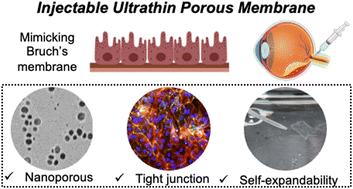
Age-related macular degeneration (AMD) is a leading cause of vision loss, characterized by the progressive degeneration of retinal cells, particularly retinal pigment epithelial (RPE) cells. Conventional treatments primarily focus on slowing disease progression without providing a cure. Recent advances in tissue engineering and cell-based therapies offer promising avenues for regenerating retinal tissue and restoring vision. In this study, we developed ultrathin, nanoporous membrane scaffolds designed to mimic Bruch's membrane (BrM) for RPE cell transplantation using vapor-induced phase separation. These scaffolds, fabricated from a blend of poly(L-lactide-co-ε-caprolactone) (PLCL) and poly(lactic-co-glycolic acid) (PLGA), exhibited favorable topography, biocompatibility, and shape-memory properties. In vitro experiments confirmed that the nanoporous topography effectively supports the formation of RPE monolayers with intact tight junctions. Additionally, the shape-memory characteristic enables the membrane to self-expand at body temperature (37 °C), facilitating minimally invasive delivery via injection. ARPE-19 cell-attached nanothin membranes successfully demonstrated shape-recovery properties and were deliverable through a catheter in an ex vivo model. Our findings suggest that the developed scaffolds provide a promising approach for retinal tissue engineering and could significantly contribute to advanced treatments for AMD and other retinal degenerative diseases.
期刊介绍:
Journal of Materials Chemistry A, B & C cover high quality studies across all fields of materials chemistry. The journals focus on those theoretical or experimental studies that report new understanding, applications, properties and synthesis of materials. Journal of Materials Chemistry A, B & C are separated by the intended application of the material studied. Broadly, applications in energy and sustainability are of interest to Journal of Materials Chemistry A, applications in biology and medicine are of interest to Journal of Materials Chemistry B, and applications in optical, magnetic and electronic devices are of interest to Journal of Materials Chemistry C.Journal of Materials Chemistry B is a Transformative Journal and Plan S compliant. Example topic areas within the scope of Journal of Materials Chemistry B are listed below. This list is neither exhaustive nor exclusive:
Antifouling coatings
Biocompatible materials
Bioelectronics
Bioimaging
Biomimetics
Biomineralisation
Bionics
Biosensors
Diagnostics
Drug delivery
Gene delivery
Immunobiology
Nanomedicine
Regenerative medicine & Tissue engineering
Scaffolds
Soft robotics
Stem cells
Therapeutic devices




 京公网安备 11010802042870号
京ICP备2023020795号-1
京公网安备 11010802042870号
京ICP备2023020795号-1

 分享
分享
 求助内容:
求助内容: 应助结果提醒方式:
 扫码关注我们
