Zhiling Wang, Tao Zheng, Shuzhan Wang, Xia-Guang Zhang, Yu Gu, Shuai Tang, Yongzhu Fu
{"title":"Topological Design of Highly Conductive Weakly Solvating Electrolytes for Ultrastable Sodium Metal Batteries Operating at −60 °C and Below","authors":"Zhiling Wang, Tao Zheng, Shuzhan Wang, Xia-Guang Zhang, Yu Gu, Shuai Tang, Yongzhu Fu","doi":"10.1021/jacs.4c16076","DOIUrl":null,"url":null,"abstract":"Weakly solvating electrolytes (WSE) can favor reversible Na batteries at −40 °C for some extreme applications because of the low desolvation energy. However, it is challenging to enable reversible Na batteries at lower temperatures. Herein, we uncover that the low ionic conductivity of WSE reduces reaction kinetics at −60 °C. Accordingly, a highly conductive weakly solvating electrolyte (HCWSE) is designed by introducing additives of strongly solvating solvents and the dilution of NaPF<sub>6</sub>. The additive can dominate the solvation sheath, increase the dissociation of NaPF<sub>6</sub> and the fluidity of the electrolyte, and thus greatly improve the ionic conductivity. Furthermore, the binding energy between Na<sup>+</sup> and solvents is proposed as a descriptor to determine the solvating power of solvents, based on which a series of ultralow-temperature HCWSEs have been topologically designed by facilely introducing strong-solvation ether additives into the weak-solvation solvents. As a demonstration, the HCWSE showcases the long cycling of Na||Na cell at −60 °C with an overpotential of 42 mV under 1 mA cm<sup>–2</sup> for 1200 h. The Na||NNFM (Na<sub>0.75</sub>Ni<sub>0.25</sub>Fe<sub>0.25</sub>Mn<sub>0.5</sub>O<sub>2</sub>) cell exhibits a reversible capacity of 79.2 mAh g<sup>–1</sup> after 160 cycles. The cells also achieve impressive performances at −70 °C.","PeriodicalId":49,"journal":{"name":"Journal of the American Chemical Society","volume":"85 1","pages":""},"PeriodicalIF":15.6000,"publicationDate":"2025-02-06","publicationTypes":"Journal Article","fieldsOfStudy":null,"isOpenAccess":false,"openAccessPdf":"","citationCount":"0","resultStr":null,"platform":"Semanticscholar","paperid":null,"PeriodicalName":"Journal of the American Chemical Society","FirstCategoryId":"92","ListUrlMain":"https://doi.org/10.1021/jacs.4c16076","RegionNum":1,"RegionCategory":"化学","ArticlePicture":[],"TitleCN":null,"AbstractTextCN":null,"PMCID":null,"EPubDate":"","PubModel":"","JCR":"Q1","JCRName":"CHEMISTRY, MULTIDISCIPLINARY","Score":null,"Total":0}
引用次数: 0
Abstract
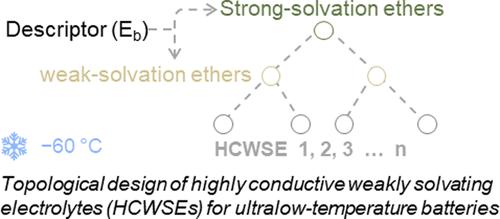
Weakly solvating electrolytes (WSE) can favor reversible Na batteries at −40 °C for some extreme applications because of the low desolvation energy. However, it is challenging to enable reversible Na batteries at lower temperatures. Herein, we uncover that the low ionic conductivity of WSE reduces reaction kinetics at −60 °C. Accordingly, a highly conductive weakly solvating electrolyte (HCWSE) is designed by introducing additives of strongly solvating solvents and the dilution of NaPF6. The additive can dominate the solvation sheath, increase the dissociation of NaPF6 and the fluidity of the electrolyte, and thus greatly improve the ionic conductivity. Furthermore, the binding energy between Na+ and solvents is proposed as a descriptor to determine the solvating power of solvents, based on which a series of ultralow-temperature HCWSEs have been topologically designed by facilely introducing strong-solvation ether additives into the weak-solvation solvents. As a demonstration, the HCWSE showcases the long cycling of Na||Na cell at −60 °C with an overpotential of 42 mV under 1 mA cm–2 for 1200 h. The Na||NNFM (Na0.75Ni0.25Fe0.25Mn0.5O2) cell exhibits a reversible capacity of 79.2 mAh g–1 after 160 cycles. The cells also achieve impressive performances at −70 °C.
弱溶剂化电解质(WSE)由于其较低的溶解能量,在- 40°C的一些极端应用中有利于可逆钠电池。然而,在较低温度下实现可逆钠电池是具有挑战性的。在此,我们发现WSE的低离子电导率降低了−60°C下的反应动力学。在此基础上,通过引入强溶剂添加剂和NaPF6的稀释,设计了高导电性弱溶剂化电解质(HCWSE)。添加剂可以控制溶剂化鞘层,增加NaPF6的解离和电解质的流动性,从而大大提高离子电导率。此外,提出了Na+与溶剂的结合能作为表征溶剂溶剂化能力的描述符,在此基础上,通过在弱溶剂溶剂中引入强溶剂性醚添加剂,设计了一系列超低温hcwse。作为演示,HCWSE展示了Na||Na电池在- 60°C下,在1 mA cm-2下的过电位为42 mV,持续1200小时。Na||NNFM (Na0.75Ni0.25Fe0.25Mn0.5O2)电池在160次循环后显示出79.2 mAh g-1的可逆容量。该电池在−70°C下也具有令人印象深刻的性能。
期刊介绍:
The flagship journal of the American Chemical Society, known as the Journal of the American Chemical Society (JACS), has been a prestigious publication since its establishment in 1879. It holds a preeminent position in the field of chemistry and related interdisciplinary sciences. JACS is committed to disseminating cutting-edge research papers, covering a wide range of topics, and encompasses approximately 19,000 pages of Articles, Communications, and Perspectives annually. With a weekly publication frequency, JACS plays a vital role in advancing the field of chemistry by providing essential research.



 京公网安备 11010802042870号
京ICP备2023020795号-1
京公网安备 11010802042870号
京ICP备2023020795号-1

 分享
分享
 求助内容:
求助内容: 应助结果提醒方式:
 扫码关注我们
