Wangrui Jin , Yuzhu Zhang , Baozhen Wang , Zhaoyong Kang , Huachao Li , Jingfeng Song , Yihua Chen , Hai Xiong , Jing Chen
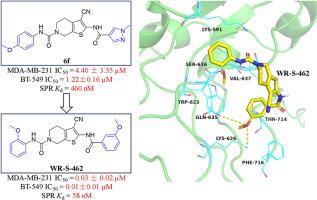
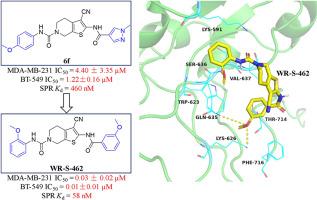
{"title":"Structural optimization and characterization of highly potent and selective STAT3 inhibitors for the treatment of triple negative breast cancer","authors":"Wangrui Jin , Yuzhu Zhang , Baozhen Wang , Zhaoyong Kang , Huachao Li , Jingfeng Song , Yihua Chen , Hai Xiong , Jing Chen","doi":"10.1016/j.ejmech.2025.117332","DOIUrl":null,"url":null,"abstract":"<div><div>Effective targeted treatments for triple-negative breast cancer (TNBC), which has the worst prognosis among various types of breast cancer, are lacking owing to its clinical heterogeneity and malignant nature. STAT3, a key transcription factor, regulates multiple physiological functions. Aberrant activation of STAT3 plays a pivotal role in the initiation and progression of TNBC and is closely associated with a poor prognosis. Therefore, targeting STAT3 is a promising potential therapeutic approach for TNBC. In this study, we further optimized the core structure of <strong>6f</strong>, which our research group previously identified as a STAT3 inhibitor and treatment for osteosarcoma, to identify additional potential STAT3 inhibitors for TNBC treatment. We identified <strong>WR-S-462</strong> as a high-binding affinity inhibitor of STAT3 that effectively suppresses its phosphorylation and biological functions <em>in vitro</em>. Notably, <strong>WR-S-462</strong> significantly inhibits TNBC growth and metastasis in a dose-dependent manner, providing robust evidence for its potential as a clinical intervention for TNBC.</div></div>","PeriodicalId":314,"journal":{"name":"European Journal of Medicinal Chemistry","volume":"287 ","pages":"Article 117332"},"PeriodicalIF":5.9000,"publicationDate":"2025-02-06","publicationTypes":"Journal Article","fieldsOfStudy":null,"isOpenAccess":false,"openAccessPdf":"","citationCount":"0","resultStr":null,"platform":"Semanticscholar","paperid":null,"PeriodicalName":"European Journal of Medicinal Chemistry","FirstCategoryId":"3","ListUrlMain":"https://www.sciencedirect.com/science/article/pii/S0223523425000972","RegionNum":2,"RegionCategory":"医学","ArticlePicture":[],"TitleCN":null,"AbstractTextCN":null,"PMCID":null,"EPubDate":"","PubModel":"","JCR":"Q1","JCRName":"CHEMISTRY, MEDICINAL","Score":null,"Total":0}
引用次数: 0
Abstract
Effective targeted treatments for triple-negative breast cancer (TNBC), which has the worst prognosis among various types of breast cancer, are lacking owing to its clinical heterogeneity and malignant nature. STAT3, a key transcription factor, regulates multiple physiological functions. Aberrant activation of STAT3 plays a pivotal role in the initiation and progression of TNBC and is closely associated with a poor prognosis. Therefore, targeting STAT3 is a promising potential therapeutic approach for TNBC. In this study, we further optimized the core structure of 6f, which our research group previously identified as a STAT3 inhibitor and treatment for osteosarcoma, to identify additional potential STAT3 inhibitors for TNBC treatment. We identified WR-S-462 as a high-binding affinity inhibitor of STAT3 that effectively suppresses its phosphorylation and biological functions in vitro. Notably, WR-S-462 significantly inhibits TNBC growth and metastasis in a dose-dependent manner, providing robust evidence for its potential as a clinical intervention for TNBC.
三阴性乳腺癌(triple negative breast cancer, TNBC)是各类乳腺癌中预后最差的一种,由于其临床异质性和恶性性质,目前缺乏有效的靶向治疗方法。STAT3是调控多种生理功能的关键转录因子。STAT3的异常激活在TNBC的发生和发展中起着关键作用,并与不良预后密切相关。因此,靶向STAT3是一种很有潜力的治疗TNBC的方法。在本研究中,我们进一步优化了6f的核心结构,以确定其他潜在的用于TNBC治疗的STAT3抑制剂,我们的课题组之前已将其确定为STAT3抑制剂和骨肉瘤的治疗方法。我们发现WR-S-462是STAT3的高结合亲和抑制剂,在体外有效抑制STAT3的磷酸化和生物学功能。值得注意的是,WR-S-462以剂量依赖的方式显著抑制TNBC的生长和转移,为其作为TNBC临床干预的潜力提供了强有力的证据。
期刊介绍:
The European Journal of Medicinal Chemistry is a global journal that publishes studies on all aspects of medicinal chemistry. It provides a medium for publication of original papers and also welcomes critical review papers.
A typical paper would report on the organic synthesis, characterization and pharmacological evaluation of compounds. Other topics of interest are drug design, QSAR, molecular modeling, drug-receptor interactions, molecular aspects of drug metabolism, prodrug synthesis and drug targeting. The journal expects manuscripts to present the rational for a study, provide insight into the design of compounds or understanding of mechanism, or clarify the targets.



 京公网安备 11010802042870号
京ICP备2023020795号-1
京公网安备 11010802042870号
京ICP备2023020795号-1

 分享
分享
 求助内容:
求助内容: 应助结果提醒方式:
 扫码关注我们
