Prashant Punia, Ashish Chugh, Sarang Gotecha, Neeraj Singh, Jayant Gaud, Ishant Rege, Ramis Abdul Aziz
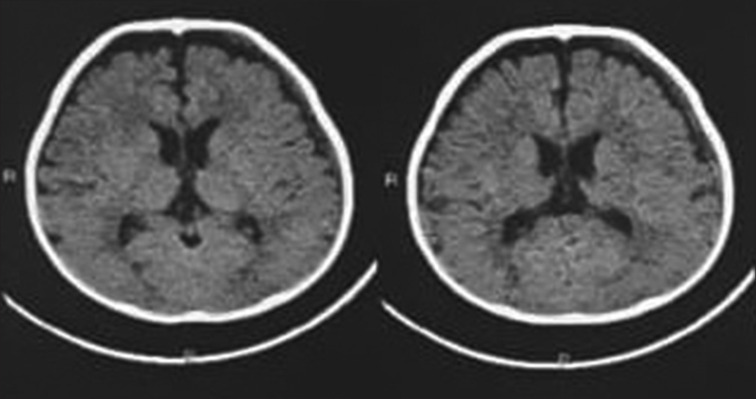
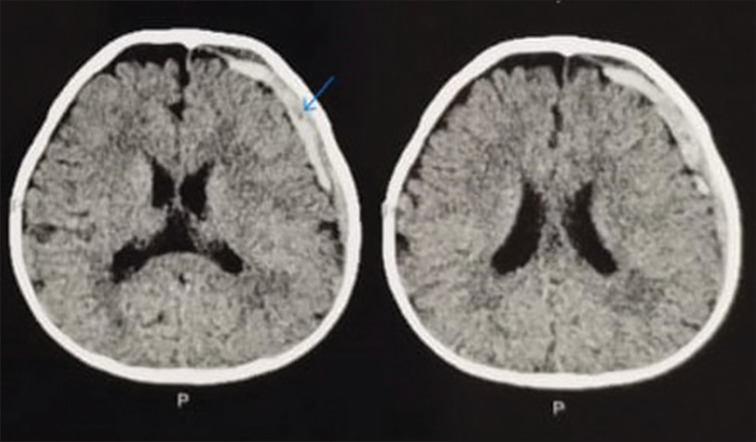
{"title":"Rapid Spontaneous Regression of Traumatic Subdural Hematoma.","authors":"Prashant Punia, Ashish Chugh, Sarang Gotecha, Neeraj Singh, Jayant Gaud, Ishant Rege, Ramis Abdul Aziz","doi":"10.4103/jets.jets_46_24","DOIUrl":null,"url":null,"abstract":"<p><p>Acute subdural hematoma (ASDH) is a type of intracranial hemorrhage and is due to the collection of blood below the inner layer of the dura but external to the brain and arachnoid membrane. It tends to occur in the temporal parietal regions. Early intervention is the key for better outcome of the patient. Management depends on neurological status and imaging. Large SDH collects along the convexity of the brain causing compression over the brain stem with midline shift. In cases of conservatively managed ASDH, spontaneous resolution usually takes weeks to months depending on the size of the bleed. In rare cases, spontaneous rapid resolution of the SDH occurs. So here, we are presenting an 11-month-old baby girl who was brought to our Emergency room/department (ER) with a history of fall and computed tomography scan was suggestion of an ASDH in the left temporoparietal region which resolves on its own in 6 h which is a rare phenomenon and needs to be highlighted.</p>","PeriodicalId":15692,"journal":{"name":"Journal of Emergencies, Trauma, and Shock","volume":"17 4","pages":"245-247"},"PeriodicalIF":0.7000,"publicationDate":"2024-10-01","publicationTypes":"Journal Article","fieldsOfStudy":null,"isOpenAccess":false,"openAccessPdf":"https://www.ncbi.nlm.nih.gov/pmc/articles/PMC11792751/pdf/","citationCount":"0","resultStr":null,"platform":"Semanticscholar","paperid":null,"PeriodicalName":"Journal of Emergencies, Trauma, and Shock","FirstCategoryId":"1085","ListUrlMain":"https://doi.org/10.4103/jets.jets_46_24","RegionNum":0,"RegionCategory":null,"ArticlePicture":[],"TitleCN":null,"AbstractTextCN":null,"PMCID":null,"EPubDate":"2024/8/30 0:00:00","PubModel":"Epub","JCR":"Q3","JCRName":"EMERGENCY MEDICINE","Score":null,"Total":0}
引用次数: 0
Abstract
Acute subdural hematoma (ASDH) is a type of intracranial hemorrhage and is due to the collection of blood below the inner layer of the dura but external to the brain and arachnoid membrane. It tends to occur in the temporal parietal regions. Early intervention is the key for better outcome of the patient. Management depends on neurological status and imaging. Large SDH collects along the convexity of the brain causing compression over the brain stem with midline shift. In cases of conservatively managed ASDH, spontaneous resolution usually takes weeks to months depending on the size of the bleed. In rare cases, spontaneous rapid resolution of the SDH occurs. So here, we are presenting an 11-month-old baby girl who was brought to our Emergency room/department (ER) with a history of fall and computed tomography scan was suggestion of an ASDH in the left temporoparietal region which resolves on its own in 6 h which is a rare phenomenon and needs to be highlighted.




 京公网安备 11010802042870号
京ICP备2023020795号-1
京公网安备 11010802042870号
京ICP备2023020795号-1

 分享
分享
 求助内容:
求助内容: 应助结果提醒方式:
 扫码关注我们
