Arum Choi, Subin Kim, Seonji Kim, Iksung Cho, Min Jae Cha, Seng Chan You
{"title":"Atherosclerotic Cardiovascular Disease in Cancer Survivors: Current Evidence, Risk Prediction, Prevention, and Management.","authors":"Arum Choi, Subin Kim, Seonji Kim, Iksung Cho, Min Jae Cha, Seng Chan You","doi":"10.12997/jla.2025.14.1.30","DOIUrl":null,"url":null,"abstract":"<p><p>While advances in cancer treatment have led to improved survival rates, cancer survivors are at a significant risk of developing atherosclerotic cardiovascular disease (ASCVD). This review examines the risk, diagnosis, and prevention of ASCVD in this population. Cancer survivors, especially those diagnosed with certain types, face a significantly higher risk of developing ASCVD than the general population. We introduce the \"triad model\" to explain this increased risk of ASCVD among cancer patients. This model includes three interconnected components: common catalysts, cancer influence, and treatment impact. The factors contributing to this model are the shared risk factors between cancer and ASCVD, such as smoking, obesity, and systemic inflammation; the direct effects of cancer on cardiovascular health through chronic systemic inflammation and endothelial damage; and the significant effects of anticancer treatments, including chemotherapy and radiation, which can worsen cardiovascular complications and hasten the progression of ASCVD. Furthermore, cancer survivors are at a higher risk of developing and dying from ASCVD, highlighting the necessity for tailored guidelines and strategies for ASCVD prevention and management in this population. The review explores the utility of diagnostic tools, such as coronary artery calcium scoring, in predicting and managing ASCVD risk. It also emphasizes the importance of prevention strategies that include regular cardiovascular monitoring and lifestyle modifications. Finally, the relationship between cancer survival and cardiovascular health highlights the importance of integrated and comprehensive care approaches. Continued research, the development of prediction models, and specific preventative strategies are essential to improve cancer survivors' overall health outcomes.</p>","PeriodicalId":16284,"journal":{"name":"Journal of Lipid and Atherosclerosis","volume":"14 1","pages":"30-39"},"PeriodicalIF":0.0000,"publicationDate":"2025-01-01","publicationTypes":"Journal Article","fieldsOfStudy":null,"isOpenAccess":false,"openAccessPdf":"https://www.ncbi.nlm.nih.gov/pmc/articles/PMC11791415/pdf/","citationCount":"0","resultStr":null,"platform":"Semanticscholar","paperid":null,"PeriodicalName":"Journal of Lipid and Atherosclerosis","FirstCategoryId":"1085","ListUrlMain":"https://doi.org/10.12997/jla.2025.14.1.30","RegionNum":0,"RegionCategory":null,"ArticlePicture":[],"TitleCN":null,"AbstractTextCN":null,"PMCID":null,"EPubDate":"2024/7/19 0:00:00","PubModel":"Epub","JCR":"Q2","JCRName":"Medicine","Score":null,"Total":0}
引用次数: 0
Abstract
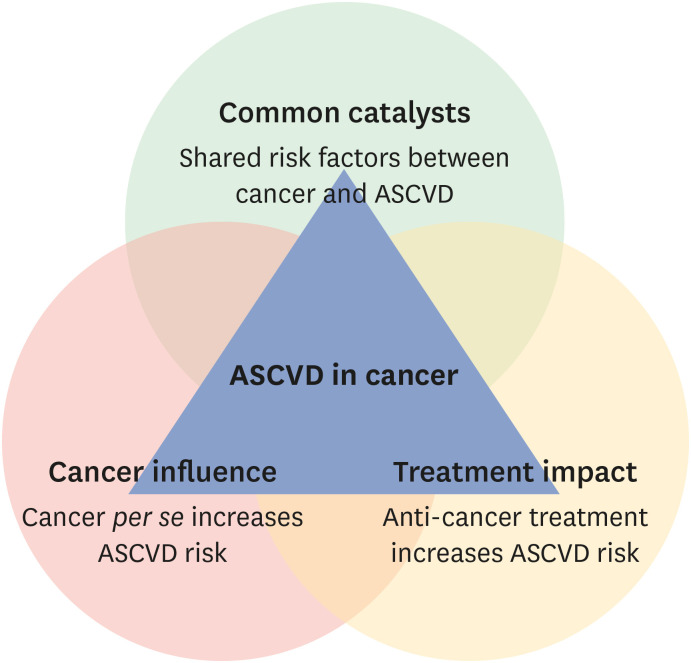
While advances in cancer treatment have led to improved survival rates, cancer survivors are at a significant risk of developing atherosclerotic cardiovascular disease (ASCVD). This review examines the risk, diagnosis, and prevention of ASCVD in this population. Cancer survivors, especially those diagnosed with certain types, face a significantly higher risk of developing ASCVD than the general population. We introduce the "triad model" to explain this increased risk of ASCVD among cancer patients. This model includes three interconnected components: common catalysts, cancer influence, and treatment impact. The factors contributing to this model are the shared risk factors between cancer and ASCVD, such as smoking, obesity, and systemic inflammation; the direct effects of cancer on cardiovascular health through chronic systemic inflammation and endothelial damage; and the significant effects of anticancer treatments, including chemotherapy and radiation, which can worsen cardiovascular complications and hasten the progression of ASCVD. Furthermore, cancer survivors are at a higher risk of developing and dying from ASCVD, highlighting the necessity for tailored guidelines and strategies for ASCVD prevention and management in this population. The review explores the utility of diagnostic tools, such as coronary artery calcium scoring, in predicting and managing ASCVD risk. It also emphasizes the importance of prevention strategies that include regular cardiovascular monitoring and lifestyle modifications. Finally, the relationship between cancer survival and cardiovascular health highlights the importance of integrated and comprehensive care approaches. Continued research, the development of prediction models, and specific preventative strategies are essential to improve cancer survivors' overall health outcomes.




 京公网安备 11010802042870号
京ICP备2023020795号-1
京公网安备 11010802042870号
京ICP备2023020795号-1

 分享
分享
 求助内容:
求助内容: 应助结果提醒方式:
 扫码关注我们
