Joy Grifoni, Valeria Crispiatico, Anna Castagna, Rosa Maria Converti, Marina Ramella, Angelo Quartarone, Teresa L'Abbate, Karolina Armonaite, Luca Paulon, Francescaroberta Panuccio, Franca Tecchio
{"title":"Musician's dystonia: a perspective on the strongest evidence towards new prevention and mitigation treatments.","authors":"Joy Grifoni, Valeria Crispiatico, Anna Castagna, Rosa Maria Converti, Marina Ramella, Angelo Quartarone, Teresa L'Abbate, Karolina Armonaite, Luca Paulon, Francescaroberta Panuccio, Franca Tecchio","doi":"10.3389/fnetp.2024.1508592","DOIUrl":null,"url":null,"abstract":"<p><p>This perspective article addresses the critical and up-to-date problem of task-specific musician's dystonia (MD) from both theoretical and practical perspectives. Theoretically, MD is explored as a result of impaired sensorimotor interplay across different brain circuits, supported by the most frequently cited scientific evidence-each referenced dozens of times in Scopus. Practically, MD is a significant issue as it occurs over 60 times more frequently in musicians compared to other professions, underscoring the influence of individual training as well as environmental, social, and emotional factors. To address these challenges, we propose a novel application of the FeeSyCy principle (feedback-synchrony-plasticity), which emphasizes the pivotal role of feedback in guiding inter-neuronal synchronization and plasticity-the foundation of learning and memory. This model integrates with established literature to form a comprehensive framework for understanding MD as an impaired FeeSyCy-mediated relationship between the individual and their environment, ultimately leading to trauma. The proposed approach provides significant advantages by enabling the development of innovative therapeutic and preventive strategies. Specifically, it lays the groundwork for multimodal psycho-physical therapies aimed at restoring balance in the neural circuits affected by MD. These strategies include personalized psychotherapy combined with physical rehabilitation to address both the psychological and physiological dimensions of MD. This integration offers a practical and value-added solution to this pressing problem, with potential for broad applicability across similar conditions.</p>","PeriodicalId":73092,"journal":{"name":"Frontiers in network physiology","volume":"4 ","pages":"1508592"},"PeriodicalIF":3.0000,"publicationDate":"2025-01-22","publicationTypes":"Journal Article","fieldsOfStudy":null,"isOpenAccess":false,"openAccessPdf":"https://www.ncbi.nlm.nih.gov/pmc/articles/PMC11794226/pdf/","citationCount":"0","resultStr":null,"platform":"Semanticscholar","paperid":null,"PeriodicalName":"Frontiers in network physiology","FirstCategoryId":"1085","ListUrlMain":"https://doi.org/10.3389/fnetp.2024.1508592","RegionNum":0,"RegionCategory":null,"ArticlePicture":[],"TitleCN":null,"AbstractTextCN":null,"PMCID":null,"EPubDate":"2024/1/1 0:00:00","PubModel":"eCollection","JCR":"","JCRName":"","Score":null,"Total":0}
引用次数: 0
Abstract
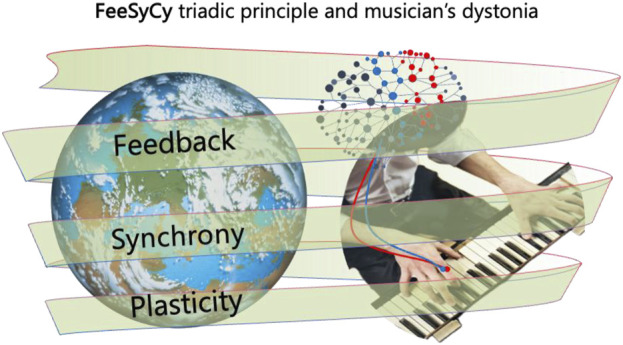
This perspective article addresses the critical and up-to-date problem of task-specific musician's dystonia (MD) from both theoretical and practical perspectives. Theoretically, MD is explored as a result of impaired sensorimotor interplay across different brain circuits, supported by the most frequently cited scientific evidence-each referenced dozens of times in Scopus. Practically, MD is a significant issue as it occurs over 60 times more frequently in musicians compared to other professions, underscoring the influence of individual training as well as environmental, social, and emotional factors. To address these challenges, we propose a novel application of the FeeSyCy principle (feedback-synchrony-plasticity), which emphasizes the pivotal role of feedback in guiding inter-neuronal synchronization and plasticity-the foundation of learning and memory. This model integrates with established literature to form a comprehensive framework for understanding MD as an impaired FeeSyCy-mediated relationship between the individual and their environment, ultimately leading to trauma. The proposed approach provides significant advantages by enabling the development of innovative therapeutic and preventive strategies. Specifically, it lays the groundwork for multimodal psycho-physical therapies aimed at restoring balance in the neural circuits affected by MD. These strategies include personalized psychotherapy combined with physical rehabilitation to address both the psychological and physiological dimensions of MD. This integration offers a practical and value-added solution to this pressing problem, with potential for broad applicability across similar conditions.



 京公网安备 11010802042870号
京ICP备2023020795号-1
京公网安备 11010802042870号
京ICP备2023020795号-1

 分享
分享

 求助内容:
求助内容: 应助结果提醒方式:
 扫码关注我们
