Timothy P L Roberts, Charlotte Birnbaum, Luke Bloy, William Gaetz
{"title":"Beyond sensitivity: what are the enabling opportunities of OPM-MEG?","authors":"Timothy P L Roberts, Charlotte Birnbaum, Luke Bloy, William Gaetz","doi":"10.3389/fmedt.2025.1515548","DOIUrl":null,"url":null,"abstract":"<p><p>While optically-pumped magnetometer (OPM) technology offers a number of compelling advantages over its SQUID predecessor for magnetoencephalography (MEG), many studies and viewpoints focus on issues of (i) scalp placement, with commensurate increases in sensitivity to weak magnetic fields and (ii) room temperature operation (without the need for baths of liquid helium to maintain superconducting properties of SQUIDs). This article addresses another unique and tantalizing opportunity-the ability for the OPM array to be \"wearable\", and thus to move with the participant. This is critical in adoption of naturalistic paradigms that move beyond \"laboratory neuroscience\" toward \"real world neuroscience\". It is also critically important in application to pediatric populations who cannot or will not remain still during conventional MEG scan procedures. Application to the developing infant brain will be considered as well as application to pediatric neuropsychiatric and developmental disorders, such as autism spectrum disorder. Rather than present solutions, this article will highlight the challenges faced by conventional SQUID-based cryo-MEG and explore the potential avenues for OPM-MEG to make a positive impact to the field of pediatric neuroscience.</p>","PeriodicalId":94015,"journal":{"name":"Frontiers in medical technology","volume":"7 ","pages":"1515548"},"PeriodicalIF":3.8000,"publicationDate":"2025-01-21","publicationTypes":"Journal Article","fieldsOfStudy":null,"isOpenAccess":false,"openAccessPdf":"https://www.ncbi.nlm.nih.gov/pmc/articles/PMC11790644/pdf/","citationCount":"0","resultStr":null,"platform":"Semanticscholar","paperid":null,"PeriodicalName":"Frontiers in medical technology","FirstCategoryId":"1085","ListUrlMain":"https://doi.org/10.3389/fmedt.2025.1515548","RegionNum":0,"RegionCategory":null,"ArticlePicture":[],"TitleCN":null,"AbstractTextCN":null,"PMCID":null,"EPubDate":"2025/1/1 0:00:00","PubModel":"eCollection","JCR":"Q3","JCRName":"ENGINEERING, BIOMEDICAL","Score":null,"Total":0}
引用次数: 0
Abstract
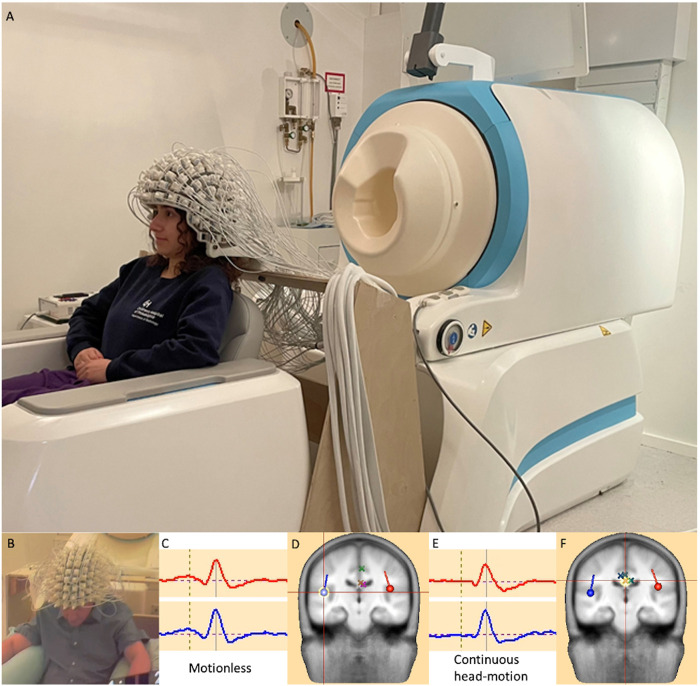
While optically-pumped magnetometer (OPM) technology offers a number of compelling advantages over its SQUID predecessor for magnetoencephalography (MEG), many studies and viewpoints focus on issues of (i) scalp placement, with commensurate increases in sensitivity to weak magnetic fields and (ii) room temperature operation (without the need for baths of liquid helium to maintain superconducting properties of SQUIDs). This article addresses another unique and tantalizing opportunity-the ability for the OPM array to be "wearable", and thus to move with the participant. This is critical in adoption of naturalistic paradigms that move beyond "laboratory neuroscience" toward "real world neuroscience". It is also critically important in application to pediatric populations who cannot or will not remain still during conventional MEG scan procedures. Application to the developing infant brain will be considered as well as application to pediatric neuropsychiatric and developmental disorders, such as autism spectrum disorder. Rather than present solutions, this article will highlight the challenges faced by conventional SQUID-based cryo-MEG and explore the potential avenues for OPM-MEG to make a positive impact to the field of pediatric neuroscience.



 京公网安备 11010802042870号
京ICP备2023020795号-1
京公网安备 11010802042870号
京ICP备2023020795号-1

 分享
分享

 求助内容:
求助内容: 应助结果提醒方式:
 扫码关注我们
