Novel Indoleamine-2,3-Dioxygenase-Targeted Pt(IV) Prodrugs Regulate the Tumor Immune Microenvironment to Achieve Chemoimmunotherapy In Vitro and In Vivo
{"title":"Novel Indoleamine-2,3-Dioxygenase-Targeted Pt(IV) Prodrugs Regulate the Tumor Immune Microenvironment to Achieve Chemoimmunotherapy In Vitro and In Vivo","authors":"Zhe Li, Xiao-Meng Liu, Fei Tan, Jia-Qian Wang, Xin Qiao, Yu-Kuan Feng, Jing-Yuan Xu, Ji-Hui Hao","doi":"10.1021/acs.jmedchem.4c02116","DOIUrl":null,"url":null,"abstract":"Convincing evidence revealed that some platinum-based drugs could stimulate immunological recognition, thereby inducing immunogenic cell death (ICD). Indoleamine-2,3-dioxygenase (IDO) is overexpressed in tumors, which caused exhaustion of tryptophan (T-cell energy) and constructed an immunosuppressive tumor microenvironment. Herein, considering IDO inhibition to improve chemotherapy, a series of IDOi-Pt(IV) prodrugs were designed to not only target DNA and IDO but also facilitate tumor-antigen exposure and immunomodulation. The optimal IDOi-Pt(IV) prodrugs (named compound <b>10</b>) significantly enhanced intracellular accumulation 22.4-fold and cytotoxicity 61.75-fold superior to cisplatin in HeLa cells. Moreover, immunofluorescence and enzyme-linked immunosorbent assays revealed that <b>10</b> induced reactive oxygen species-mediated endoplasmic reticulum stress and secretion of damage-associated molecular patterns, thereby presenting ICD effects. Molecular docking, enzyme inhibition, and Western blot assays demonstrated that <b>10</b> could effectively inhibit IDO1 and reverse immunosuppression, as further verified by mixed leukocyte reactions. <i>In vivo</i> tests showed that <b>10</b> exhibited high-efficiency and low-toxicity antitumor effects compared to cisplatin, presenting successful chemoimmunotherapy.","PeriodicalId":46,"journal":{"name":"Journal of Medicinal Chemistry","volume":"207 1","pages":""},"PeriodicalIF":6.8000,"publicationDate":"2025-02-07","publicationTypes":"Journal Article","fieldsOfStudy":null,"isOpenAccess":false,"openAccessPdf":"","citationCount":"0","resultStr":null,"platform":"Semanticscholar","paperid":null,"PeriodicalName":"Journal of Medicinal Chemistry","FirstCategoryId":"3","ListUrlMain":"https://doi.org/10.1021/acs.jmedchem.4c02116","RegionNum":1,"RegionCategory":"医学","ArticlePicture":[],"TitleCN":null,"AbstractTextCN":null,"PMCID":null,"EPubDate":"","PubModel":"","JCR":"Q1","JCRName":"CHEMISTRY, MEDICINAL","Score":null,"Total":0}
引用次数: 0
Abstract
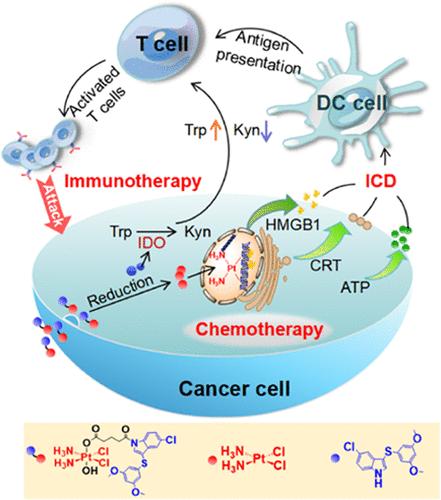
Convincing evidence revealed that some platinum-based drugs could stimulate immunological recognition, thereby inducing immunogenic cell death (ICD). Indoleamine-2,3-dioxygenase (IDO) is overexpressed in tumors, which caused exhaustion of tryptophan (T-cell energy) and constructed an immunosuppressive tumor microenvironment. Herein, considering IDO inhibition to improve chemotherapy, a series of IDOi-Pt(IV) prodrugs were designed to not only target DNA and IDO but also facilitate tumor-antigen exposure and immunomodulation. The optimal IDOi-Pt(IV) prodrugs (named compound 10) significantly enhanced intracellular accumulation 22.4-fold and cytotoxicity 61.75-fold superior to cisplatin in HeLa cells. Moreover, immunofluorescence and enzyme-linked immunosorbent assays revealed that 10 induced reactive oxygen species-mediated endoplasmic reticulum stress and secretion of damage-associated molecular patterns, thereby presenting ICD effects. Molecular docking, enzyme inhibition, and Western blot assays demonstrated that 10 could effectively inhibit IDO1 and reverse immunosuppression, as further verified by mixed leukocyte reactions. In vivo tests showed that 10 exhibited high-efficiency and low-toxicity antitumor effects compared to cisplatin, presenting successful chemoimmunotherapy.
期刊介绍:
The Journal of Medicinal Chemistry is a prestigious biweekly peer-reviewed publication that focuses on the multifaceted field of medicinal chemistry. Since its inception in 1959 as the Journal of Medicinal and Pharmaceutical Chemistry, it has evolved to become a cornerstone in the dissemination of research findings related to the design, synthesis, and development of therapeutic agents.
The Journal of Medicinal Chemistry is recognized for its significant impact in the scientific community, as evidenced by its 2022 impact factor of 7.3. This metric reflects the journal's influence and the importance of its content in shaping the future of drug discovery and development. The journal serves as a vital resource for chemists, pharmacologists, and other researchers interested in the molecular mechanisms of drug action and the optimization of therapeutic compounds.



 京公网安备 11010802042870号
京ICP备2023020795号-1
京公网安备 11010802042870号
京ICP备2023020795号-1

 分享
分享
 求助内容:
求助内容: 应助结果提醒方式:
 扫码关注我们
