Fokko P. Wieringa , Swathi Suran , Henning Søndergaard , Stephen Ash , Cian Cummins , Ashesh Ray Chaudhuri , Tugrul Irmak , Karin Gerritsen , Jeroen Vollenbroek
{"title":"The Future of Technology-Based Kidney Replacement Therapies: An Update on Portable, Wearable, and Implantable Artificial Kidneys","authors":"Fokko P. Wieringa , Swathi Suran , Henning Søndergaard , Stephen Ash , Cian Cummins , Ashesh Ray Chaudhuri , Tugrul Irmak , Karin Gerritsen , Jeroen Vollenbroek","doi":"10.1053/j.ajkd.2024.10.015","DOIUrl":null,"url":null,"abstract":"<div><div>Worldwide, the number of people who need lifesaving kidney replacement therapy (KRT) steadily increases, but approximately two thirds of them lack access to KRT and therefore die. Access to KRT depends on economic, social, infrastructural, ecological, and political factors. Current KRTs include kidney transplant, peritoneal dialysis, and hemodialysis. The field of xenotransplantation has been opening promising new perspectives recently but needs improvement. Unfortunately, not all patients are suitable for transplant. Peritoneal dialysis and hemodialysis will remain important KRTs, but they are expensive and strongly dependent on infrastructure, with few fundamental changes since the 1980s. The KRT field might learn from the “African mobile phone revolution” that beat infrastructural limitations, lowered costs, and increased access. We provide a nonexhaustive overview of promising ways to increase the mobility of technology-based KRTs by dialysate regeneration, chip-based nanoporous filters, bioreactor-enabling technologies, and using the gut as a “third kidney.” In 2018, the Kidney Health Initiative published a road map for innovative KRTs composed by leading innovators, but the pace of innovation is slower than was targeted. Ambitious political statements about realizing this road map can only succeed if the granted funding matches the targeted time scale. Patient-centered international “coopetition” (ie, the act of cooperation between competing entities) seems to offer the quickest pathway to success.</div></div>","PeriodicalId":7419,"journal":{"name":"American Journal of Kidney Diseases","volume":"85 6","pages":"Pages 787-796"},"PeriodicalIF":8.2000,"publicationDate":"2025-06-01","publicationTypes":"Journal Article","fieldsOfStudy":null,"isOpenAccess":false,"openAccessPdf":"","citationCount":"0","resultStr":null,"platform":"Semanticscholar","paperid":null,"PeriodicalName":"American Journal of Kidney Diseases","FirstCategoryId":"3","ListUrlMain":"https://www.sciencedirect.com/science/article/pii/S0272638625000538","RegionNum":1,"RegionCategory":"医学","ArticlePicture":[],"TitleCN":null,"AbstractTextCN":null,"PMCID":null,"EPubDate":"2025/2/4 0:00:00","PubModel":"Epub","JCR":"Q1","JCRName":"UROLOGY & NEPHROLOGY","Score":null,"Total":0}
引用次数: 0
Abstract
Worldwide, the number of people who need lifesaving kidney replacement therapy (KRT) steadily increases, but approximately two thirds of them lack access to KRT and therefore die. Access to KRT depends on economic, social, infrastructural, ecological, and political factors. Current KRTs include kidney transplant, peritoneal dialysis, and hemodialysis. The field of xenotransplantation has been opening promising new perspectives recently but needs improvement. Unfortunately, not all patients are suitable for transplant. Peritoneal dialysis and hemodialysis will remain important KRTs, but they are expensive and strongly dependent on infrastructure, with few fundamental changes since the 1980s. The KRT field might learn from the “African mobile phone revolution” that beat infrastructural limitations, lowered costs, and increased access. We provide a nonexhaustive overview of promising ways to increase the mobility of technology-based KRTs by dialysate regeneration, chip-based nanoporous filters, bioreactor-enabling technologies, and using the gut as a “third kidney.” In 2018, the Kidney Health Initiative published a road map for innovative KRTs composed by leading innovators, but the pace of innovation is slower than was targeted. Ambitious political statements about realizing this road map can only succeed if the granted funding matches the targeted time scale. Patient-centered international “coopetition” (ie, the act of cooperation between competing entities) seems to offer the quickest pathway to success.
期刊介绍:
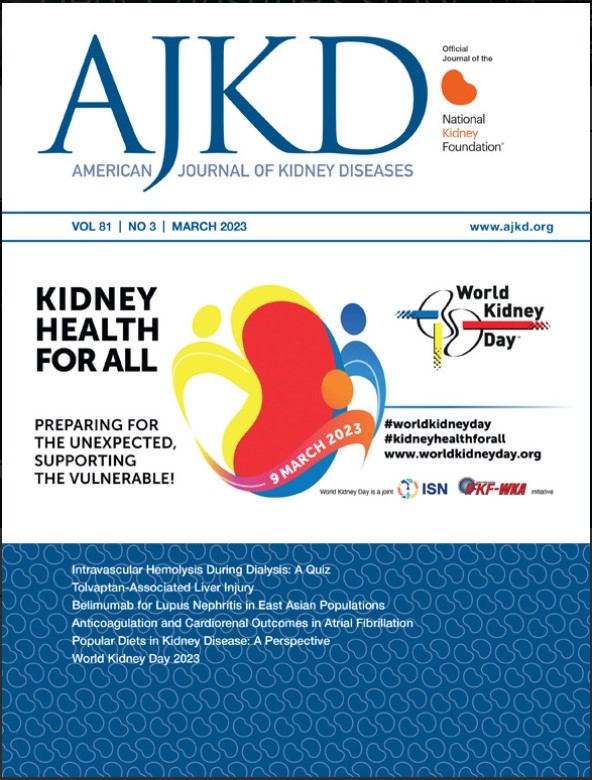
The American Journal of Kidney Diseases (AJKD), the National Kidney Foundation's official journal, is globally recognized for its leadership in clinical nephrology content. Monthly, AJKD publishes original investigations on kidney diseases, hypertension, dialysis therapies, and kidney transplantation. Rigorous peer-review, statistical scrutiny, and a structured format characterize the publication process. Each issue includes case reports unveiling new diseases and potential therapeutic strategies.




 京公网安备 11010802042870号
京ICP备2023020795号-1
京公网安备 11010802042870号
京ICP备2023020795号-1

 分享
分享
 求助内容:
求助内容: 应助结果提醒方式:
 扫码关注我们
