Gloria Mavinga Bundutidi, Kota Mochizuki, Yuichi Matsuo, Mizuki Hayashishita, Takaya Sakura, Yuri Ando, Gregory Murray Cook, Acharjee Rajib, Frédéric Bringaud, Michael Boshart, Shinjiro Hamano, Masakazu Sekijima, Kenji Hirayama, Kiyoshi Kita, Daniel Ken Inaoka
{"title":"Development of tolerance to bedaquiline by overexpression of trypanosomal acetate: succinate CoA transferase in Mycobacterium smegmatis.","authors":"Gloria Mavinga Bundutidi, Kota Mochizuki, Yuichi Matsuo, Mizuki Hayashishita, Takaya Sakura, Yuri Ando, Gregory Murray Cook, Acharjee Rajib, Frédéric Bringaud, Michael Boshart, Shinjiro Hamano, Masakazu Sekijima, Kenji Hirayama, Kiyoshi Kita, Daniel Ken Inaoka","doi":"10.1038/s42003-025-07611-0","DOIUrl":null,"url":null,"abstract":"<p><p>The F-type ATP synthase inhibitor bedaquiline (BDQ) is a potent inhibitor of mycobacterial growth and this inhibition cannot be rescued by fermentable carbon sources that would supply ATP by an alternative pathway (substrate level phosphorylation). To gain mechanistic insight into this phenomenon, we employed a metabolic engineering approach. We introduced into Mycobacterium smegmatis an alternative ATP production pathway by substrate-level phosphorylation, specifically through overexpression of trypanosomal acetate:succinate co-enzyme A (CoA) transferase (ASCT). Intriguingly, the overexpression of ASCT partially restored intracellular ATP levels and resulted in acquired tolerance to BDQ growth inhibition at low, but not high concentrations of BDQ. These results implicate intracellular ATP levels in modulating the growth inhibitory activity of BDQ at low concentrations. These findings shed light on the intricate interplay between BDQ and mycobacterial energy metabolism, while also providing a novel tool for the development of next-generation ATP synthase-specific inhibitors targeting mycobacteria.</p>","PeriodicalId":10552,"journal":{"name":"Communications Biology","volume":"8 1","pages":"187"},"PeriodicalIF":5.1000,"publicationDate":"2025-02-06","publicationTypes":"Journal Article","fieldsOfStudy":null,"isOpenAccess":false,"openAccessPdf":"https://www.ncbi.nlm.nih.gov/pmc/articles/PMC11802737/pdf/","citationCount":"0","resultStr":null,"platform":"Semanticscholar","paperid":null,"PeriodicalName":"Communications Biology","FirstCategoryId":"99","ListUrlMain":"https://doi.org/10.1038/s42003-025-07611-0","RegionNum":1,"RegionCategory":"生物学","ArticlePicture":[],"TitleCN":null,"AbstractTextCN":null,"PMCID":null,"EPubDate":"","PubModel":"","JCR":"Q1","JCRName":"BIOLOGY","Score":null,"Total":0}
引用次数: 0
Abstract
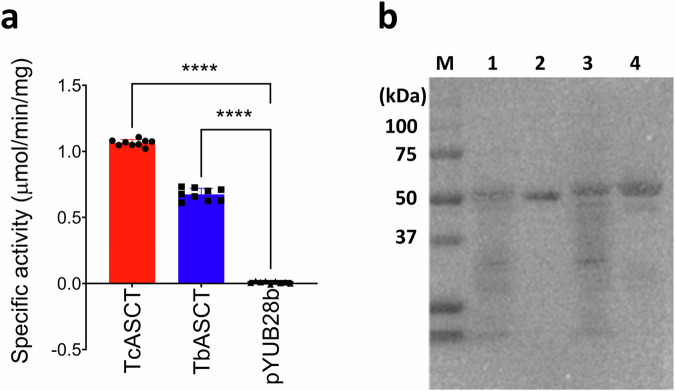
The F-type ATP synthase inhibitor bedaquiline (BDQ) is a potent inhibitor of mycobacterial growth and this inhibition cannot be rescued by fermentable carbon sources that would supply ATP by an alternative pathway (substrate level phosphorylation). To gain mechanistic insight into this phenomenon, we employed a metabolic engineering approach. We introduced into Mycobacterium smegmatis an alternative ATP production pathway by substrate-level phosphorylation, specifically through overexpression of trypanosomal acetate:succinate co-enzyme A (CoA) transferase (ASCT). Intriguingly, the overexpression of ASCT partially restored intracellular ATP levels and resulted in acquired tolerance to BDQ growth inhibition at low, but not high concentrations of BDQ. These results implicate intracellular ATP levels in modulating the growth inhibitory activity of BDQ at low concentrations. These findings shed light on the intricate interplay between BDQ and mycobacterial energy metabolism, while also providing a novel tool for the development of next-generation ATP synthase-specific inhibitors targeting mycobacteria.
期刊介绍:
Communications Biology is an open access journal from Nature Research publishing high-quality research, reviews and commentary in all areas of the biological sciences. Research papers published by the journal represent significant advances bringing new biological insight to a specialized area of research.




 京公网安备 11010802042870号
京ICP备2023020795号-1
京公网安备 11010802042870号
京ICP备2023020795号-1

 分享
分享
 求助内容:
求助内容: 应助结果提醒方式:
 扫码关注我们
