T Corina Margain, Emily Powell, Alexandra Clark, Adam Bush
{"title":"Phonocardiography based pulse wave velocity system for non-occlusive assessment of arterial stiffness.","authors":"T Corina Margain, Emily Powell, Alexandra Clark, Adam Bush","doi":"10.3389/fcvm.2025.1481836","DOIUrl":null,"url":null,"abstract":"<p><p>Arterial stiffness is strongly associated with vascular aging and pathology and can be assessed in many ways. Existing devices for measuring central arterial stiffness, such as carotid-femoral pulse wave velocity (PWV), are limited by high costs and the need for specialized expertise, limiting widespread clinical adoption. This study introduces a semi- and non-occlusive PWV measurement system using phonocardiography (PCG) and plethysmography (PPG) and a single femoral pressure cuff, aiming to address these limitations. We conducted a study comparing a semi-occlusive (carotid-femoral PWV) and a non-occlusive (carotid-toe PWV) PCG-based PWV measurements across a cohort of 63 volunteers, as compared to literature reference PWV values. Results demonstrated strong correlations between our PCG-based PWV measures (PWV<sub>carotid-femoral</sub>: 8.42 ± 3.99 m/s vs. PWV<sub>carotid-toe</sub>: 10.62 ± 3.86 m/s) with age as a significant predictor (PWV<sub>carotid-femoral</sub>: <i>r</i> <sup>2</sup> = 0.45; PWV<sub>carotid-toe</sub>: <i>r</i> <sup>2</sup> = 0.28, <i>p</i> < 0.05). Ultrasound measured distensibility assessments confirmed the reliability of our PCG approach in reflecting central arterial stiffness dynamics, particularly at the aortic level. Test-retest reliability analyses yielded high intraclass correlation coefficients (0.75 ≤ ICC ≤ 90), indicating robust repeatability of our method. This study highlights the feasibility and accuracy of our low-cost, semi and non-occlusive PWV measurement systems to enhance accessibility in arterial stiffness assessments, potentially easing cardiovascular risk stratification.</p>","PeriodicalId":12414,"journal":{"name":"Frontiers in Cardiovascular Medicine","volume":"12 ","pages":"1481836"},"PeriodicalIF":2.8000,"publicationDate":"2025-01-23","publicationTypes":"Journal Article","fieldsOfStudy":null,"isOpenAccess":false,"openAccessPdf":"https://www.ncbi.nlm.nih.gov/pmc/articles/PMC11798789/pdf/","citationCount":"0","resultStr":null,"platform":"Semanticscholar","paperid":null,"PeriodicalName":"Frontiers in Cardiovascular Medicine","FirstCategoryId":"3","ListUrlMain":"https://doi.org/10.3389/fcvm.2025.1481836","RegionNum":3,"RegionCategory":"医学","ArticlePicture":[],"TitleCN":null,"AbstractTextCN":null,"PMCID":null,"EPubDate":"2025/1/1 0:00:00","PubModel":"eCollection","JCR":"Q2","JCRName":"CARDIAC & CARDIOVASCULAR SYSTEMS","Score":null,"Total":0}
引用次数: 0
Abstract
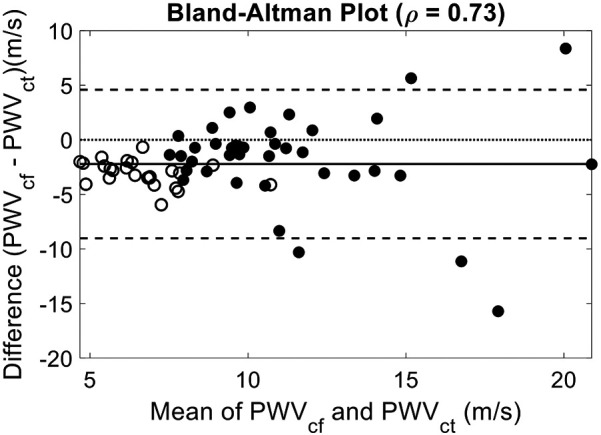
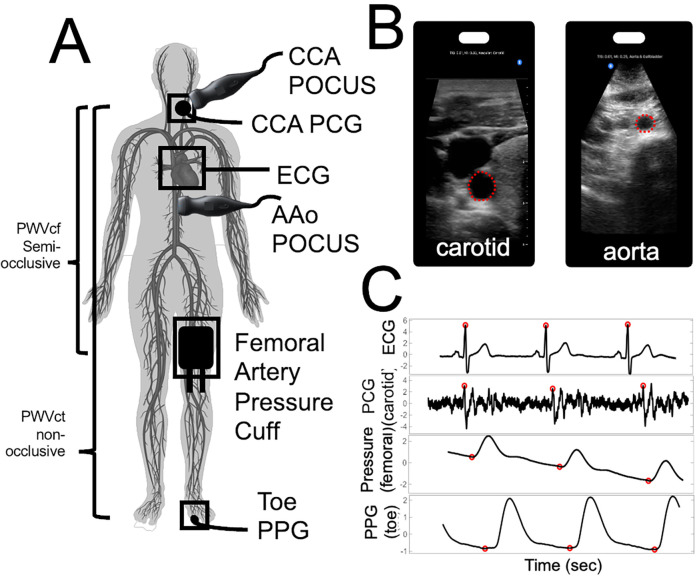
Arterial stiffness is strongly associated with vascular aging and pathology and can be assessed in many ways. Existing devices for measuring central arterial stiffness, such as carotid-femoral pulse wave velocity (PWV), are limited by high costs and the need for specialized expertise, limiting widespread clinical adoption. This study introduces a semi- and non-occlusive PWV measurement system using phonocardiography (PCG) and plethysmography (PPG) and a single femoral pressure cuff, aiming to address these limitations. We conducted a study comparing a semi-occlusive (carotid-femoral PWV) and a non-occlusive (carotid-toe PWV) PCG-based PWV measurements across a cohort of 63 volunteers, as compared to literature reference PWV values. Results demonstrated strong correlations between our PCG-based PWV measures (PWVcarotid-femoral: 8.42 ± 3.99 m/s vs. PWVcarotid-toe: 10.62 ± 3.86 m/s) with age as a significant predictor (PWVcarotid-femoral: r2 = 0.45; PWVcarotid-toe: r2 = 0.28, p < 0.05). Ultrasound measured distensibility assessments confirmed the reliability of our PCG approach in reflecting central arterial stiffness dynamics, particularly at the aortic level. Test-retest reliability analyses yielded high intraclass correlation coefficients (0.75 ≤ ICC ≤ 90), indicating robust repeatability of our method. This study highlights the feasibility and accuracy of our low-cost, semi and non-occlusive PWV measurement systems to enhance accessibility in arterial stiffness assessments, potentially easing cardiovascular risk stratification.
动脉僵硬与血管老化和病理密切相关,可以通过多种方式进行评估。现有的测量中心动脉硬度的设备,如颈-股脉搏波速度(PWV),由于成本高和需要专业知识而受到限制,限制了临床的广泛采用。本研究介绍了一种半闭塞和非闭塞的PWV测量系统,该系统使用心音图(PCG)和体积描记仪(PPG)以及单个股压袖带,旨在解决这些局限性。我们对63名志愿者进行了一项研究,比较了半闭塞(颈动脉-股骨PWV)和非闭塞(颈动脉-脚趾PWV)基于pcg的PWV测量,并与文献参考PWV值进行了比较。结果显示,我们基于pcg的PWV测量(pwvcarooid -股骨:8.42±3.99 m/s vs. pwvcarooid -脚趾:10.62±3.86 m/s)与年龄有很强的相关性(pwvcarooid -股骨:r 2 = 0.45;pwvcaroid -toe: r 2 = 0.28, p
期刊介绍:
Frontiers? Which frontiers? Where exactly are the frontiers of cardiovascular medicine? And who should be defining these frontiers?
At Frontiers in Cardiovascular Medicine we believe it is worth being curious to foresee and explore beyond the current frontiers. In other words, we would like, through the articles published by our community journal Frontiers in Cardiovascular Medicine, to anticipate the future of cardiovascular medicine, and thus better prevent cardiovascular disorders and improve therapeutic options and outcomes of our patients.




 京公网安备 11010802042870号
京ICP备2023020795号-1
京公网安备 11010802042870号
京ICP备2023020795号-1

 分享
分享
 求助内容:
求助内容: 应助结果提醒方式:
 扫码关注我们
