Jessie P Bakker, Samantha J McClenahan, Piper Fromy, Simon Turner, Barry T Peterson, Benjamin Vandendriessche, Jennifer C Goldsack
{"title":"A Hierarchical Framework for Selecting Reference Measures for the Analytical Validation of Sensor-Based Digital Health Technologies.","authors":"Jessie P Bakker, Samantha J McClenahan, Piper Fromy, Simon Turner, Barry T Peterson, Benjamin Vandendriessche, Jennifer C Goldsack","doi":"10.2196/58956","DOIUrl":null,"url":null,"abstract":"<p><p>Sensor-based digital health technologies (sDHTs) are increasingly used to support scientific and clinical decision-making. The digital clinical measures they generate offer enormous benefits, including providing more patient-relevant data, improving patient access, reducing costs, and driving inclusion across health care ecosystems. Scientific best practices and regulatory guidance now provide clear direction to investigators seeking to evaluate sDHTs for use in different contexts. However, the quality of the evidence reported for analytical validation of sDHTs-evaluation of algorithms converting sample-level sensor data into a measure that is clinically interpretable-is inconsistent and too often insufficient to support a particular digital measure as fit-for-purpose. We propose a hierarchical framework to address challenges related to selecting the most appropriate reference measure for conducting analytical validation and codify best practices and an approach that will help capture the greatest value of sDHTs for public health, patient care, and medical product development.</p>","PeriodicalId":16337,"journal":{"name":"Journal of Medical Internet Research","volume":"27 ","pages":"e58956"},"PeriodicalIF":6.0000,"publicationDate":"2025-02-07","publicationTypes":"Journal Article","fieldsOfStudy":null,"isOpenAccess":false,"openAccessPdf":"https://www.ncbi.nlm.nih.gov/pmc/articles/PMC11845878/pdf/","citationCount":"0","resultStr":null,"platform":"Semanticscholar","paperid":null,"PeriodicalName":"Journal of Medical Internet Research","FirstCategoryId":"3","ListUrlMain":"https://doi.org/10.2196/58956","RegionNum":2,"RegionCategory":"医学","ArticlePicture":[],"TitleCN":null,"AbstractTextCN":null,"PMCID":null,"EPubDate":"","PubModel":"","JCR":"Q1","JCRName":"HEALTH CARE SCIENCES & SERVICES","Score":null,"Total":0}
引用次数: 0
Abstract
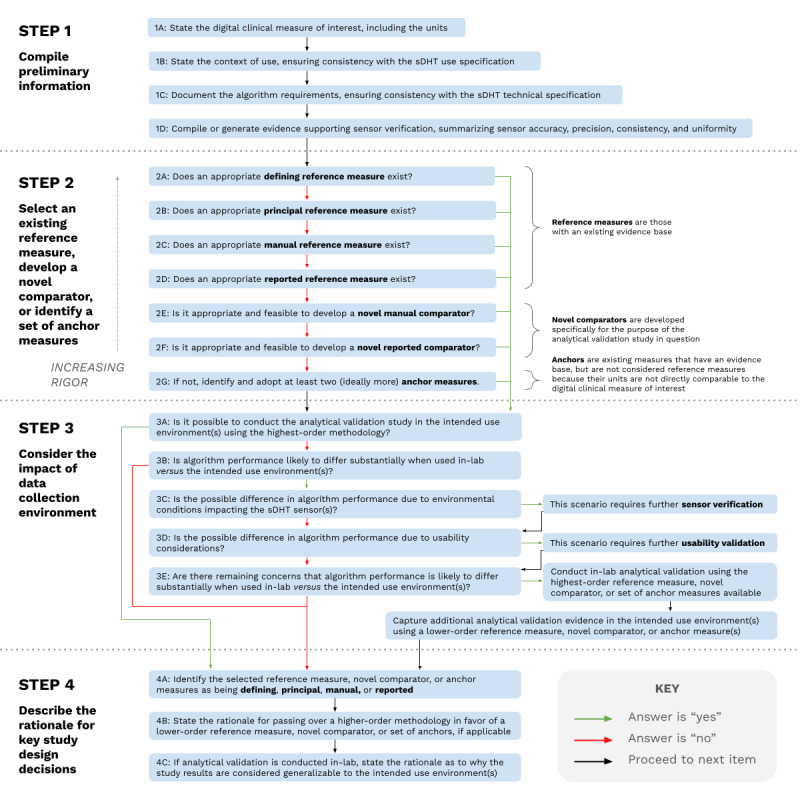
Sensor-based digital health technologies (sDHTs) are increasingly used to support scientific and clinical decision-making. The digital clinical measures they generate offer enormous benefits, including providing more patient-relevant data, improving patient access, reducing costs, and driving inclusion across health care ecosystems. Scientific best practices and regulatory guidance now provide clear direction to investigators seeking to evaluate sDHTs for use in different contexts. However, the quality of the evidence reported for analytical validation of sDHTs-evaluation of algorithms converting sample-level sensor data into a measure that is clinically interpretable-is inconsistent and too often insufficient to support a particular digital measure as fit-for-purpose. We propose a hierarchical framework to address challenges related to selecting the most appropriate reference measure for conducting analytical validation and codify best practices and an approach that will help capture the greatest value of sDHTs for public health, patient care, and medical product development.
期刊介绍:
The Journal of Medical Internet Research (JMIR) is a highly respected publication in the field of health informatics and health services. With a founding date in 1999, JMIR has been a pioneer in the field for over two decades.
As a leader in the industry, the journal focuses on digital health, data science, health informatics, and emerging technologies for health, medicine, and biomedical research. It is recognized as a top publication in these disciplines, ranking in the first quartile (Q1) by Impact Factor.
Notably, JMIR holds the prestigious position of being ranked #1 on Google Scholar within the "Medical Informatics" discipline.



 京公网安备 11010802042870号
京ICP备2023020795号-1
京公网安备 11010802042870号
京ICP备2023020795号-1

 分享
分享
 求助内容:
求助内容: 应助结果提醒方式:
 扫码关注我们
