Benedikt Litz, Leonie F Forth, Florian Pfaff, Martin Beer, Michael Eschbaumer
{"title":"Distinct mutations emerge in the genome of serotype O foot-and-mouth disease virus during persistence in cattle.","authors":"Benedikt Litz, Leonie F Forth, Florian Pfaff, Martin Beer, Michael Eschbaumer","doi":"10.1128/jvi.01422-24","DOIUrl":null,"url":null,"abstract":"<p><p>Like other RNA viruses, foot-and-mouth disease virus (FMDV) has a high mutation rate. After the acute phase of infection, about half of infected cattle develop a persistent FMDV infection that can last for weeks or months. During this persistent phase, the virus continues to replicate, resulting in the emergence of genomic heterogeneity. We have documented the pattern of mutations in the persistent phase by obtaining consensus-level sequences directly from oropharyngeal fluid (OPF) without prior virus isolation in culture. OPF samples were repeatedly collected from 22 experimentally infected cattle, 20 of which were virus positive in the OPF on day 21 after infection or later. We observed that during the persistent phase, the amount of non-synonymous mutations causing an amino acid change increased over time. Two amino acid changes that showed a striking increase during the persistent phase, VP3 A75T and VP2 Y79H, were present neither in the inoculum nor during the acute phase. Another amino acid change in VP3, R56C, which was previously implicated in FMDV pathogenicity, was already present in the inoculum and dominated toward the end of the trial in most samples. Several other amino acid changes occurred, particularly on the surface of VP2 around residue VP2 79. By functional analysis, we show that the persistent isolates evolve distinctly compared with cell culture adaptation but do not show signs of antigenic escape from neutralizing antibodies. In agreement with previous observations, we conclude that these amino acid changes are indeed associated with persistent infection of cattle with FMDV serotype O.</p><p><strong>Importance: </strong>Our research article describes the genetic changes that occur during the acute and persistent foot-and-mouth disease (FMDV) infection. This is of particular interest to understand viral dynamics within an infected population from which new viral strains could emerge. Especially FMDV, with its high antigenic diversity and very limited cross-reactivity between strains and serotypes, has already demonstrated in the past that new variants can quickly emerge and evade vaccine responses. In our study, we have observed that this dynamic evolution continues during the persistent phase. Persistently infected animals, which are clinically indistinguishable from healthy animals, also pose a reservoir for recombination. A better understanding of viral dynamics is essential for improved vaccines to prevent the emergence of antigenic variants.</p>","PeriodicalId":17583,"journal":{"name":"Journal of Virology","volume":" ","pages":"e0142224"},"PeriodicalIF":3.8000,"publicationDate":"2025-03-18","publicationTypes":"Journal Article","fieldsOfStudy":null,"isOpenAccess":false,"openAccessPdf":"https://www.ncbi.nlm.nih.gov/pmc/articles/PMC11915810/pdf/","citationCount":"0","resultStr":null,"platform":"Semanticscholar","paperid":null,"PeriodicalName":"Journal of Virology","FirstCategoryId":"3","ListUrlMain":"https://doi.org/10.1128/jvi.01422-24","RegionNum":2,"RegionCategory":"医学","ArticlePicture":[],"TitleCN":null,"AbstractTextCN":null,"PMCID":null,"EPubDate":"2025/2/7 0:00:00","PubModel":"Epub","JCR":"Q2","JCRName":"VIROLOGY","Score":null,"Total":0}
引用次数: 0
Abstract
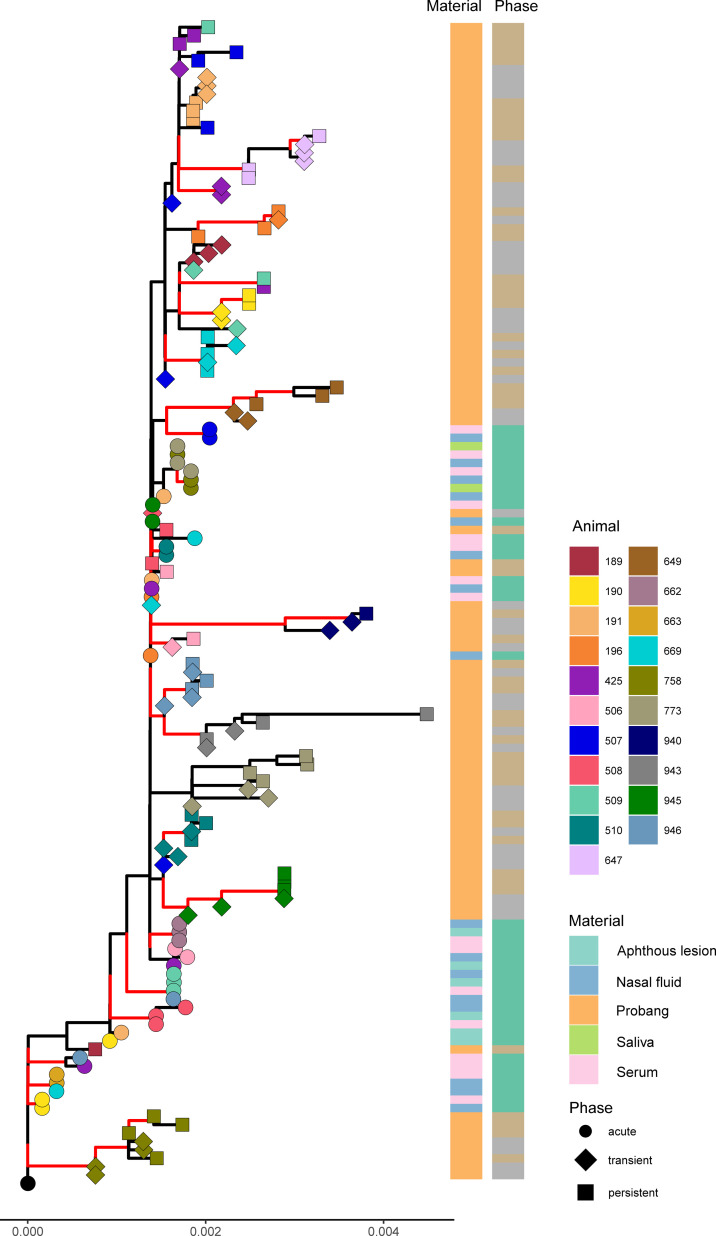
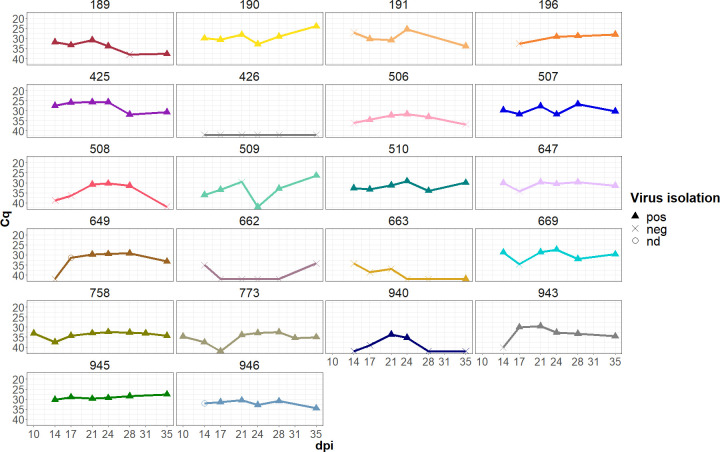
Like other RNA viruses, foot-and-mouth disease virus (FMDV) has a high mutation rate. After the acute phase of infection, about half of infected cattle develop a persistent FMDV infection that can last for weeks or months. During this persistent phase, the virus continues to replicate, resulting in the emergence of genomic heterogeneity. We have documented the pattern of mutations in the persistent phase by obtaining consensus-level sequences directly from oropharyngeal fluid (OPF) without prior virus isolation in culture. OPF samples were repeatedly collected from 22 experimentally infected cattle, 20 of which were virus positive in the OPF on day 21 after infection or later. We observed that during the persistent phase, the amount of non-synonymous mutations causing an amino acid change increased over time. Two amino acid changes that showed a striking increase during the persistent phase, VP3 A75T and VP2 Y79H, were present neither in the inoculum nor during the acute phase. Another amino acid change in VP3, R56C, which was previously implicated in FMDV pathogenicity, was already present in the inoculum and dominated toward the end of the trial in most samples. Several other amino acid changes occurred, particularly on the surface of VP2 around residue VP2 79. By functional analysis, we show that the persistent isolates evolve distinctly compared with cell culture adaptation but do not show signs of antigenic escape from neutralizing antibodies. In agreement with previous observations, we conclude that these amino acid changes are indeed associated with persistent infection of cattle with FMDV serotype O.
Importance: Our research article describes the genetic changes that occur during the acute and persistent foot-and-mouth disease (FMDV) infection. This is of particular interest to understand viral dynamics within an infected population from which new viral strains could emerge. Especially FMDV, with its high antigenic diversity and very limited cross-reactivity between strains and serotypes, has already demonstrated in the past that new variants can quickly emerge and evade vaccine responses. In our study, we have observed that this dynamic evolution continues during the persistent phase. Persistently infected animals, which are clinically indistinguishable from healthy animals, also pose a reservoir for recombination. A better understanding of viral dynamics is essential for improved vaccines to prevent the emergence of antigenic variants.
期刊介绍:
Journal of Virology (JVI) explores the nature of the viruses of animals, archaea, bacteria, fungi, plants, and protozoa. We welcome papers on virion structure and assembly, viral genome replication and regulation of gene expression, genetic diversity and evolution, virus-cell interactions, cellular responses to infection, transformation and oncogenesis, gene delivery, viral pathogenesis and immunity, and vaccines and antiviral agents.





 京公网安备 11010802042870号
京ICP备2023020795号-1
京公网安备 11010802042870号
京ICP备2023020795号-1

 分享
分享
 求助内容:
求助内容: 应助结果提醒方式:
 扫码关注我们
