Alejandro Mediavilla, Begoña Febrer-Sendra, Aroa Silgado, Patricia Martínez-Vallejo, Beatriz Crego-Vicente, Arlette Nindia, Carles Rubio Maturana, Lidia Goterris, Joan Martínez-Campreciós, Sandra Aixut, Pedro Fernández-Soto, María Luisa Aznar, Antonio Muro, Inés Oliveira-Souto, Israel Molina, Elena Sulleiro
{"title":"Evaluation of dried blood spot sampling for real-time PCR malaria diagnostics in a rural setting in Angola.","authors":"Alejandro Mediavilla, Begoña Febrer-Sendra, Aroa Silgado, Patricia Martínez-Vallejo, Beatriz Crego-Vicente, Arlette Nindia, Carles Rubio Maturana, Lidia Goterris, Joan Martínez-Campreciós, Sandra Aixut, Pedro Fernández-Soto, María Luisa Aznar, Antonio Muro, Inés Oliveira-Souto, Israel Molina, Elena Sulleiro","doi":"10.1186/s13071-025-06685-3","DOIUrl":null,"url":null,"abstract":"<p><strong>Background: </strong>Malaria is the parasitic disease with the highest morbidity and mortality worldwide. Angola is one of the five sub-Saharan African countries with the highest malaria burden. Real-time PCR diagnosis in endemic areas has not been implemented due to its high cost and the need for adequate infrastructure. Dried blood spots (DBSs) are an alternative for collecting, preserving, and transporting blood samples to reference laboratories. The objective of the study was to assess the efficacy of DBS as a sampling method for malaria research studies employing real-time PCR.</p><p><strong>Methods: </strong>The study was divided into two phases: (i) prospective study at the Hospital Universitario Vall d'Hebron (HUVH) to compare real-time PCR from whole blood or DBS, including 12 venous blood samples from patients with positive real-time PCR for Plasmodium spp. and 10 quality control samples (nine infected samples and one negative control). Samples were collected as DBSs (10, 20, 50 µl/circle). Samples from both phases of the study were analyzed by generic real-time PCR (Plasmodium spp.) and the subsequent positive samples underwent species-specific real-time PCR (Plasmodium species) and (ii) cross-sectional study conducted at the Hospital Nossa Senhora da Paz, Cubal (Angola), including 200 participants with fever. For each patient, a fresh capillary blood specimen [for thin and thick blood films and rapid diagnostic test (RDT)] and venous blood, collected as DBSs (two 10-µl circles were combined for a total volume of 20 µl of DBS), were obtained. DBSs were sent to HUVH, Barcelona, Spain.</p><p><strong>Results: </strong>(i) Real-time PCR from whole blood collection was positive for 100% of the 21 Plasmodium spp.-infected samples, whereas real-time PCR from DBSs detected Plasmodium spp. infection at lower proportions: 76.19% (16/21) for 10 µl, 85.71% (18/21) for 20 µl, 88.24% (15/17) for 50 µl and 85.71% (18/21) for 100 µl DBSs. (ii) Field diagnosis (microscopy and/or RDT) showed a 51.5% (103/200) positivity rate, while 50% (100/200) of the DBS samples tested positive by real-time PCR. Using field diagnosis as the reference method, the sensitivity of real-time PCR in DBS samples was 77.67% with a specificity of 79.38%. Plasmodium species were identified in 86 samples by real-time PCR: 81.40% (16/86) were caused by Plasmodium falciparum, 11.63% (10/86) were coinfections of P. falciparum + P. malariae, 4.65% (4/86) were P. falciparum + P. ovale, and 2.33% (2/86) were triple coinfections.</p><p><strong>Conclusions: </strong>The DBS volume used for DNA extraction is a determining factor in the performance of real-time PCR for Plasmodium DNA detection. A DBS volume of 50-100 µl appears to be optimal for malaria diagnosis and Plasmodium species determination by real-time PCR. DBS is a suitable method for sample collection in Cubal followed by real-time PCR analysis in a reference laboratory.</p>","PeriodicalId":19793,"journal":{"name":"Parasites & Vectors","volume":"18 1","pages":"44"},"PeriodicalIF":3.5000,"publicationDate":"2025-02-07","publicationTypes":"Journal Article","fieldsOfStudy":null,"isOpenAccess":false,"openAccessPdf":"https://www.ncbi.nlm.nih.gov/pmc/articles/PMC11803990/pdf/","citationCount":"0","resultStr":null,"platform":"Semanticscholar","paperid":null,"PeriodicalName":"Parasites & Vectors","FirstCategoryId":"3","ListUrlMain":"https://doi.org/10.1186/s13071-025-06685-3","RegionNum":2,"RegionCategory":"医学","ArticlePicture":[],"TitleCN":null,"AbstractTextCN":null,"PMCID":null,"EPubDate":"","PubModel":"","JCR":"Q1","JCRName":"PARASITOLOGY","Score":null,"Total":0}
引用次数: 0
Abstract
Background: Malaria is the parasitic disease with the highest morbidity and mortality worldwide. Angola is one of the five sub-Saharan African countries with the highest malaria burden. Real-time PCR diagnosis in endemic areas has not been implemented due to its high cost and the need for adequate infrastructure. Dried blood spots (DBSs) are an alternative for collecting, preserving, and transporting blood samples to reference laboratories. The objective of the study was to assess the efficacy of DBS as a sampling method for malaria research studies employing real-time PCR.
Methods: The study was divided into two phases: (i) prospective study at the Hospital Universitario Vall d'Hebron (HUVH) to compare real-time PCR from whole blood or DBS, including 12 venous blood samples from patients with positive real-time PCR for Plasmodium spp. and 10 quality control samples (nine infected samples and one negative control). Samples were collected as DBSs (10, 20, 50 µl/circle). Samples from both phases of the study were analyzed by generic real-time PCR (Plasmodium spp.) and the subsequent positive samples underwent species-specific real-time PCR (Plasmodium species) and (ii) cross-sectional study conducted at the Hospital Nossa Senhora da Paz, Cubal (Angola), including 200 participants with fever. For each patient, a fresh capillary blood specimen [for thin and thick blood films and rapid diagnostic test (RDT)] and venous blood, collected as DBSs (two 10-µl circles were combined for a total volume of 20 µl of DBS), were obtained. DBSs were sent to HUVH, Barcelona, Spain.
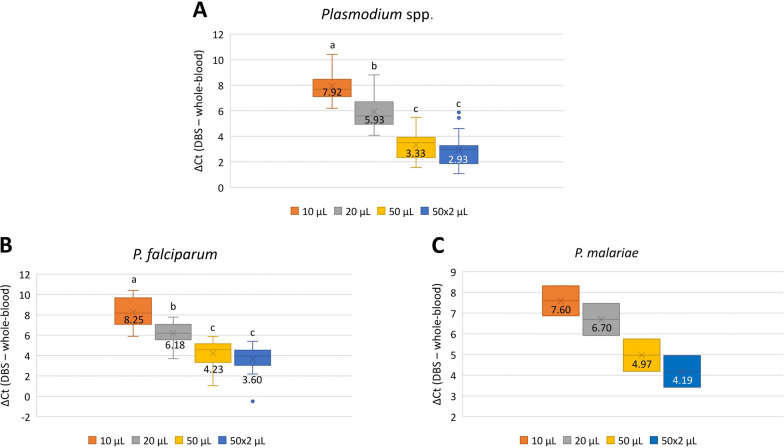
Results: (i) Real-time PCR from whole blood collection was positive for 100% of the 21 Plasmodium spp.-infected samples, whereas real-time PCR from DBSs detected Plasmodium spp. infection at lower proportions: 76.19% (16/21) for 10 µl, 85.71% (18/21) for 20 µl, 88.24% (15/17) for 50 µl and 85.71% (18/21) for 100 µl DBSs. (ii) Field diagnosis (microscopy and/or RDT) showed a 51.5% (103/200) positivity rate, while 50% (100/200) of the DBS samples tested positive by real-time PCR. Using field diagnosis as the reference method, the sensitivity of real-time PCR in DBS samples was 77.67% with a specificity of 79.38%. Plasmodium species were identified in 86 samples by real-time PCR: 81.40% (16/86) were caused by Plasmodium falciparum, 11.63% (10/86) were coinfections of P. falciparum + P. malariae, 4.65% (4/86) were P. falciparum + P. ovale, and 2.33% (2/86) were triple coinfections.
Conclusions: The DBS volume used for DNA extraction is a determining factor in the performance of real-time PCR for Plasmodium DNA detection. A DBS volume of 50-100 µl appears to be optimal for malaria diagnosis and Plasmodium species determination by real-time PCR. DBS is a suitable method for sample collection in Cubal followed by real-time PCR analysis in a reference laboratory.
期刊介绍:
Parasites & Vectors is an open access, peer-reviewed online journal dealing with the biology of parasites, parasitic diseases, intermediate hosts, vectors and vector-borne pathogens. Manuscripts published in this journal will be available to all worldwide, with no barriers to access, immediately following acceptance. However, authors retain the copyright of their material and may use it, or distribute it, as they wish.
Manuscripts on all aspects of the basic and applied biology of parasites, intermediate hosts, vectors and vector-borne pathogens will be considered. In addition to the traditional and well-established areas of science in these fields, we also aim to provide a vehicle for publication of the rapidly developing resources and technology in parasite, intermediate host and vector genomics and their impacts on biological research. We are able to publish large datasets and extensive results, frequently associated with genomic and post-genomic technologies, which are not readily accommodated in traditional journals. Manuscripts addressing broader issues, for example economics, social sciences and global climate change in relation to parasites, vectors and disease control, are also welcomed.





 京公网安备 11010802042870号
京ICP备2023020795号-1
京公网安备 11010802042870号
京ICP备2023020795号-1

 分享
分享
 求助内容:
求助内容: 应助结果提醒方式:
 扫码关注我们
