Youngju Kim, Hironori Taniguchi, Kotoba Okuyama, Junpei Kamimoto, Kenji Kawakami
{"title":"Pneumococcal vaccination in elderly care facilities in Japan: A cross-sectional, web-based survey.","authors":"Youngju Kim, Hironori Taniguchi, Kotoba Okuyama, Junpei Kamimoto, Kenji Kawakami","doi":"10.1080/21645515.2025.2461814","DOIUrl":null,"url":null,"abstract":"<p><p>This study evaluated pneumococcal vaccination status using evaluable data collected from 445 of 1,313 managing directors of elderly care facilities in Japan through an online survey (September 5, 2022-November 25, 2022; UMIN000048747); comparisons were made with the influenza (2021-2022 vaccination only) and coronavirus disease 2019 (COVID-19) vaccination status. Among facilities who kept pneumococcal vaccination records (<i>n</i> = 42), the mean pneumococcal vaccination rate was 31.1%, with the rate being higher for the influenza (93.1%; <i>n</i> = 234) and COVID-19 (94.3%; <i>n</i> = 285) vaccines. Overall, excluding facilities that answered that the corresponding vaccine status at their sites was unknown, the percentage of facilities with high vaccination rates (80% to 100%) was substantially higher for the influenza (80.5%; 351/436) and COVID-19 (89.6%; 396/442) vaccines than for the pneumococcal vaccine (6.5%; 24/370). Multivariable analysis showed that major factors associated with a high pneumococcal vaccination rate (≥15%) were \"managing director's willingness to recommend\" and \"pneumococcal vaccination request from the residents.\" The most common reason for their willingness to recommend the pneumococcal vaccine was that it is an effective disease prevention strategy (83.3%; 65/78) and for their unwillingness to recommend the pneumococcal vaccine was the inability to understand the effectiveness of the vaccine (43.6%; 17/39). In conclusion, there is a need to improve pneumococcal vaccination rates in elderly care facilities in Japan. Strategies such as increasing awareness and encouraging pneumococcal vaccine recommendation among managing directors, especially for residents not eligible for the national subsidy program, and providing regular training on the pneumococcal vaccine for staff and residents are required.</p>","PeriodicalId":49067,"journal":{"name":"Human Vaccines & Immunotherapeutics","volume":"21 1","pages":"2461814"},"PeriodicalIF":3.5000,"publicationDate":"2025-12-01","publicationTypes":"Journal Article","fieldsOfStudy":null,"isOpenAccess":false,"openAccessPdf":"https://www.ncbi.nlm.nih.gov/pmc/articles/PMC11810092/pdf/","citationCount":"0","resultStr":null,"platform":"Semanticscholar","paperid":null,"PeriodicalName":"Human Vaccines & Immunotherapeutics","FirstCategoryId":"3","ListUrlMain":"https://doi.org/10.1080/21645515.2025.2461814","RegionNum":4,"RegionCategory":"医学","ArticlePicture":[],"TitleCN":null,"AbstractTextCN":null,"PMCID":null,"EPubDate":"2025/2/7 0:00:00","PubModel":"Epub","JCR":"Q2","JCRName":"BIOTECHNOLOGY & APPLIED MICROBIOLOGY","Score":null,"Total":0}
引用次数: 0
Abstract
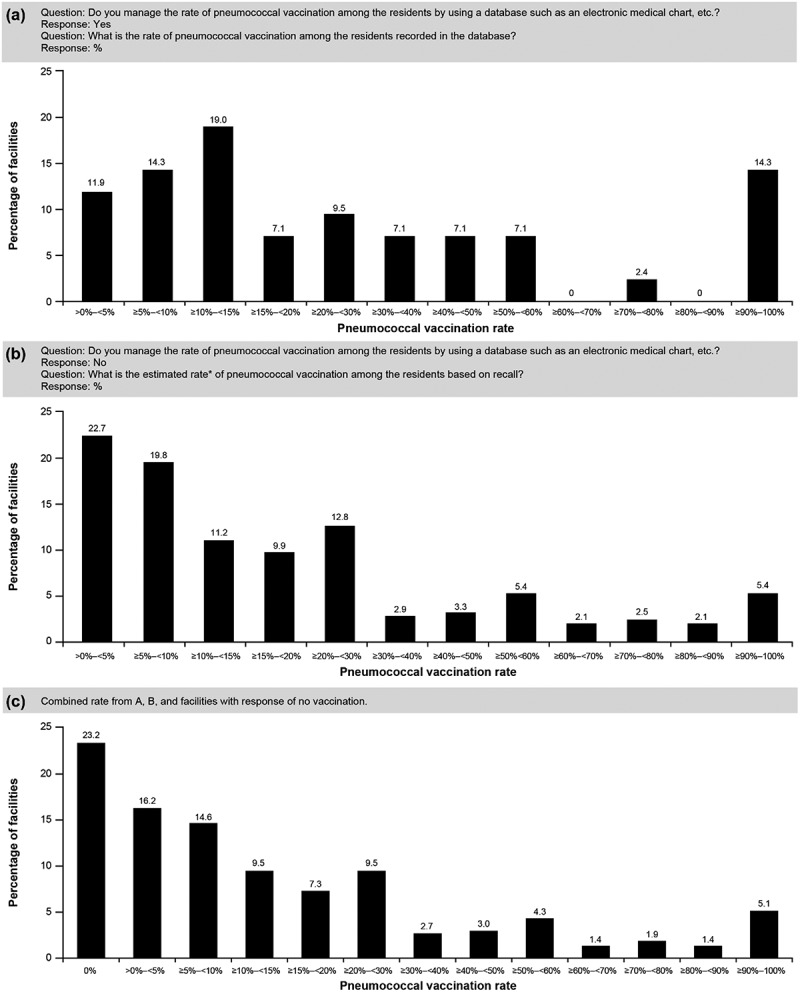
This study evaluated pneumococcal vaccination status using evaluable data collected from 445 of 1,313 managing directors of elderly care facilities in Japan through an online survey (September 5, 2022-November 25, 2022; UMIN000048747); comparisons were made with the influenza (2021-2022 vaccination only) and coronavirus disease 2019 (COVID-19) vaccination status. Among facilities who kept pneumococcal vaccination records (n = 42), the mean pneumococcal vaccination rate was 31.1%, with the rate being higher for the influenza (93.1%; n = 234) and COVID-19 (94.3%; n = 285) vaccines. Overall, excluding facilities that answered that the corresponding vaccine status at their sites was unknown, the percentage of facilities with high vaccination rates (80% to 100%) was substantially higher for the influenza (80.5%; 351/436) and COVID-19 (89.6%; 396/442) vaccines than for the pneumococcal vaccine (6.5%; 24/370). Multivariable analysis showed that major factors associated with a high pneumococcal vaccination rate (≥15%) were "managing director's willingness to recommend" and "pneumococcal vaccination request from the residents." The most common reason for their willingness to recommend the pneumococcal vaccine was that it is an effective disease prevention strategy (83.3%; 65/78) and for their unwillingness to recommend the pneumococcal vaccine was the inability to understand the effectiveness of the vaccine (43.6%; 17/39). In conclusion, there is a need to improve pneumococcal vaccination rates in elderly care facilities in Japan. Strategies such as increasing awareness and encouraging pneumococcal vaccine recommendation among managing directors, especially for residents not eligible for the national subsidy program, and providing regular training on the pneumococcal vaccine for staff and residents are required.
期刊介绍:
(formerly Human Vaccines; issn 1554-8619)
Vaccine research and development is extending its reach beyond the prevention of bacterial or viral diseases. There are experimental vaccines for immunotherapeutic purposes and for applications outside of infectious diseases, in diverse fields such as cancer, autoimmunity, allergy, Alzheimer’s and addiction. Many of these vaccines and immunotherapeutics should become available in the next two decades, with consequent benefit for human health. Continued advancement in this field will benefit from a forum that can (A) help to promote interest by keeping investigators updated, and (B) enable an exchange of ideas regarding the latest progress in the many topics pertaining to vaccines and immunotherapeutics.
Human Vaccines & Immunotherapeutics provides such a forum. It is published monthly in a format that is accessible to a wide international audience in the academic, industrial and public sectors.



 京公网安备 11010802042870号
京ICP备2023020795号-1
京公网安备 11010802042870号
京ICP备2023020795号-1

 分享
分享
 求助内容:
求助内容: 应助结果提醒方式:
 扫码关注我们
