Ari Brouwer, Joshua K Brown, Earth Erowid, Fire Erowid, Sylvia Thyssen, Charles L Raison, Robin L Carhart-Harris
{"title":"A qualitative analysis of the psychedelic mushroom come-up and come-down.","authors":"Ari Brouwer, Joshua K Brown, Earth Erowid, Fire Erowid, Sylvia Thyssen, Charles L Raison, Robin L Carhart-Harris","doi":"10.1038/s44184-024-00095-6","DOIUrl":null,"url":null,"abstract":"<p><p>Psychedelic therapy has the potential to become a revolutionary and transdiagnostic mental health treatment, yielding enduring benefits that are often attributed to the experiences that coincide with peak psychedelic effects. However, there may be an underrecognized temporal structure to this process that helps explain why psychedelic and related altered states of consciousness can have an initially distressing but ultimately distress-resolving effect. Here we present a qualitative analysis of the self-reported 'come-up' or onset phase, and 'come-down' or falling phase, of the psychedelic experience. Focusing on psilocybin or psilocybin-containing mushroom experience reports submitted to Erowid.org, we use phenomenological, thematic content and word frequency analysis to show that the come-up is more often characterized by negatively valenced feeling states that resemble an acute stress reaction, while the come-down phase is more often characterized by positively valenced feeling states of the sort often observed following recovery from illness or resolution of stress. The therapeutic and theoretical relevance of these findings are discussed.</p>","PeriodicalId":74321,"journal":{"name":"Npj mental health research","volume":"4 1","pages":"6"},"PeriodicalIF":0.0000,"publicationDate":"2025-02-07","publicationTypes":"Journal Article","fieldsOfStudy":null,"isOpenAccess":false,"openAccessPdf":"https://www.ncbi.nlm.nih.gov/pmc/articles/PMC11802880/pdf/","citationCount":"0","resultStr":null,"platform":"Semanticscholar","paperid":null,"PeriodicalName":"Npj mental health research","FirstCategoryId":"1085","ListUrlMain":"https://doi.org/10.1038/s44184-024-00095-6","RegionNum":0,"RegionCategory":null,"ArticlePicture":[],"TitleCN":null,"AbstractTextCN":null,"PMCID":null,"EPubDate":"","PubModel":"","JCR":"","JCRName":"","Score":null,"Total":0}
引用次数: 0
Abstract
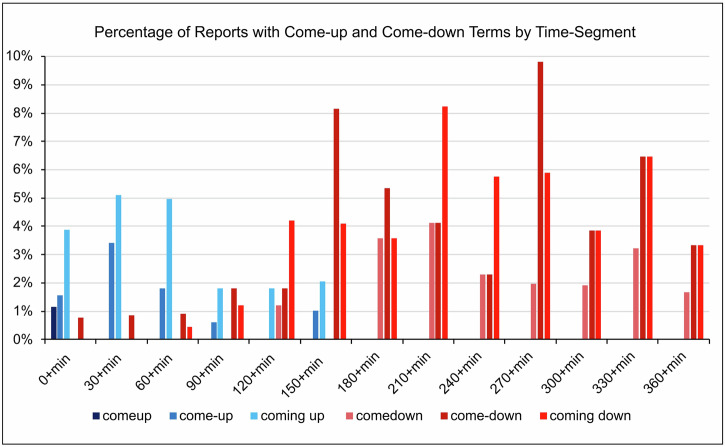
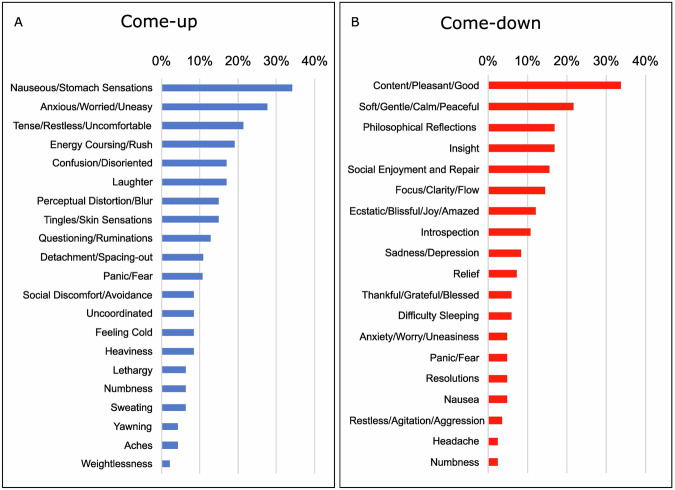
Psychedelic therapy has the potential to become a revolutionary and transdiagnostic mental health treatment, yielding enduring benefits that are often attributed to the experiences that coincide with peak psychedelic effects. However, there may be an underrecognized temporal structure to this process that helps explain why psychedelic and related altered states of consciousness can have an initially distressing but ultimately distress-resolving effect. Here we present a qualitative analysis of the self-reported 'come-up' or onset phase, and 'come-down' or falling phase, of the psychedelic experience. Focusing on psilocybin or psilocybin-containing mushroom experience reports submitted to Erowid.org, we use phenomenological, thematic content and word frequency analysis to show that the come-up is more often characterized by negatively valenced feeling states that resemble an acute stress reaction, while the come-down phase is more often characterized by positively valenced feeling states of the sort often observed following recovery from illness or resolution of stress. The therapeutic and theoretical relevance of these findings are discussed.



 京公网安备 11010802042870号
京ICP备2023020795号-1
京公网安备 11010802042870号
京ICP备2023020795号-1

 分享
分享

 求助内容:
求助内容: 应助结果提醒方式:
 扫码关注我们
