Francisco J Pérez-Reche, Nathan J Cheetham, Ruth C E Bowyer, Ellen J Thompson, Francesca Tettamanzi, Cristina Menni, Claire J Steves
{"title":"ESPClust: unsupervised identification of modifiers for the effect size profile in omics association studies.","authors":"Francisco J Pérez-Reche, Nathan J Cheetham, Ruth C E Bowyer, Ellen J Thompson, Francesca Tettamanzi, Cristina Menni, Claire J Steves","doi":"10.1093/bioinformatics/btaf065","DOIUrl":null,"url":null,"abstract":"<p><strong>Motivation: </strong>High-throughput omics technologies have revolutionized the identification of associations between individual traits and underlying biological characteristics, but still use 'one effect-size fits all' approaches. While covariates are often used, their potential as effect modifiers often remains unexplored.</p><p><strong>Results: </strong>We propose ESPClust, a novel unsupervised method designed to identify covariates that modify the effect size of associations between sets of omics variables and outcomes. By extending the concept of moderators to encompass multiple exposures, ESPClust analyses the effect size profile (ESP) to identify regions in covariate space with different ESP, enabling the discovery of subpopulations with distinct associations. Applying ESPClust to synthetic data, insulin resistance and COVID-19 symptom manifestation, we demonstrate its versatility and ability to uncover nuanced effect size modifications that traditional analyses may overlook. By integrating information from multiple exposures, ESPClust identifies effect size modifiers in datasets that are too small for traditional univariate stratified analyses. This method provides a robust framework for understanding complex omics data and holds promise for personalised medicine.</p><p><strong>Availability and implementation: </strong>The source code ESPClust is available at https://github.com/fjpreche/ESPClust.git. It can be installed via Python package repositories as 'pip install ESPClust==1.1.0'.</p>","PeriodicalId":93899,"journal":{"name":"Bioinformatics (Oxford, England)","volume":" ","pages":""},"PeriodicalIF":5.4000,"publicationDate":"2025-02-04","publicationTypes":"Journal Article","fieldsOfStudy":null,"isOpenAccess":false,"openAccessPdf":"https://www.ncbi.nlm.nih.gov/pmc/articles/PMC11879214/pdf/","citationCount":"0","resultStr":null,"platform":"Semanticscholar","paperid":null,"PeriodicalName":"Bioinformatics (Oxford, England)","FirstCategoryId":"1085","ListUrlMain":"https://doi.org/10.1093/bioinformatics/btaf065","RegionNum":0,"RegionCategory":null,"ArticlePicture":[],"TitleCN":null,"AbstractTextCN":null,"PMCID":null,"EPubDate":"","PubModel":"","JCR":"","JCRName":"","Score":null,"Total":0}
引用次数: 0
Abstract
Motivation: High-throughput omics technologies have revolutionized the identification of associations between individual traits and underlying biological characteristics, but still use 'one effect-size fits all' approaches. While covariates are often used, their potential as effect modifiers often remains unexplored.
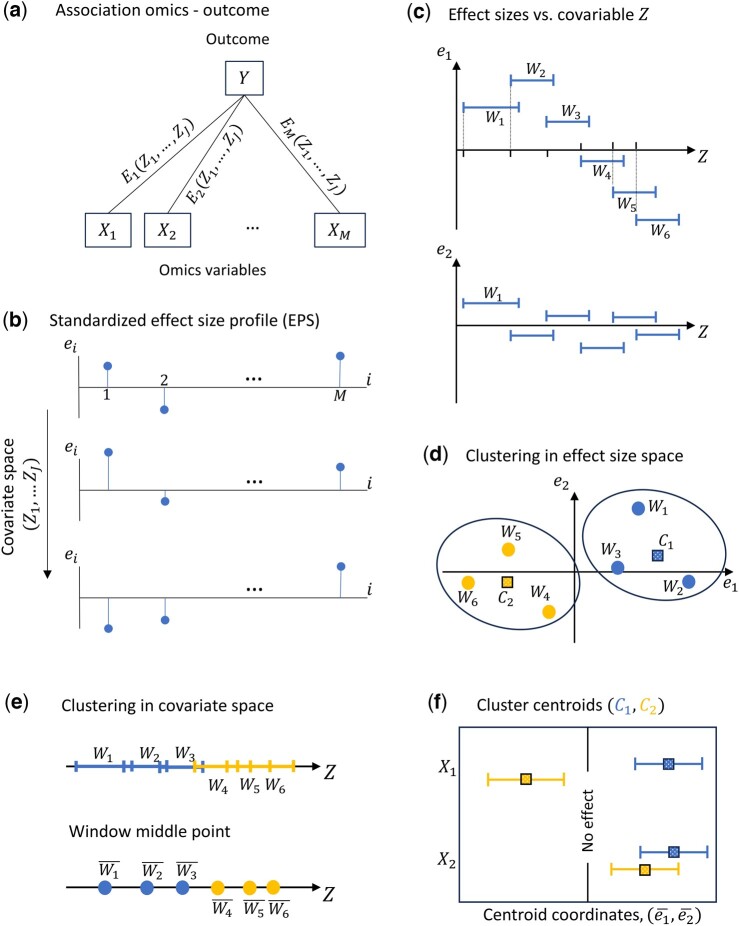
Results: We propose ESPClust, a novel unsupervised method designed to identify covariates that modify the effect size of associations between sets of omics variables and outcomes. By extending the concept of moderators to encompass multiple exposures, ESPClust analyses the effect size profile (ESP) to identify regions in covariate space with different ESP, enabling the discovery of subpopulations with distinct associations. Applying ESPClust to synthetic data, insulin resistance and COVID-19 symptom manifestation, we demonstrate its versatility and ability to uncover nuanced effect size modifications that traditional analyses may overlook. By integrating information from multiple exposures, ESPClust identifies effect size modifiers in datasets that are too small for traditional univariate stratified analyses. This method provides a robust framework for understanding complex omics data and holds promise for personalised medicine.
Availability and implementation: The source code ESPClust is available at https://github.com/fjpreche/ESPClust.git. It can be installed via Python package repositories as 'pip install ESPClust==1.1.0'.




 京公网安备 11010802042870号
京ICP备2023020795号-1
京公网安备 11010802042870号
京ICP备2023020795号-1

 分享
分享

 求助内容:
求助内容: 应助结果提醒方式:
 扫码关注我们
