Carolina Veloso Lima, Alanna Barros de Arruda, Mayara Dos Santos Noronha, Aline Araujo Sampaio, Marise Fagundes Silveira, Andrea Maria Eleuterio de Barros Lima Martins, Raquel Conceição Ferreira, Aline Netto de Godoy, Daniela Marques da Silva Sousa, Patrick Pereira Garcia, Cyrene Piazera Silva Costa, João Gabriel Silva Souza, Bárbara Emanoele Costa Oliveira
{"title":"Income-related inequalities in the prevalence of dental pain intensity in adults: gender differences.","authors":"Carolina Veloso Lima, Alanna Barros de Arruda, Mayara Dos Santos Noronha, Aline Araujo Sampaio, Marise Fagundes Silveira, Andrea Maria Eleuterio de Barros Lima Martins, Raquel Conceição Ferreira, Aline Netto de Godoy, Daniela Marques da Silva Sousa, Patrick Pereira Garcia, Cyrene Piazera Silva Costa, João Gabriel Silva Souza, Bárbara Emanoele Costa Oliveira","doi":"10.3389/froh.2025.1510345","DOIUrl":null,"url":null,"abstract":"<p><strong>Introduction: </strong>Dental pain is a multifactorial and unpleasant experience that negatively affects daily activities. Previous studies have shown that adults living in socioeconomically disadvantaged areas showed higher dental pain prevalence. This study evaluated whether income inequalities are related to increased dental pain intensity among adults and identified differences between women and men.</p><p><strong>Methods: </strong>A probabilistic sample of adults was investigated, and income inequality was evaluated using the Gini Index. Dental pain intensity was recorded on a scale from 1-10 for those who experienced dental pain in the 6 months preceding the survey. The covariates were contextual (related to cities) and individual (related to individuals). Associations were investigated for the entire sample and stratified by gender using multilevel Poisson regression models.</p><p><strong>Results: </strong>Dental pain was reported by 41% of the included sample (<i>n</i> = 4,512 adults). Maximum pain intensity was reported more frequently for women than for men. Those living in municipalities with higher Gini Index values reported 1.26 times (95% CI: 1.01-1.56) greater dental pain intensity compared to adults living in cities with lower Gini Index values, even after adjustment by variables. The same pattern was observed when stratified by gender, but it was not statistically significant.</p><p><strong>Conclusion: </strong>Thus, the contexts of income inequalities can contribute to more severe dental pain intensity among adults. Also, the findings suggest that income inequality does not modify the relationship between gender and dental pain intensity.</p>","PeriodicalId":94016,"journal":{"name":"Frontiers in oral health","volume":"6 ","pages":"1510345"},"PeriodicalIF":3.1000,"publicationDate":"2025-01-23","publicationTypes":"Journal Article","fieldsOfStudy":null,"isOpenAccess":false,"openAccessPdf":"https://www.ncbi.nlm.nih.gov/pmc/articles/PMC11800115/pdf/","citationCount":"0","resultStr":null,"platform":"Semanticscholar","paperid":null,"PeriodicalName":"Frontiers in oral health","FirstCategoryId":"1085","ListUrlMain":"https://doi.org/10.3389/froh.2025.1510345","RegionNum":0,"RegionCategory":null,"ArticlePicture":[],"TitleCN":null,"AbstractTextCN":null,"PMCID":null,"EPubDate":"2025/1/1 0:00:00","PubModel":"eCollection","JCR":"Q1","JCRName":"DENTISTRY, ORAL SURGERY & MEDICINE","Score":null,"Total":0}
引用次数: 0
Abstract
Introduction: Dental pain is a multifactorial and unpleasant experience that negatively affects daily activities. Previous studies have shown that adults living in socioeconomically disadvantaged areas showed higher dental pain prevalence. This study evaluated whether income inequalities are related to increased dental pain intensity among adults and identified differences between women and men.
Methods: A probabilistic sample of adults was investigated, and income inequality was evaluated using the Gini Index. Dental pain intensity was recorded on a scale from 1-10 for those who experienced dental pain in the 6 months preceding the survey. The covariates were contextual (related to cities) and individual (related to individuals). Associations were investigated for the entire sample and stratified by gender using multilevel Poisson regression models.
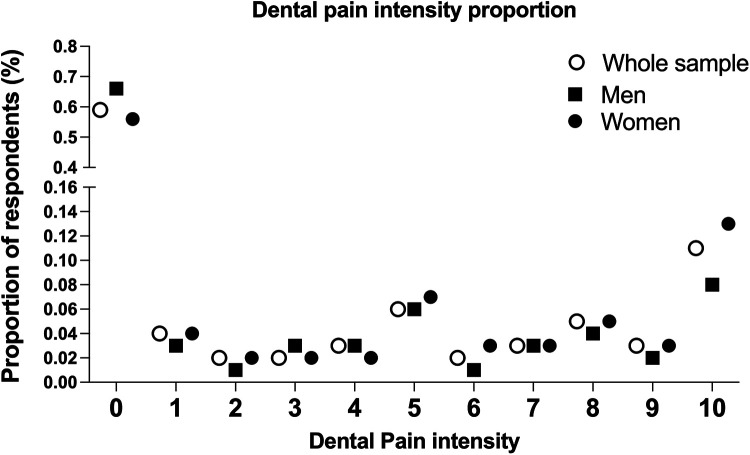
Results: Dental pain was reported by 41% of the included sample (n = 4,512 adults). Maximum pain intensity was reported more frequently for women than for men. Those living in municipalities with higher Gini Index values reported 1.26 times (95% CI: 1.01-1.56) greater dental pain intensity compared to adults living in cities with lower Gini Index values, even after adjustment by variables. The same pattern was observed when stratified by gender, but it was not statistically significant.
Conclusion: Thus, the contexts of income inequalities can contribute to more severe dental pain intensity among adults. Also, the findings suggest that income inequality does not modify the relationship between gender and dental pain intensity.




 京公网安备 11010802042870号
京ICP备2023020795号-1
京公网安备 11010802042870号
京ICP备2023020795号-1

 分享
分享

 求助内容:
求助内容: 应助结果提醒方式:
 扫码关注我们
