M. Bocharova, T. Borza, L. O. Watne, K. Engedal, J. T. O’Brien, G. Selbæk, A. V. Idland, J. Hodsoll, A. H. Young, D. Aarsland
{"title":"The role of plasma inflammatory markers in late-life depression and conversion to dementia: a 3-year follow-up study","authors":"M. Bocharova, T. Borza, L. O. Watne, K. Engedal, J. T. O’Brien, G. Selbæk, A. V. Idland, J. Hodsoll, A. H. Young, D. Aarsland","doi":"10.1038/s41380-025-02908-2","DOIUrl":null,"url":null,"abstract":"Late-life depression (LLD) has been linked to increased likelihood of dementia, although mechanisms responsible for this association remain largely unknown. One feature frequently observed in both LLD and dementia is elevated levels of plasma inflammatory markers. The present study aimed to compare the levels of 12 plasma inflammatory markers between older people with LLD and controls, and to explore whether these markers, along with clinical characteristics, can predict dementia in patients with LLD within 3 years of follow-up. Using multiple linear regression with stepwise adjustment, we compared levels of plasma inflammatory markers (IL-1β, IL-1ra, IL-6, IL-10, IL-17a, IL-18, IL-33, TNFα, CD40L, IFN-γ, CCL-2 and CCL-4) between 136 inpatients with LLD (PRODE cohort) and 103 cognitively healthy non-depressed controls (COGNORM cohort). In the PRODE cohort, follow-up data was available for 139 patients (of them 123 had data on baseline plasma inflammatory markers); 36 (25.9%) developed dementia by Year 3 (n = 31 for those with cytokine data). Using Cox proportional hazards regression, we explored whether inflammatory markers and clinical characteristics of LLD (age of onset, treatment response, number of episodes) predicted progression to dementia during follow-up. Levels of IL-1ra, CCL-2, CCL-4, IFN-γ and IL-17a were significantly higher in LLD patients compared to controls in the majority of models. However, none of the inflammatory markers predicted progression from LLD to dementia in the PRODE cohort. Among clinical features, only poor response to treatment significantly predicted higher risk of progression to dementia.","PeriodicalId":19008,"journal":{"name":"Molecular Psychiatry","volume":"30 7","pages":"3029-3038"},"PeriodicalIF":10.1000,"publicationDate":"2025-02-08","publicationTypes":"Journal Article","fieldsOfStudy":null,"isOpenAccess":false,"openAccessPdf":"https://www.nature.comhttps://www.nature.com/articles/s41380-025-02908-2.pdf","citationCount":"0","resultStr":null,"platform":"Semanticscholar","paperid":null,"PeriodicalName":"Molecular Psychiatry","FirstCategoryId":"3","ListUrlMain":"https://www.nature.com/articles/s41380-025-02908-2","RegionNum":1,"RegionCategory":"医学","ArticlePicture":[],"TitleCN":null,"AbstractTextCN":null,"PMCID":null,"EPubDate":"","PubModel":"","JCR":"Q1","JCRName":"BIOCHEMISTRY & MOLECULAR BIOLOGY","Score":null,"Total":0}
引用次数: 0
Abstract
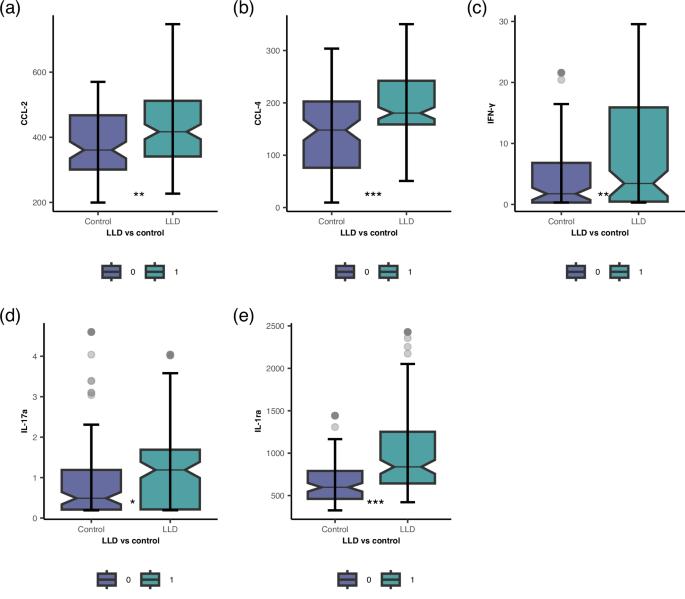
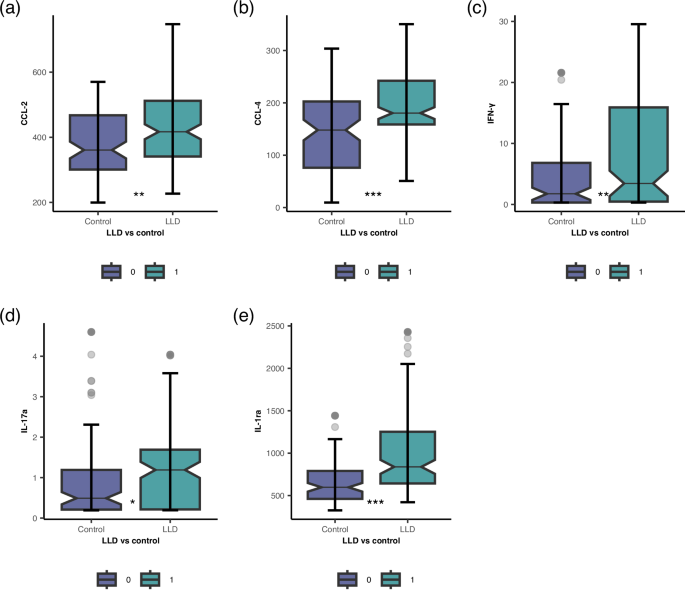
Late-life depression (LLD) has been linked to increased likelihood of dementia, although mechanisms responsible for this association remain largely unknown. One feature frequently observed in both LLD and dementia is elevated levels of plasma inflammatory markers. The present study aimed to compare the levels of 12 plasma inflammatory markers between older people with LLD and controls, and to explore whether these markers, along with clinical characteristics, can predict dementia in patients with LLD within 3 years of follow-up. Using multiple linear regression with stepwise adjustment, we compared levels of plasma inflammatory markers (IL-1β, IL-1ra, IL-6, IL-10, IL-17a, IL-18, IL-33, TNFα, CD40L, IFN-γ, CCL-2 and CCL-4) between 136 inpatients with LLD (PRODE cohort) and 103 cognitively healthy non-depressed controls (COGNORM cohort). In the PRODE cohort, follow-up data was available for 139 patients (of them 123 had data on baseline plasma inflammatory markers); 36 (25.9%) developed dementia by Year 3 (n = 31 for those with cytokine data). Using Cox proportional hazards regression, we explored whether inflammatory markers and clinical characteristics of LLD (age of onset, treatment response, number of episodes) predicted progression to dementia during follow-up. Levels of IL-1ra, CCL-2, CCL-4, IFN-γ and IL-17a were significantly higher in LLD patients compared to controls in the majority of models. However, none of the inflammatory markers predicted progression from LLD to dementia in the PRODE cohort. Among clinical features, only poor response to treatment significantly predicted higher risk of progression to dementia.
期刊介绍:
Molecular Psychiatry focuses on publishing research that aims to uncover the biological mechanisms behind psychiatric disorders and their treatment. The journal emphasizes studies that bridge pre-clinical and clinical research, covering cellular, molecular, integrative, clinical, imaging, and psychopharmacology levels.



 京公网安备 11010802042870号
京ICP备2023020795号-1
京公网安备 11010802042870号
京ICP备2023020795号-1

 分享
分享
 求助内容:
求助内容: 应助结果提醒方式:
 扫码关注我们
