Xiaoyan Liu, Tingting Huang, Hui Ding, Juan Xiao, Xiaolan Fan, Zhiwei Yu, Li Zhang and Guancheng Xu
{"title":"Mn doping promotes deep surface reconstruction of CoP nanosheet arrays to drive efficient water splitting†","authors":"Xiaoyan Liu, Tingting Huang, Hui Ding, Juan Xiao, Xiaolan Fan, Zhiwei Yu, Li Zhang and Guancheng Xu","doi":"10.1039/D4QI02949F","DOIUrl":null,"url":null,"abstract":"<p >Among the non-precious metal electrocatalysts, transition metal phosphides (TMPs) show the greatest promise, but their activity and stability still fall short of expectations. Therefore, in order to improve the catalytic activity of TMPs, doping of heteroatoms with different electronegativities becomes one of the best methods. In this study, Mn<small><sub>10</sub></small>-doped CoP (the molar amount of Mn accounts for 10% of the total molar amount of metal salts) nanosheet arrays were successfully loaded on coal-based carbon nanofibers (CNFs) <em>via</em> electrodeposition and low-temperature phosphating. Experimentally, the generated electrocatalyst Mn<small><sub>10</sub></small>-CoP@CNFs demonstrated remarkable catalytic activity at 10 mA cm<small><sup>−2</sup></small> in 1 M KOH solution, which only needed overpotentials of 62 mV and 230 mV for the hydrogen evolution reaction (HER) and the oxygen evolution reaction (OER), respectively. <em>In situ</em> Raman spectroscopy was used to explore the active intermediates present under catalytic conditions. The results showed that the incorporation of Mn into CoP promoted the formation of the active layered intermediate CoOOH, thus improving the performance of the OER. Prominently, at a current density of 10 mA cm<small><sup>−2</sup></small>, the catalyst also exhibited durability of more than 80 hours and an extremely low voltage of 1.537 V when it was used as the full hydrolysis catalyst. This study provides a general approach for the production of high-performance and effective catalysts for water splitting.</p>","PeriodicalId":79,"journal":{"name":"Inorganic Chemistry Frontiers","volume":" 7","pages":" 2792-2804"},"PeriodicalIF":6.4000,"publicationDate":"2025-02-08","publicationTypes":"Journal Article","fieldsOfStudy":null,"isOpenAccess":false,"openAccessPdf":"","citationCount":"0","resultStr":null,"platform":"Semanticscholar","paperid":null,"PeriodicalName":"Inorganic Chemistry Frontiers","FirstCategoryId":"92","ListUrlMain":"https://pubs.rsc.org/en/content/articlelanding/2025/qi/d4qi02949f","RegionNum":1,"RegionCategory":"化学","ArticlePicture":[],"TitleCN":null,"AbstractTextCN":null,"PMCID":null,"EPubDate":"","PubModel":"","JCR":"Q1","JCRName":"CHEMISTRY, INORGANIC & NUCLEAR","Score":null,"Total":0}
引用次数: 0
Abstract
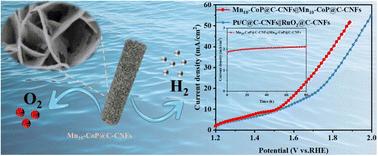
Among the non-precious metal electrocatalysts, transition metal phosphides (TMPs) show the greatest promise, but their activity and stability still fall short of expectations. Therefore, in order to improve the catalytic activity of TMPs, doping of heteroatoms with different electronegativities becomes one of the best methods. In this study, Mn10-doped CoP (the molar amount of Mn accounts for 10% of the total molar amount of metal salts) nanosheet arrays were successfully loaded on coal-based carbon nanofibers (CNFs) via electrodeposition and low-temperature phosphating. Experimentally, the generated electrocatalyst Mn10-CoP@CNFs demonstrated remarkable catalytic activity at 10 mA cm−2 in 1 M KOH solution, which only needed overpotentials of 62 mV and 230 mV for the hydrogen evolution reaction (HER) and the oxygen evolution reaction (OER), respectively. In situ Raman spectroscopy was used to explore the active intermediates present under catalytic conditions. The results showed that the incorporation of Mn into CoP promoted the formation of the active layered intermediate CoOOH, thus improving the performance of the OER. Prominently, at a current density of 10 mA cm−2, the catalyst also exhibited durability of more than 80 hours and an extremely low voltage of 1.537 V when it was used as the full hydrolysis catalyst. This study provides a general approach for the production of high-performance and effective catalysts for water splitting.
在非贵金属电催化剂中,过渡金属磷化物(TMPs)表现出最大的潜力,但其活性和稳定性仍未达到预期。因此,为了提高TMPs的催化活性,掺杂具有不同电负性的杂原子成为最好的方法之一。本文通过电沉积和低温磷化的方法,成功地将Mn10掺杂的CoP (Mn的摩尔量占金属盐总摩尔量的10%)纳米片阵列负载在煤基纳米纤维(CNFs)上。实验结果表明,Mn10-CoP@CNFs电催化剂在1 M KOH溶液中表现出10 mA cm-2的催化活性,析氢反应(HER)和析氧反应(OER)分别只需要62 mV和230 mV的过电位。利用原位拉曼光谱研究了催化条件下的活性中间体。结果表明,Mn的掺入促进了活性层状中间体CoOOH的形成,从而提高了OER的性能。值得注意的是,在电流密度为10 mA cm-2时,该催化剂在1.537 V的极低电压下也表现出超过80小时的耐久性。本研究为生产高效高效的水裂解催化剂提供了一条通用途径。



 京公网安备 11010802042870号
京ICP备2023020795号-1
京公网安备 11010802042870号
京ICP备2023020795号-1

 分享
分享
 求助内容:
求助内容: 应助结果提醒方式:
 扫码关注我们
