Haoran Li, Yan Lin, Zhengyao Li, Tongtong Zhang, Leijuan Gan, Dali Mu
{"title":"A Predictive Model for Breast Tissue Resection Weight in Vertical-Scar Reduction Mammoplasty","authors":"Haoran Li, Yan Lin, Zhengyao Li, Tongtong Zhang, Leijuan Gan, Dali Mu","doi":"10.1007/s00266-025-04713-2","DOIUrl":null,"url":null,"abstract":"<div><h3>Background</h3><p>Breast reduction surgery is currently the most critical treatment for macromastia. Preoperatively, patients are not only concerned about the surgical outcomes and potential complications but also about the amount of breast tissue that can be resected. Previous studies have proposed formulas to predict the amount of resected breast tissue; however, these studies often suffer from limited variables and small sample sizes, leading to less accurate predictions. Therefore, this study aims to develop a more accurate predictive model for breast tissue resection in breast reduction surgery by incorporating a greater number of variables, providing better clinical guidance.</p><h3>Methods</h3><p>Retrospective data from 360 patients (711 sides) who underwent vertical-scar reduction mammoplasty were collected. The data included preoperative patient information such as age, height, weight, BMI, and breast surface measurements, along with the accurately measured weight of breast tissue resected from each side during surgery. Statistical analysis was performed on the data, and multiple linear regression was used to determine the relationship between these variables and the weight of the resected breast tissue.</p><h3>Results</h3><p>The formula established is as follows: Breast tissue resection weight (g) = (15 × Sternal Notch-to-Nipple + 10 × Clavicle-to-Nipple + 23 × Nipple-to-Inframammary Fold + 10 × BMI + 6 × Inter-Nipple distance + 8 × Midline-to-Nipple)−1023.</p><h3>Conclusions</h3><p>This predictive model for breast tissue resection weight in vertical-scar reduction mammoplasty represents an empirical summary of clinical data. Implementing this model can aid surgeons in preoperatively estimating resection weight, ultimately improving surgical outcomes and increasing patient satisfaction.</p><h3>Level of Evidence IV</h3><p>This journal requires that authors assign a level of evidence to each article. For a full description of these Evidence-Based Medicine ratings, please refer to the Table of Contents or the online Instructions to Authors www.springer.com/00266.</p></div>","PeriodicalId":7609,"journal":{"name":"Aesthetic Plastic Surgery","volume":"49 14","pages":"4006 - 4012"},"PeriodicalIF":2.8000,"publicationDate":"2025-02-07","publicationTypes":"Journal Article","fieldsOfStudy":null,"isOpenAccess":false,"openAccessPdf":"","citationCount":"0","resultStr":null,"platform":"Semanticscholar","paperid":null,"PeriodicalName":"Aesthetic Plastic Surgery","FirstCategoryId":"3","ListUrlMain":"https://link.springer.com/article/10.1007/s00266-025-04713-2","RegionNum":3,"RegionCategory":"医学","ArticlePicture":[],"TitleCN":null,"AbstractTextCN":null,"PMCID":null,"EPubDate":"","PubModel":"","JCR":"Q2","JCRName":"SURGERY","Score":null,"Total":0}
引用次数: 0
Abstract
Background
Breast reduction surgery is currently the most critical treatment for macromastia. Preoperatively, patients are not only concerned about the surgical outcomes and potential complications but also about the amount of breast tissue that can be resected. Previous studies have proposed formulas to predict the amount of resected breast tissue; however, these studies often suffer from limited variables and small sample sizes, leading to less accurate predictions. Therefore, this study aims to develop a more accurate predictive model for breast tissue resection in breast reduction surgery by incorporating a greater number of variables, providing better clinical guidance.
Methods
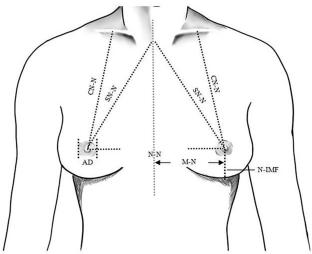
Retrospective data from 360 patients (711 sides) who underwent vertical-scar reduction mammoplasty were collected. The data included preoperative patient information such as age, height, weight, BMI, and breast surface measurements, along with the accurately measured weight of breast tissue resected from each side during surgery. Statistical analysis was performed on the data, and multiple linear regression was used to determine the relationship between these variables and the weight of the resected breast tissue.
Results
The formula established is as follows: Breast tissue resection weight (g) = (15 × Sternal Notch-to-Nipple + 10 × Clavicle-to-Nipple + 23 × Nipple-to-Inframammary Fold + 10 × BMI + 6 × Inter-Nipple distance + 8 × Midline-to-Nipple)−1023.
Conclusions
This predictive model for breast tissue resection weight in vertical-scar reduction mammoplasty represents an empirical summary of clinical data. Implementing this model can aid surgeons in preoperatively estimating resection weight, ultimately improving surgical outcomes and increasing patient satisfaction.
Level of Evidence IV
This journal requires that authors assign a level of evidence to each article. For a full description of these Evidence-Based Medicine ratings, please refer to the Table of Contents or the online Instructions to Authors www.springer.com/00266.
期刊介绍:
Aesthetic Plastic Surgery is a publication of the International Society of Aesthetic Plastic Surgery and the official journal of the European Association of Societies of Aesthetic Plastic Surgery (EASAPS), Società Italiana di Chirurgia Plastica Ricostruttiva ed Estetica (SICPRE), Vereinigung der Deutschen Aesthetisch Plastischen Chirurgen (VDAPC), the Romanian Aesthetic Surgery Society (RASS), Asociación Española de Cirugía Estética Plástica (AECEP), La Sociedad Argentina de Cirugía Plástica, Estética y Reparadora (SACPER), the Rhinoplasty Society of Europe (RSE), the Iranian Society of Plastic and Aesthetic Surgeons (ISPAS), the Singapore Association of Plastic Surgeons (SAPS), the Australasian Society of Aesthetic Plastic Surgeons (ASAPS), the Egyptian Society of Plastic and Reconstructive Surgeons (ESPRS), and the Sociedad Chilena de Cirugía Plástica, Reconstructiva y Estética (SCCP).
Aesthetic Plastic Surgery provides a forum for original articles advancing the art of aesthetic plastic surgery. Many describe surgical craftsmanship; others deal with complications in surgical procedures and methods by which to treat or avoid them. Coverage includes "second thoughts" on established techniques, which might be abandoned, modified, or improved. Also included are case histories; improvements in surgical instruments, pharmaceuticals, and operating room equipment; and discussions of problems such as the role of psychosocial factors in the doctor-patient and the patient-public interrelationships.
Aesthetic Plastic Surgery is covered in Current Contents/Clinical Medicine, SciSearch, Research Alert, Index Medicus-Medline, and Excerpta Medica/Embase.



 京公网安备 11010802042870号
京ICP备2023020795号-1
京公网安备 11010802042870号
京ICP备2023020795号-1

 分享
分享
 求助内容:
求助内容: 应助结果提醒方式:
 扫码关注我们
