{"title":"Genomic analysis of the SMN1 gene region in patients with clinically diagnosed spinal muscular atrophy: a retrospective observational study.","authors":"Tamaki Kato, Mamoru Yokomura, Yutaka Osawa, Kensuke Matsuo, Yuji Kubo, Taihei Homma, Kayoko Saito","doi":"10.1186/s13023-025-03568-9","DOIUrl":null,"url":null,"abstract":"<p><strong>Background: </strong>Spinal muscular atrophy (SMA) is an autosomal recessive neuromuscular disease. Most patients with SMA have a mutation in the survival motor neuron 1 (SMN1) gene on chromosome 5q. With current genetic testing, SMN1 copy number is determined; a diagnosis is reached when the copy number is zero. When the SMN1 copy number is 1, exons and intron/exon boundaries of the allele are examined for single-nucleotide variants (SNVs). Genetically undiagnosed cases of SMA exist when 2 copies of SMN1 exist or when a SNV is in the deep intron. Furthermore, SMN1 is highly homologous to SMN2; therefore, it is expected that many SNVs have not been elucidated.</p><p><strong>Methods: </strong>This retrospective observational study conducted in Japan used pre-collected DNA samples from patients with clinically diagnosed SMA. Enrollment period was January 28, 2020 to September 30, 2021. SNV analysis of SMN1 (exon 1-8 and intron 1-7) was conducted by long-range polymerase chain reaction and next-generation sequencing.</p><p><strong>Results: </strong>From 336 DNA samples collected from patients, 62 patient samples were included in the SNV analysis. Two patients have been genetically diagnosed (a heterozygous variant in intron 6 with 1 copy of SMN1; a homozygous missense mutation in exon 3 with 2 copies of SMN1). Three SNVs in intron 6, c.834+1506A>G (n = 9), c.834+1751G>A (n = 2), and c.835-367C>A (n = 5) were identified; all were numerically, and c.834+1506A>G and c.835-367C>A were significantly, more frequent in patients with 0 copies versus those with ≥ 1 copy of exon 7 in SMN1. We confirmed 3 hybrid SMN gene types in 5 patients that contained SMN2 gene sequence (aaTgg) flanked by upstream \"t\" and downstream \"G\" SMN1 sequence.</p><p><strong>Conclusions: </strong>In this study of patients with clinically diagnosed SMA, 2 cases with genetic SMN types were identified that would not have been identified through current genetic testing, which examines SMN1 deletions only. Furthermore, for 1 patient with a homozygous SMN1 missense mutation, SMA was not suspected by the current copy number screening method. This study demonstrated the importance of performing full-length sequencing for clinically diagnosed SMA to complement current screening methods.</p><p><strong>Trial registration: </strong>University Hospital Medical Information Network Clinical Trials Registry (Number: UMIN000040095).</p>","PeriodicalId":19651,"journal":{"name":"Orphanet Journal of Rare Diseases","volume":"20 1","pages":"55"},"PeriodicalIF":3.5000,"publicationDate":"2025-02-07","publicationTypes":"Journal Article","fieldsOfStudy":null,"isOpenAccess":false,"openAccessPdf":"https://www.ncbi.nlm.nih.gov/pmc/articles/PMC11803984/pdf/","citationCount":"0","resultStr":null,"platform":"Semanticscholar","paperid":null,"PeriodicalName":"Orphanet Journal of Rare Diseases","FirstCategoryId":"3","ListUrlMain":"https://doi.org/10.1186/s13023-025-03568-9","RegionNum":2,"RegionCategory":"医学","ArticlePicture":[],"TitleCN":null,"AbstractTextCN":null,"PMCID":null,"EPubDate":"","PubModel":"","JCR":"Q2","JCRName":"GENETICS & HEREDITY","Score":null,"Total":0}
引用次数: 0
Abstract
Background: Spinal muscular atrophy (SMA) is an autosomal recessive neuromuscular disease. Most patients with SMA have a mutation in the survival motor neuron 1 (SMN1) gene on chromosome 5q. With current genetic testing, SMN1 copy number is determined; a diagnosis is reached when the copy number is zero. When the SMN1 copy number is 1, exons and intron/exon boundaries of the allele are examined for single-nucleotide variants (SNVs). Genetically undiagnosed cases of SMA exist when 2 copies of SMN1 exist or when a SNV is in the deep intron. Furthermore, SMN1 is highly homologous to SMN2; therefore, it is expected that many SNVs have not been elucidated.
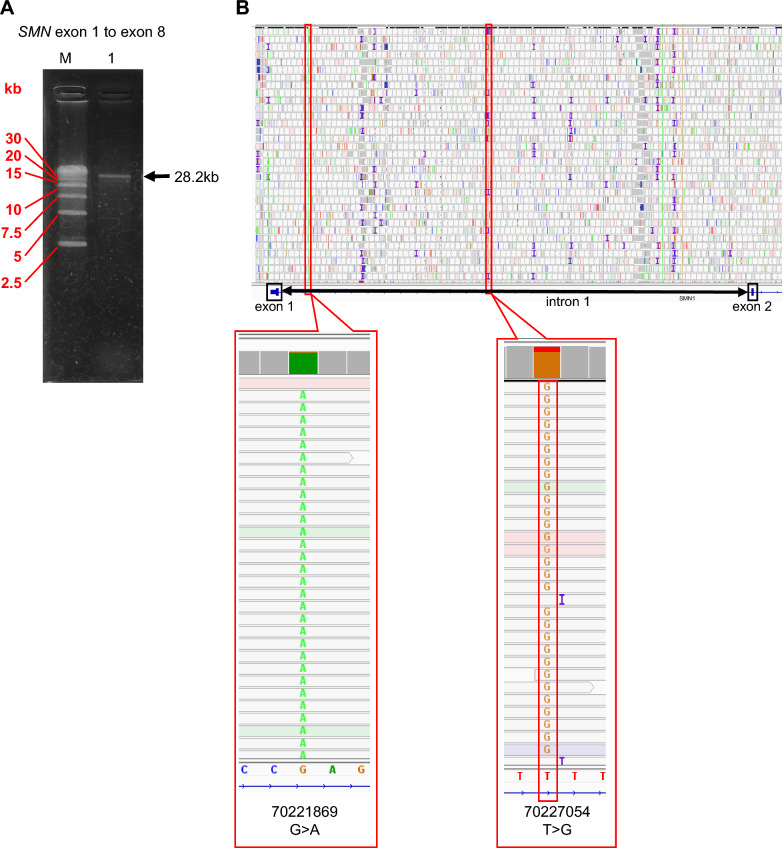
Methods: This retrospective observational study conducted in Japan used pre-collected DNA samples from patients with clinically diagnosed SMA. Enrollment period was January 28, 2020 to September 30, 2021. SNV analysis of SMN1 (exon 1-8 and intron 1-7) was conducted by long-range polymerase chain reaction and next-generation sequencing.
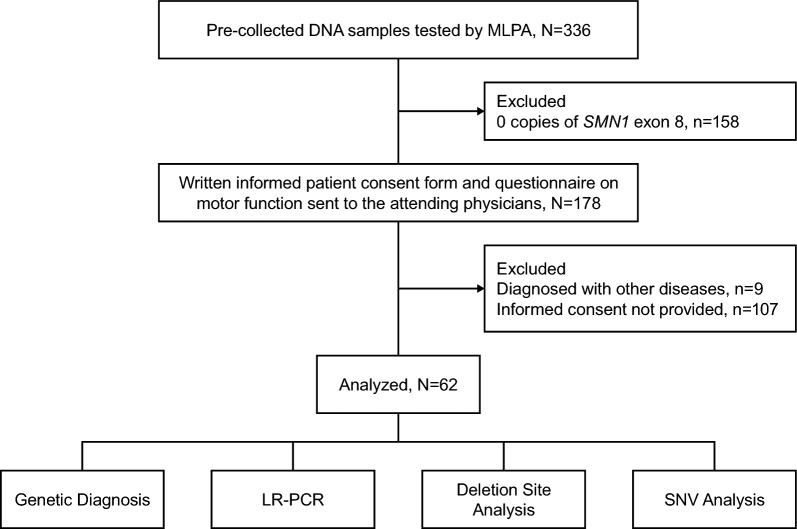
Results: From 336 DNA samples collected from patients, 62 patient samples were included in the SNV analysis. Two patients have been genetically diagnosed (a heterozygous variant in intron 6 with 1 copy of SMN1; a homozygous missense mutation in exon 3 with 2 copies of SMN1). Three SNVs in intron 6, c.834+1506A>G (n = 9), c.834+1751G>A (n = 2), and c.835-367C>A (n = 5) were identified; all were numerically, and c.834+1506A>G and c.835-367C>A were significantly, more frequent in patients with 0 copies versus those with ≥ 1 copy of exon 7 in SMN1. We confirmed 3 hybrid SMN gene types in 5 patients that contained SMN2 gene sequence (aaTgg) flanked by upstream "t" and downstream "G" SMN1 sequence.
Conclusions: In this study of patients with clinically diagnosed SMA, 2 cases with genetic SMN types were identified that would not have been identified through current genetic testing, which examines SMN1 deletions only. Furthermore, for 1 patient with a homozygous SMN1 missense mutation, SMA was not suspected by the current copy number screening method. This study demonstrated the importance of performing full-length sequencing for clinically diagnosed SMA to complement current screening methods.
Trial registration: University Hospital Medical Information Network Clinical Trials Registry (Number: UMIN000040095).
期刊介绍:
Orphanet Journal of Rare Diseases is an open access, peer-reviewed journal that encompasses all aspects of rare diseases and orphan drugs. The journal publishes high-quality reviews on specific rare diseases. In addition, the journal may consider articles on clinical trial outcome reports, either positive or negative, and articles on public health issues in the field of rare diseases and orphan drugs. The journal does not accept case reports.




 京公网安备 11010802042870号
京ICP备2023020795号-1
京公网安备 11010802042870号
京ICP备2023020795号-1

 分享
分享
 求助内容:
求助内容: 应助结果提醒方式:
 扫码关注我们
