Minjia Mo, Maria Eriksdotter, Sofia Ajeganova, Sumonto Mitra, Sara Garcia-Ptacek, Hong Xu
{"title":"Association of Rheumatoid Arthritis With Progression of Cognitive Impairment and Risk of Mortality in People With Dementia.","authors":"Minjia Mo, Maria Eriksdotter, Sofia Ajeganova, Sumonto Mitra, Sara Garcia-Ptacek, Hong Xu","doi":"10.1212/WNL.0000000000213405","DOIUrl":null,"url":null,"abstract":"<p><strong>Background and objectives: </strong>Rheumatoid arthritis (RA) has been linked to an increased risk of dementia, yet little is known about how RA affects the progression of cognitive impairment and the risk of mortality in people with dementia. We aimed to investigate whether RA is linked to an accelerated cognitive decline and a higher risk of all-cause mortality in patients with dementia.</p><p><strong>Methods: </strong>We conducted a propensity score-matched register-based cohort study based on the Swedish Registry for Cognitive/Dementia Disorders-SveDem. Patients diagnosed with dementia and registered in SveDem between May 1, 2007, and October 16, 2018, were included. The main outcome for the study was cognitive decline, measured by Mini-Mental State Examination (MMSE) score changes over years. The secondary outcome was all-cause death. We used mixed-effects models to examine the association between RA and cognitive decline, and Cox proportional hazards models to investigate the risk of all-cause mortality. We also conducted subgroup analyses to explore the potential effects of sociodemographic, baseline MMSE, comorbidities, and the use of dementia medications on the association between RA and outcomes.</p><p><strong>Results: </strong>We included 1,685 dementia patients with RA (mean [SD] age, 79.9 [6.7] years; 73.4% were women) and 5,055 dementia patients with non-RA (80.1 [7.5] years; 73.1% were women). The median follow-up was 2.9 years (interquartile range, 1.5-4.6 years) for non-RA and 2.6 years (interquartile range, 1.4-4.2 years) for RA. In total, 111,266 MMSE measurements were available for analysis. Compared with non-RA patients, patients with RA presented faster cognitive decline (β = -0.24 points/y; 95% CI -0.38 to -0.10) and an increased risk of death (hazard ratio 1.15; 95% CI 1.06-1.24). In subgroup analysis, significant interactions were observed between RA and baseline MMSE scores as well as living conditions regarding cognitive decline (<i>p</i> for interaction <0.05).</p><p><strong>Discussion: </strong>We identified a worse cognitive function and an increased mortality risk in dementia patients with RA compared with non-RA. However, we lacked information on the duration of RA before the onset of dementia and on disease activity, which could influence our findings. Further studies are needed to validate these results in comparable populations.</p>","PeriodicalId":19256,"journal":{"name":"Neurology","volume":"104 5","pages":"e213405"},"PeriodicalIF":8.5000,"publicationDate":"2025-03-11","publicationTypes":"Journal Article","fieldsOfStudy":null,"isOpenAccess":false,"openAccessPdf":"https://www.ncbi.nlm.nih.gov/pmc/articles/PMC11810133/pdf/","citationCount":"0","resultStr":null,"platform":"Semanticscholar","paperid":null,"PeriodicalName":"Neurology","FirstCategoryId":"3","ListUrlMain":"https://doi.org/10.1212/WNL.0000000000213405","RegionNum":1,"RegionCategory":"医学","ArticlePicture":[],"TitleCN":null,"AbstractTextCN":null,"PMCID":null,"EPubDate":"2025/2/7 0:00:00","PubModel":"Epub","JCR":"Q1","JCRName":"CLINICAL NEUROLOGY","Score":null,"Total":0}
引用次数: 0
Abstract
Background and objectives: Rheumatoid arthritis (RA) has been linked to an increased risk of dementia, yet little is known about how RA affects the progression of cognitive impairment and the risk of mortality in people with dementia. We aimed to investigate whether RA is linked to an accelerated cognitive decline and a higher risk of all-cause mortality in patients with dementia.
Methods: We conducted a propensity score-matched register-based cohort study based on the Swedish Registry for Cognitive/Dementia Disorders-SveDem. Patients diagnosed with dementia and registered in SveDem between May 1, 2007, and October 16, 2018, were included. The main outcome for the study was cognitive decline, measured by Mini-Mental State Examination (MMSE) score changes over years. The secondary outcome was all-cause death. We used mixed-effects models to examine the association between RA and cognitive decline, and Cox proportional hazards models to investigate the risk of all-cause mortality. We also conducted subgroup analyses to explore the potential effects of sociodemographic, baseline MMSE, comorbidities, and the use of dementia medications on the association between RA and outcomes.
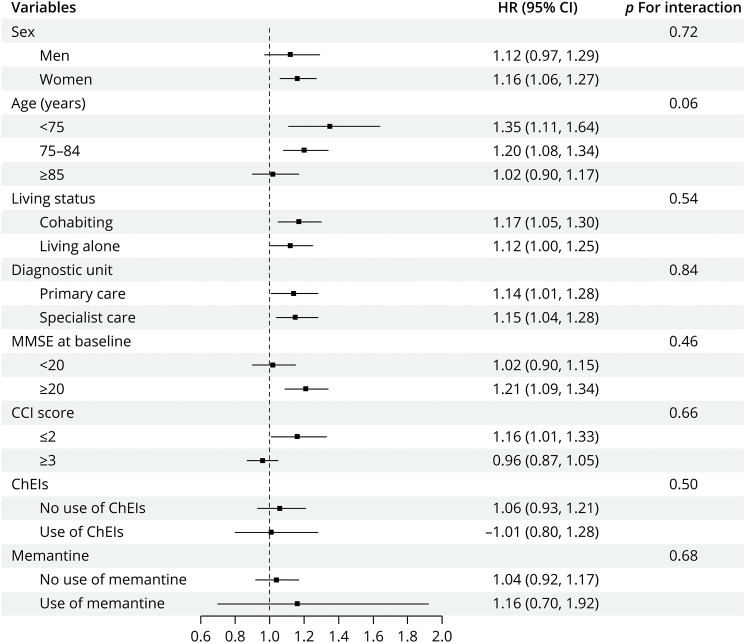
Results: We included 1,685 dementia patients with RA (mean [SD] age, 79.9 [6.7] years; 73.4% were women) and 5,055 dementia patients with non-RA (80.1 [7.5] years; 73.1% were women). The median follow-up was 2.9 years (interquartile range, 1.5-4.6 years) for non-RA and 2.6 years (interquartile range, 1.4-4.2 years) for RA. In total, 111,266 MMSE measurements were available for analysis. Compared with non-RA patients, patients with RA presented faster cognitive decline (β = -0.24 points/y; 95% CI -0.38 to -0.10) and an increased risk of death (hazard ratio 1.15; 95% CI 1.06-1.24). In subgroup analysis, significant interactions were observed between RA and baseline MMSE scores as well as living conditions regarding cognitive decline (p for interaction <0.05).
Discussion: We identified a worse cognitive function and an increased mortality risk in dementia patients with RA compared with non-RA. However, we lacked information on the duration of RA before the onset of dementia and on disease activity, which could influence our findings. Further studies are needed to validate these results in comparable populations.
背景和目的:类风湿性关节炎(RA)与痴呆风险增加有关,但对RA如何影响痴呆患者认知功能障碍的进展和死亡风险知之甚少。我们的目的是调查RA是否与痴呆患者认知能力加速下降和全因死亡率增高有关。方法:我们进行了一项基于瑞典认知/痴呆登记- svedem的倾向评分匹配登记队列研究。研究纳入了2007年5月1日至2018年10月16日期间在SveDem登记的诊断为痴呆症的患者。该研究的主要结果是认知能力下降,通过多年来的迷你精神状态检查(MMSE)评分变化来衡量。次要结果是全因死亡。我们使用混合效应模型来检验类风湿关节炎与认知能力下降之间的关系,并使用Cox比例风险模型来调查全因死亡率的风险。我们还进行了亚组分析,以探讨社会人口学、基线MMSE、合并症和痴呆药物使用对RA和预后之间关系的潜在影响。结果:我们纳入了1685例RA痴呆患者(平均[SD]年龄79.9[6.7]岁;73.4%为女性)和5055名非ra痴呆患者(80.1[7.5]岁;73.1%为女性)。非RA的中位随访时间为2.9年(四分位数范围为1.5-4.6年),RA的中位随访时间为2.6年(四分位数范围为1.4-4.2年)。总共有111,266个MMSE测量值可用于分析。与非RA患者相比,RA患者的认知能力下降更快(β = -0.24分/y;95% CI -0.38 ~ -0.10)和死亡风险增加(风险比1.15;95% ci 1.06-1.24)。在亚组分析中,观察到RA与基线MMSE评分之间的显著相互作用,以及与认知能力下降有关的生活条件(p为相互作用)。讨论:我们发现,与非RA相比,RA痴呆患者的认知功能更差,死亡风险更高。然而,我们缺乏关于RA在痴呆发病前的持续时间和疾病活动的信息,这可能会影响我们的研究结果。需要进一步的研究在可比人群中验证这些结果。
期刊介绍:
Neurology, the official journal of the American Academy of Neurology, aspires to be the premier peer-reviewed journal for clinical neurology research. Its mission is to publish exceptional peer-reviewed original research articles, editorials, and reviews to improve patient care, education, clinical research, and professionalism in neurology.
As the leading clinical neurology journal worldwide, Neurology targets physicians specializing in nervous system diseases and conditions. It aims to advance the field by presenting new basic and clinical research that influences neurological practice. The journal is a leading source of cutting-edge, peer-reviewed information for the neurology community worldwide. Editorial content includes Research, Clinical/Scientific Notes, Views, Historical Neurology, NeuroImages, Humanities, Letters, and position papers from the American Academy of Neurology. The online version is considered the definitive version, encompassing all available content.
Neurology is indexed in prestigious databases such as MEDLINE/PubMed, Embase, Scopus, Biological Abstracts®, PsycINFO®, Current Contents®, Web of Science®, CrossRef, and Google Scholar.




 京公网安备 11010802042870号
京ICP备2023020795号-1
京公网安备 11010802042870号
京ICP备2023020795号-1

 分享
分享
 求助内容:
求助内容: 应助结果提醒方式:
 扫码关注我们
