Vishnu Kumarasamy, Jianxin Wang, Michelle Roti, Yin Wan, Adam P. Dommer, Hanna Rosenheck, Sivasankar Putta, Alec Trub, John Bisi, Jay Strum, Patrick Roberts, Seth M. Rubin, Costakis Frangou, Karen McLean, Agnieszka K. Witkiewicz, Erik S. Knudsen
{"title":"Discrete vulnerability to pharmacological CDK2 inhibition is governed by heterogeneity of the cancer cell cycle","authors":"Vishnu Kumarasamy, Jianxin Wang, Michelle Roti, Yin Wan, Adam P. Dommer, Hanna Rosenheck, Sivasankar Putta, Alec Trub, John Bisi, Jay Strum, Patrick Roberts, Seth M. Rubin, Costakis Frangou, Karen McLean, Agnieszka K. Witkiewicz, Erik S. Knudsen","doi":"10.1038/s41467-025-56674-4","DOIUrl":null,"url":null,"abstract":"<p>Cyclin dependent kinase 2 (CDK2) regulates cell cycle and is an emerging target for cancer therapy. There are relatively small numbers of tumor models that exhibit strong dependence on CDK2 and undergo G1 cell cycle arrest following CDK2 inhibition. The expression of P16INK4A and cyclin E1 determines this sensitivity to CDK2 inhibition. The co-expression of these genes occurs in breast cancer patients highlighting their clinical significance as predictive biomarkers for CDK2-targeted therapies. In cancer models that are genetically independent of CDK2, pharmacological inhibitors suppress cell proliferation by inducing 4N cell cycle arrest and increasing the expressions of phospho-CDK1 (Y15) and cyclin B1. CRISPR screens identify CDK2 loss as a mediator of resistance to a CDK2 inhibitor, INX-315. Furthermore, CDK2 deletion reverses the G2/M block induced by CDK2 inhibitors and restores cell proliferation. Complementary drug screens define multiple means to cooperate with CDK2 inhibition beyond G1/S. These include the depletion of mitotic regulators as well as CDK4/6 inhibitors cooperate with CDK2 inhibition in multiple phases of the cell cycle. Overall, this study underscores two fundamentally distinct features of response to CDK2 inhibitors that are conditioned by tumor context and could serve as the basis for differential therapeutic strategies in a wide range of cancers.</p>","PeriodicalId":19066,"journal":{"name":"Nature Communications","volume":"42 1","pages":""},"PeriodicalIF":15.7000,"publicationDate":"2025-02-09","publicationTypes":"Journal Article","fieldsOfStudy":null,"isOpenAccess":false,"openAccessPdf":"","citationCount":"0","resultStr":null,"platform":"Semanticscholar","paperid":null,"PeriodicalName":"Nature Communications","FirstCategoryId":"103","ListUrlMain":"https://doi.org/10.1038/s41467-025-56674-4","RegionNum":1,"RegionCategory":"综合性期刊","ArticlePicture":[],"TitleCN":null,"AbstractTextCN":null,"PMCID":null,"EPubDate":"","PubModel":"","JCR":"Q1","JCRName":"MULTIDISCIPLINARY SCIENCES","Score":null,"Total":0}
引用次数: 0
Abstract
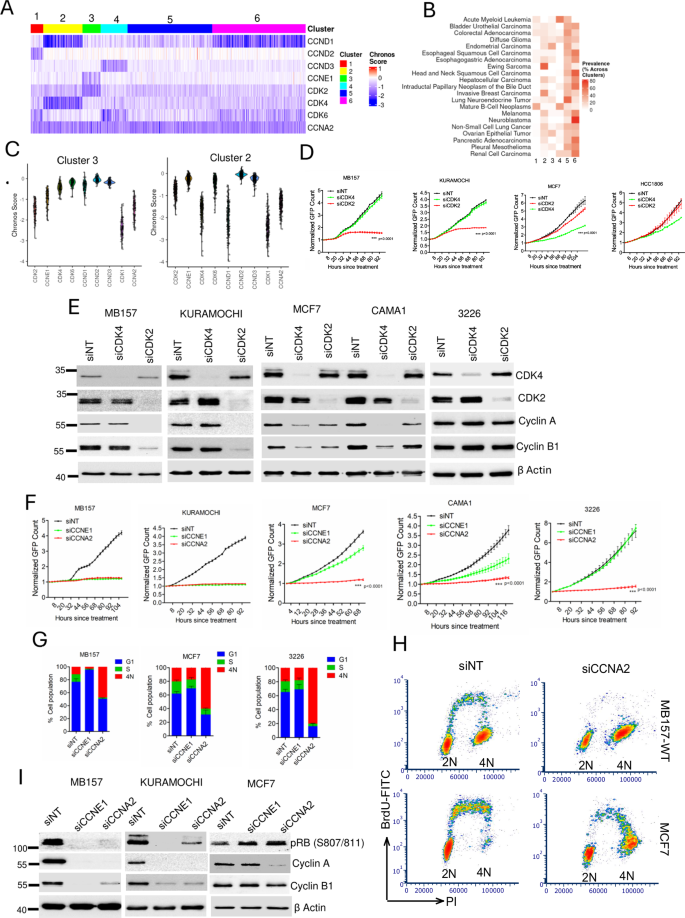
Cyclin dependent kinase 2 (CDK2) regulates cell cycle and is an emerging target for cancer therapy. There are relatively small numbers of tumor models that exhibit strong dependence on CDK2 and undergo G1 cell cycle arrest following CDK2 inhibition. The expression of P16INK4A and cyclin E1 determines this sensitivity to CDK2 inhibition. The co-expression of these genes occurs in breast cancer patients highlighting their clinical significance as predictive biomarkers for CDK2-targeted therapies. In cancer models that are genetically independent of CDK2, pharmacological inhibitors suppress cell proliferation by inducing 4N cell cycle arrest and increasing the expressions of phospho-CDK1 (Y15) and cyclin B1. CRISPR screens identify CDK2 loss as a mediator of resistance to a CDK2 inhibitor, INX-315. Furthermore, CDK2 deletion reverses the G2/M block induced by CDK2 inhibitors and restores cell proliferation. Complementary drug screens define multiple means to cooperate with CDK2 inhibition beyond G1/S. These include the depletion of mitotic regulators as well as CDK4/6 inhibitors cooperate with CDK2 inhibition in multiple phases of the cell cycle. Overall, this study underscores two fundamentally distinct features of response to CDK2 inhibitors that are conditioned by tumor context and could serve as the basis for differential therapeutic strategies in a wide range of cancers.
期刊介绍:
Nature Communications, an open-access journal, publishes high-quality research spanning all areas of the natural sciences. Papers featured in the journal showcase significant advances relevant to specialists in each respective field. With a 2-year impact factor of 16.6 (2022) and a median time of 8 days from submission to the first editorial decision, Nature Communications is committed to rapid dissemination of research findings. As a multidisciplinary journal, it welcomes contributions from biological, health, physical, chemical, Earth, social, mathematical, applied, and engineering sciences, aiming to highlight important breakthroughs within each domain.




 京公网安备 11010802042870号
京ICP备2023020795号-1
京公网安备 11010802042870号
京ICP备2023020795号-1

 分享
分享
 求助内容:
求助内容: 应助结果提醒方式:
 扫码关注我们
