{"title":"Diffusion in Molten Sodium Carbonate.","authors":"M C Wilding, F Demmel, M Wilson","doi":"10.1021/acs.jpca.4c04649","DOIUrl":null,"url":null,"abstract":"<p><p>The diffusion of sodium and carbonate ions in molten sodium carbonate is investigated by quasi-elastic neutron scattering (QENS) at <i>T</i> = 1143 K. The quasi-elastic scattering at small wave vectors is dominated by diffusing sodium ions, and the derived self-diffusion coefficient of <i>D</i><sub>Na</sub> = 4.5 × 10<sup>-5</sup> cm<sup>2</sup>/s agrees well with previous tracer diffusion measurements. The quasi-elastic scattering from the carbonate anion is coherent, and the coherent scattering dominates the QENS signal at scattering vectors with a modulus greater than 1 Å<sup>-1</sup>. The line width of the coherent scattering function is used to obtain the diffusion coefficient of the carbonate anion at this temperature of <i>D</i><sub>CO<sub>3</sub><sup>2-</sup></sub> = 2.4 × 10<sup>-5</sup> cm<sup>2</sup>/s, again in agreement with values from tracer diffusion studies. The results from this QENS measurement are larger compared with molecular dynamics simulations using a recently developed model, which introduces flexibility to the carbonate anion and allows charge to fluctuate across the anion. The model was improved concerning the melting point of the simulated liquid. Scaling the temperature in terms of this melting point is shown to bring the simulated and experimental diffusion coefficients into good agreement. The self-diffusion coefficients are consistent with those expected for a fragile liquid, and the changes in viscosity expected as the carbonate liquid is cooled are explained by the development of chains and complex structures that directly result from the flexibility of the anion introduced in this modeling approach. This simulation methodology can therefore be applied to further studies of complex molten salts.</p>","PeriodicalId":59,"journal":{"name":"The Journal of Physical Chemistry A","volume":" ","pages":"1890-1895"},"PeriodicalIF":2.8000,"publicationDate":"2025-02-20","publicationTypes":"Journal Article","fieldsOfStudy":null,"isOpenAccess":false,"openAccessPdf":"https://www.ncbi.nlm.nih.gov/pmc/articles/PMC11848922/pdf/","citationCount":"0","resultStr":null,"platform":"Semanticscholar","paperid":null,"PeriodicalName":"The Journal of Physical Chemistry A","FirstCategoryId":"1","ListUrlMain":"https://doi.org/10.1021/acs.jpca.4c04649","RegionNum":2,"RegionCategory":"化学","ArticlePicture":[],"TitleCN":null,"AbstractTextCN":null,"PMCID":null,"EPubDate":"2025/2/8 0:00:00","PubModel":"Epub","JCR":"Q3","JCRName":"CHEMISTRY, PHYSICAL","Score":null,"Total":0}
引用次数: 0
Abstract
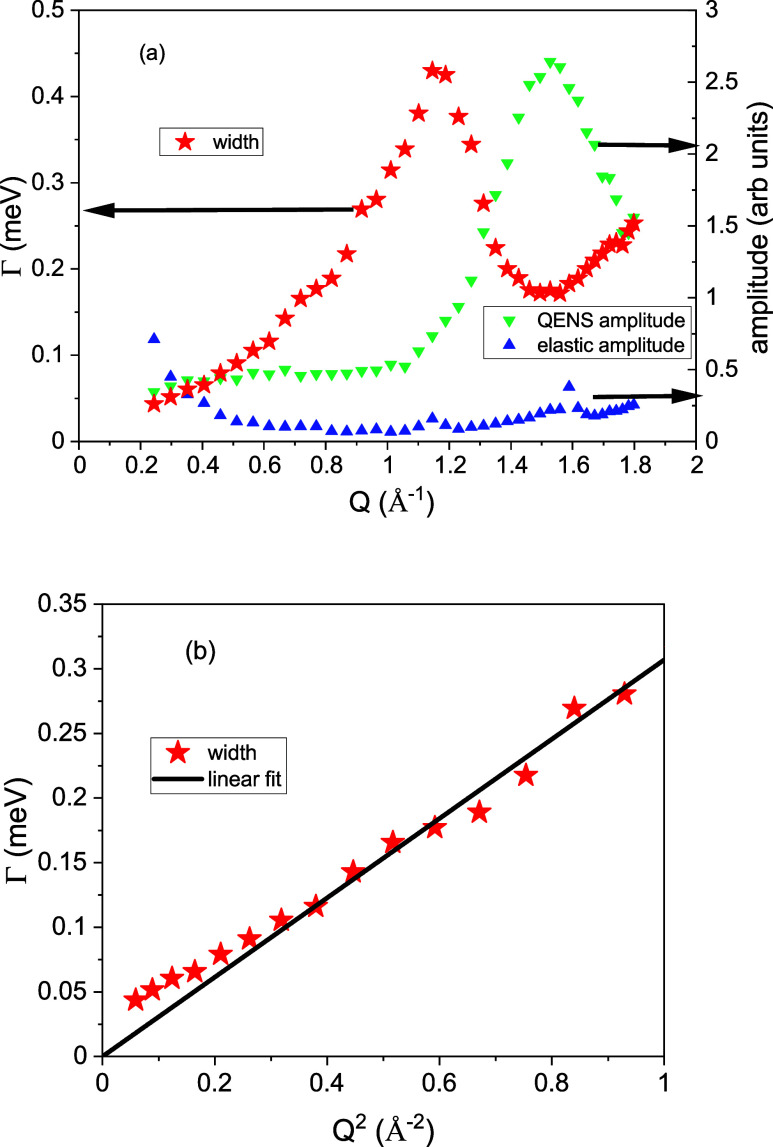
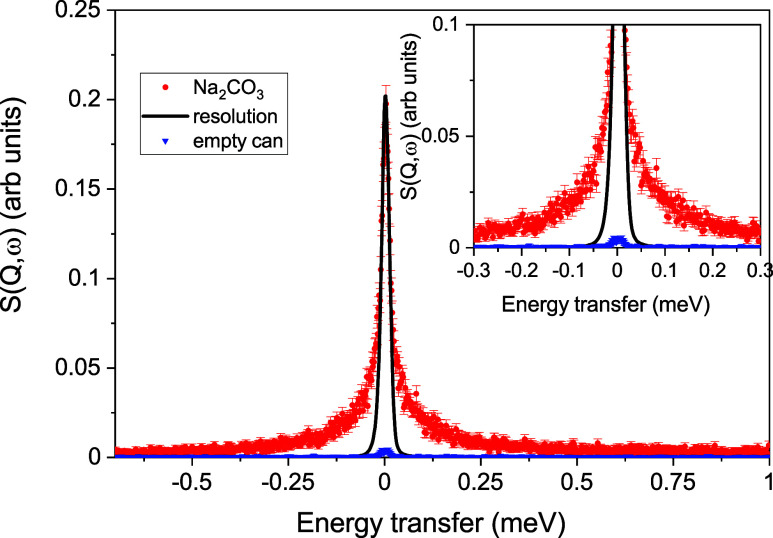
The diffusion of sodium and carbonate ions in molten sodium carbonate is investigated by quasi-elastic neutron scattering (QENS) at T = 1143 K. The quasi-elastic scattering at small wave vectors is dominated by diffusing sodium ions, and the derived self-diffusion coefficient of DNa = 4.5 × 10⁻⁵ cm2/s agrees well with previous tracer diffusion measurements. The quasi-elastic scattering from the carbonate anion is coherent, and the coherent scattering dominates the QENS signal at scattering vectors with a modulus greater than 1 Å-1. The line width of the coherent scattering function is used to obtain the diffusion coefficient of the carbonate anion at this temperature of DCO32- = 2.4 × 10⁻⁵ cm2/s, again in agreement with values from tracer diffusion studies. The results from this QENS measurement are larger compared with molecular dynamics simulations using a recently developed model, which introduces flexibility to the carbonate anion and allows charge to fluctuate across the anion. The model was improved concerning the melting point of the simulated liquid. Scaling the temperature in terms of this melting point is shown to bring the simulated and experimental diffusion coefficients into good agreement. The self-diffusion coefficients are consistent with those expected for a fragile liquid, and the changes in viscosity expected as the carbonate liquid is cooled are explained by the development of chains and complex structures that directly result from the flexibility of the anion introduced in this modeling approach. This simulation methodology can therefore be applied to further studies of complex molten salts.
期刊介绍:
The Journal of Physical Chemistry A is devoted to reporting new and original experimental and theoretical basic research of interest to physical chemists, biophysical chemists, and chemical physicists.




 京公网安备 11010802042870号
京ICP备2023020795号-1
京公网安备 11010802042870号
京ICP备2023020795号-1

 分享
分享
 求助内容:
求助内容: 应助结果提醒方式:
 扫码关注我们
