Effects of lower limb strengthening training on lower limb biomechanical characteristics and knee pain in patients with patellofemoral pain: a systematic review and meta-analysis.
Zeyang Zhang, Zeyi Zhang, Bosong Zheng, Yuhang Yang, Youping Sun
{"title":"Effects of lower limb strengthening training on lower limb biomechanical characteristics and knee pain in patients with patellofemoral pain: a systematic review and meta-analysis.","authors":"Zeyang Zhang, Zeyi Zhang, Bosong Zheng, Yuhang Yang, Youping Sun","doi":"10.1186/s40001-025-02347-3","DOIUrl":null,"url":null,"abstract":"<p><p>The objective of this study was to conduct a comprehensive comparison of the effects of hip and knee strengthening training in patients with patellofemoral pain (PFP). A meta-analysis was conducted to investigate the effects of these two types of strengthening training on patients' lower limb biomechanics, knee pain and function. The aim was to evaluate the effectiveness of the two training modalities and provide evidence-based recommendations for the rehabilitation of patients with PFP. A total of 12 studies were identified through a search of the Web of Science, EBSCO, and PubMed databases. The selected studies comprised nine randomized controlled trials (RCTs), one comparative controlled trial (CCTs) and two cohort studies (CSs), with a total of 1,066 patients. The quality of the included studies was evaluated via the PEDro scale, and a meta-analysis was conducted via Stata18 software. The results show that both types of strengthening training positively impact pain reduction and improved knee function in PFP patients. Moderate evidence from meta-analyses indicated that hip strengthening training (SMD = -1.740, 95%; CI -2.212 to -1.267, P < 0.001) was more effective than knee strengthening training (SMD = -1.302, 95%; CI -1.75 to -0.86, P < 0.001) in reducing pain (VAS). Similarly, Strong evidence suggests that hip strengthening training (SMD = 1.205, 95%; CI 0.968 to 1.443, P < 0.001) was significantly more effective than knee strengthening training (SMD = 1.023, 95%; CI 0.722 to 1.325, P < 0.001) in improving knee function (AKPS). Additionally, moderate evidence suggests that hip strengthening training significantly increased hip abductor strength (SMD = 0.848, 95%; CI 0.508-1.187, P < 0.001) and external rotator strength (SMD = 0.780, 95%; CI 0.416-1.145, P < 0.001), while strong evidence suggests that knee strengthening training did not significantly enhance knee extensor strength (SMD = 0.212, 95%; CI -0.014 to 0.439, P = 0.066). Therefore, clinicians should use hip strengthening as one of the primary training interventions when treating patients with PFP.</p>","PeriodicalId":11949,"journal":{"name":"European Journal of Medical Research","volume":"30 1","pages":"90"},"PeriodicalIF":3.4000,"publicationDate":"2025-02-08","publicationTypes":"Journal Article","fieldsOfStudy":null,"isOpenAccess":false,"openAccessPdf":"https://www.ncbi.nlm.nih.gov/pmc/articles/PMC11807312/pdf/","citationCount":"0","resultStr":null,"platform":"Semanticscholar","paperid":null,"PeriodicalName":"European Journal of Medical Research","FirstCategoryId":"3","ListUrlMain":"https://doi.org/10.1186/s40001-025-02347-3","RegionNum":3,"RegionCategory":"医学","ArticlePicture":[],"TitleCN":null,"AbstractTextCN":null,"PMCID":null,"EPubDate":"","PubModel":"","JCR":"Q2","JCRName":"MEDICINE, RESEARCH & EXPERIMENTAL","Score":null,"Total":0}
引用次数: 0
Abstract
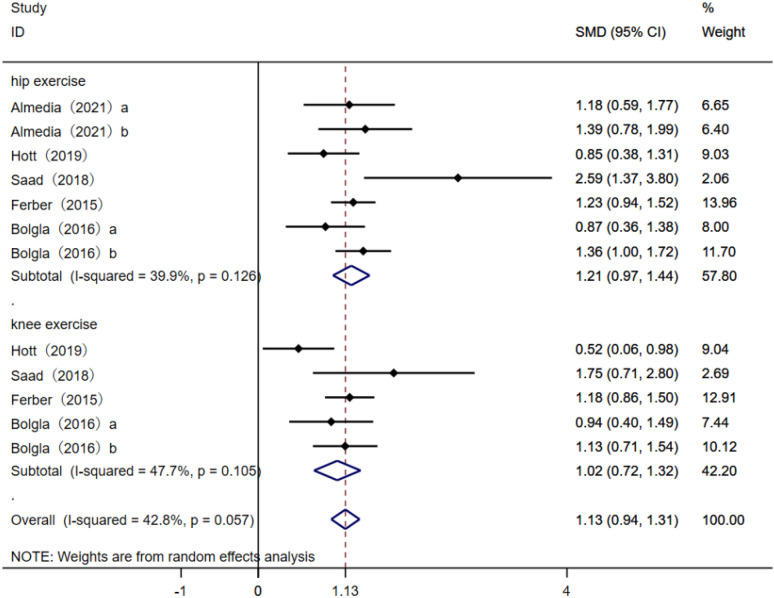
The objective of this study was to conduct a comprehensive comparison of the effects of hip and knee strengthening training in patients with patellofemoral pain (PFP). A meta-analysis was conducted to investigate the effects of these two types of strengthening training on patients' lower limb biomechanics, knee pain and function. The aim was to evaluate the effectiveness of the two training modalities and provide evidence-based recommendations for the rehabilitation of patients with PFP. A total of 12 studies were identified through a search of the Web of Science, EBSCO, and PubMed databases. The selected studies comprised nine randomized controlled trials (RCTs), one comparative controlled trial (CCTs) and two cohort studies (CSs), with a total of 1,066 patients. The quality of the included studies was evaluated via the PEDro scale, and a meta-analysis was conducted via Stata18 software. The results show that both types of strengthening training positively impact pain reduction and improved knee function in PFP patients. Moderate evidence from meta-analyses indicated that hip strengthening training (SMD = -1.740, 95%; CI -2.212 to -1.267, P < 0.001) was more effective than knee strengthening training (SMD = -1.302, 95%; CI -1.75 to -0.86, P < 0.001) in reducing pain (VAS). Similarly, Strong evidence suggests that hip strengthening training (SMD = 1.205, 95%; CI 0.968 to 1.443, P < 0.001) was significantly more effective than knee strengthening training (SMD = 1.023, 95%; CI 0.722 to 1.325, P < 0.001) in improving knee function (AKPS). Additionally, moderate evidence suggests that hip strengthening training significantly increased hip abductor strength (SMD = 0.848, 95%; CI 0.508-1.187, P < 0.001) and external rotator strength (SMD = 0.780, 95%; CI 0.416-1.145, P < 0.001), while strong evidence suggests that knee strengthening training did not significantly enhance knee extensor strength (SMD = 0.212, 95%; CI -0.014 to 0.439, P = 0.066). Therefore, clinicians should use hip strengthening as one of the primary training interventions when treating patients with PFP.
本研究的目的是对髌骨股痛(PFP)患者进行髋关节和膝关节强化训练的效果进行全面比较。通过meta分析研究这两种强化训练对患者下肢生物力学、膝关节疼痛和功能的影响。目的是评估两种训练方式的有效性,并为PFP患者的康复提供循证建议。通过检索Web of Science、EBSCO和PubMed数据库,共确定了12项研究。入选研究包括9项随机对照试验(RCTs)、1项比较对照试验(CCTs)和2项队列研究(CSs),共1066例患者。通过PEDro量表评估纳入研究的质量,并通过Stata18软件进行meta分析。结果表明,两种类型的强化训练对PFP患者的疼痛减轻和膝关节功能改善都有积极的影响。来自荟萃分析的中度证据表明,髋关节强化训练(SMD = -1.740, 95%;CI -2.212 -1.267, P
期刊介绍:
European Journal of Medical Research publishes translational and clinical research of international interest across all medical disciplines, enabling clinicians and other researchers to learn about developments and innovations within these disciplines and across the boundaries between disciplines. The journal publishes high quality research and reviews and aims to ensure that the results of all well-conducted research are published, regardless of their outcome.





 京公网安备 11010802042870号
京ICP备2023020795号-1
京公网安备 11010802042870号
京ICP备2023020795号-1

 分享
分享
 求助内容:
求助内容: 应助结果提醒方式:
 扫码关注我们
