Ruiqi Xue , Kejia Liu , Xia Hu , Xueying Ma , Shaojian Li , Zhenhong Deng , Ke Zhong , Jingwen Yang , Xiaoqiu Zhu , Sheng Liu , Zhongshan Shi , Meijuan Zhou , Yamei Tang
{"title":"Longitudinal observation of radiation-induced cognitive impairment and emotional dysfunction: Based on animal model and clinical cohort","authors":"Ruiqi Xue , Kejia Liu , Xia Hu , Xueying Ma , Shaojian Li , Zhenhong Deng , Ke Zhong , Jingwen Yang , Xiaoqiu Zhu , Sheng Liu , Zhongshan Shi , Meijuan Zhou , Yamei Tang","doi":"10.1016/j.neuroscience.2025.02.010","DOIUrl":null,"url":null,"abstract":"<div><div>Radiation-induced cognitive impairment (RICI) and emotional disorder (RIED) are comorbidities that seriously affect the quality of life in patients with radiation-induced brain injury (RIBI). A longitudinal study was conducted to observe the occurrence and development of RICI and RIED in an RIBI animal model and a clinical cohort following intensity modulated radiotherapy (IMRT). RIBI mice and sham controls were subjected to three cycles of behavior tests for cognitive and emotional function at post-irradiation 1 week (1w), 5 weeks (5w), and 9 weeks (9w) corresponding to early, middle and late stage after radiotherapy. Additionally, 139 patients who underwent IMRT after nasopharyngeal carcinoma and were firstly diagnosed with radiation-induced brain injury were enrolled. Pre-treatment and follow-up neuropsychological assessments of cognition, anxiety and depression were completed. Compared with control, significant declines in working memory, object recognition memory and social memory were observed in RIBI mice at post-irradiation 5w and 9w. Longitudinal observations revealed that memory impairment predominantly occurred in the middle stage and persisted into the late stage. Anxiety-like behaviors were only observed at post-irradiation 9w. In the clinical cohort, RICI exhibited a parallel cumulative incidence curve and a similar median onset to RIBI. RICI predominantly occurred 2–6 years post-IMRT 2–6 and progressively deteriorated beyond 6 years while RIED gradually increased beyond 6 years after IMRT. During two-year follow-up visits, half of the patients with RICI combined with RIBI benefited from drug treatment, achieving stable or improved cognition, while the other half showed no response or experienced cognition aggravation. In summary, RICI predominantly occurred in the middle stage post-irradiation and progressed to the late stage while RIED mostly emerged in the late stage in RIBI. Consistency in the development process of RICI and RIED was observed in the animal model and the clinical cohort.</div></div>","PeriodicalId":19142,"journal":{"name":"Neuroscience","volume":"572 ","pages":"Pages 171-181"},"PeriodicalIF":2.8000,"publicationDate":"2025-02-05","publicationTypes":"Journal Article","fieldsOfStudy":null,"isOpenAccess":false,"openAccessPdf":"","citationCount":"0","resultStr":null,"platform":"Semanticscholar","paperid":null,"PeriodicalName":"Neuroscience","FirstCategoryId":"3","ListUrlMain":"https://www.sciencedirect.com/science/article/pii/S0306452225000946","RegionNum":3,"RegionCategory":"医学","ArticlePicture":[],"TitleCN":null,"AbstractTextCN":null,"PMCID":null,"EPubDate":"","PubModel":"","JCR":"Q2","JCRName":"NEUROSCIENCES","Score":null,"Total":0}
引用次数: 0
Abstract
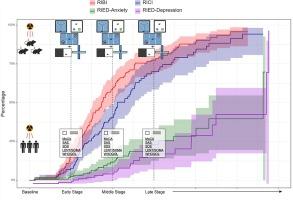
Radiation-induced cognitive impairment (RICI) and emotional disorder (RIED) are comorbidities that seriously affect the quality of life in patients with radiation-induced brain injury (RIBI). A longitudinal study was conducted to observe the occurrence and development of RICI and RIED in an RIBI animal model and a clinical cohort following intensity modulated radiotherapy (IMRT). RIBI mice and sham controls were subjected to three cycles of behavior tests for cognitive and emotional function at post-irradiation 1 week (1w), 5 weeks (5w), and 9 weeks (9w) corresponding to early, middle and late stage after radiotherapy. Additionally, 139 patients who underwent IMRT after nasopharyngeal carcinoma and were firstly diagnosed with radiation-induced brain injury were enrolled. Pre-treatment and follow-up neuropsychological assessments of cognition, anxiety and depression were completed. Compared with control, significant declines in working memory, object recognition memory and social memory were observed in RIBI mice at post-irradiation 5w and 9w. Longitudinal observations revealed that memory impairment predominantly occurred in the middle stage and persisted into the late stage. Anxiety-like behaviors were only observed at post-irradiation 9w. In the clinical cohort, RICI exhibited a parallel cumulative incidence curve and a similar median onset to RIBI. RICI predominantly occurred 2–6 years post-IMRT 2–6 and progressively deteriorated beyond 6 years while RIED gradually increased beyond 6 years after IMRT. During two-year follow-up visits, half of the patients with RICI combined with RIBI benefited from drug treatment, achieving stable or improved cognition, while the other half showed no response or experienced cognition aggravation. In summary, RICI predominantly occurred in the middle stage post-irradiation and progressed to the late stage while RIED mostly emerged in the late stage in RIBI. Consistency in the development process of RICI and RIED was observed in the animal model and the clinical cohort.
期刊介绍:
Neuroscience publishes papers describing the results of original research on any aspect of the scientific study of the nervous system. Any paper, however short, will be considered for publication provided that it reports significant, new and carefully confirmed findings with full experimental details.



 京公网安备 11010802042870号
京ICP备2023020795号-1
京公网安备 11010802042870号
京ICP备2023020795号-1

 分享
分享
 求助内容:
求助内容: 应助结果提醒方式:
 扫码关注我们
