Pratap Mane, Ravi Kumar Trivedi, Parthasarathy Velusamy and Brahmananda Chakraborty
{"title":"Electron doping in non-magnetic YH3 leads to room temperature ferromagnetism and a flat band: insights from density functional theory†","authors":"Pratap Mane, Ravi Kumar Trivedi, Parthasarathy Velusamy and Brahmananda Chakraborty","doi":"10.1039/D4CP03859B","DOIUrl":null,"url":null,"abstract":"<p >Herein, we investigated the origin of induced room temperature d<small><sup>0</sup></small> ferromagnetism in YH<small><sub>3</sub></small> doped with B (2<em>μ</em><small><sub>B</sub></small> per defect magnetic moment) using density functional theory (DFT) simulations. The prediction of d<small><sup>0</sup></small> ferromagnetism in non-magnetic YH<small><sub>3</sub></small> using the generalized gradient approximation functional was further confirmed using the hybrid HSE06 functional. Interestingly, B doping in the system led to the appearance of a flat band, which may be due to electron doping in the system. The presence of a flat band at the Fermi level may lead to stable ferromagnetism in the system. We found that YH<small><sub>3</sub></small> attained 2.0<em>μ</em><small><sub>B</sub></small> magnetic moment per defect using a single B atom with an impurity concentration of 1.04 at%. The partial density of states along with the spin-density plot implied that the induced magnetic moment was the result of the interaction between the localized 2p and 4d orbitals of the impurity B and host Y atoms, respectively, within the doped system, satisfying the Stoner criteria for induced ferromagnetism. Ferromagnetism in the system at room temperature was estimated by calculating the Curie temperature, which was around <em>T</em><small><sub>c</sub></small> = 510 K, using the mean field approximation. The thermodynamic and dynamic stabilities of the system at 25 GPa were confirmed using <em>ab initio</em> MD simulation and phonon dispersion, respectively. All these results indicate the experimental feasibility of the system as a spintronic device, and we propose that electron doping may be a possible route for designing materials with interesting properties.</p>","PeriodicalId":99,"journal":{"name":"Physical Chemistry Chemical Physics","volume":" 10","pages":" 5215-5227"},"PeriodicalIF":2.9000,"publicationDate":"2025-02-10","publicationTypes":"Journal Article","fieldsOfStudy":null,"isOpenAccess":false,"openAccessPdf":"","citationCount":"0","resultStr":null,"platform":"Semanticscholar","paperid":null,"PeriodicalName":"Physical Chemistry Chemical Physics","FirstCategoryId":"92","ListUrlMain":"https://pubs.rsc.org/en/content/articlelanding/2025/cp/d4cp03859b","RegionNum":3,"RegionCategory":"化学","ArticlePicture":[],"TitleCN":null,"AbstractTextCN":null,"PMCID":null,"EPubDate":"","PubModel":"","JCR":"Q3","JCRName":"CHEMISTRY, PHYSICAL","Score":null,"Total":0}
引用次数: 0
Abstract
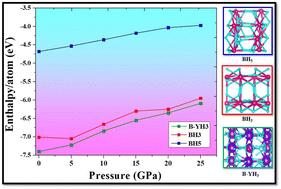
Herein, we investigated the origin of induced room temperature d0 ferromagnetism in YH3 doped with B (2μB per defect magnetic moment) using density functional theory (DFT) simulations. The prediction of d0 ferromagnetism in non-magnetic YH3 using the generalized gradient approximation functional was further confirmed using the hybrid HSE06 functional. Interestingly, B doping in the system led to the appearance of a flat band, which may be due to electron doping in the system. The presence of a flat band at the Fermi level may lead to stable ferromagnetism in the system. We found that YH3 attained 2.0μB magnetic moment per defect using a single B atom with an impurity concentration of 1.04 at%. The partial density of states along with the spin-density plot implied that the induced magnetic moment was the result of the interaction between the localized 2p and 4d orbitals of the impurity B and host Y atoms, respectively, within the doped system, satisfying the Stoner criteria for induced ferromagnetism. Ferromagnetism in the system at room temperature was estimated by calculating the Curie temperature, which was around Tc = 510 K, using the mean field approximation. The thermodynamic and dynamic stabilities of the system at 25 GPa were confirmed using ab initio MD simulation and phonon dispersion, respectively. All these results indicate the experimental feasibility of the system as a spintronic device, and we propose that electron doping may be a possible route for designing materials with interesting properties.
期刊介绍:
Physical Chemistry Chemical Physics (PCCP) is an international journal co-owned by 19 physical chemistry and physics societies from around the world. This journal publishes original, cutting-edge research in physical chemistry, chemical physics and biophysical chemistry. To be suitable for publication in PCCP, articles must include significant innovation and/or insight into physical chemistry; this is the most important criterion that reviewers and Editors will judge against when evaluating submissions.
The journal has a broad scope and welcomes contributions spanning experiment, theory, computation and data science. Topical coverage includes spectroscopy, dynamics, kinetics, statistical mechanics, thermodynamics, electrochemistry, catalysis, surface science, quantum mechanics, quantum computing and machine learning. Interdisciplinary research areas such as polymers and soft matter, materials, nanoscience, energy, surfaces/interfaces, and biophysical chemistry are welcomed if they demonstrate significant innovation and/or insight into physical chemistry. Joined experimental/theoretical studies are particularly appreciated when complementary and based on up-to-date approaches.




 京公网安备 11010802042870号
京ICP备2023020795号-1
京公网安备 11010802042870号
京ICP备2023020795号-1

 分享
分享
 求助内容:
求助内容: 应助结果提醒方式:
 扫码关注我们
