David C Gibbs, Myles R McCrary, Carlos S Moreno, Lindsey Seldin, Chaoran Li, Nourine A H Kamili, Brian P Pollack
{"title":"Epidermal growth factor dampens pro-inflammatory gene expression induced by interferon-gamma in global transcriptome analysis of keratinocytes.","authors":"David C Gibbs, Myles R McCrary, Carlos S Moreno, Lindsey Seldin, Chaoran Li, Nourine A H Kamili, Brian P Pollack","doi":"10.1186/s12864-025-11237-1","DOIUrl":null,"url":null,"abstract":"<p><strong>Background: </strong>Epidermal growth factor receptor inhibitors (EGFRIs) are used to treat certain cancers but frequently cause cutaneous inflammation that can hinder treatment. This is due in part to the effects of EGFRIs on pro-inflammatory signaling by interferon-γ (IFN-γ). However, the impact of EGFR ligands (i.e. EGF) on interferon signaling is unclear. The purpose of this study was to investigate the impact of EGF on IFN-γ transcriptional responses on a genome-wide scale in keratinocytes.</p><p><strong>Methods: </strong>RNA-seq was performed in human keratinocyte (HaCaT) cells treated with IFN-γ, EGF, both, or neither (control). Differentially expressed genes in each treatment group, relative to control, were identified using DESeq2 with a false discovery rate (FDR) threshold of 0.01. Associated biologic processes and gene pathways were examined in gene-set enrichment analyses. Correlations between gene expression were investigated in vivo using RNA-seq data from biopsies of psoriatic and matched normal skin, which were collected from 116 individuals with psoriasis enrolled in the AMAGINE randomized clinical trials.</p><p><strong>Results: </strong>Of the 2,792 differentially expressed genes following IFN-γ treatment, 2,083 (75%) were no longer differentially expressed when EGF was added. IFN-γ-induced genes with significantly lower expression in the presence of EGF included CXCL10, IL-6, IL-1 A, HLA-DMA, and GBP5 (activator of the NLRP3 inflammasome); the top enriched biologic processes and pathways were related to MHC-class II antigen presentation (GO:0019886) and cytokine signaling (KEGG:04060). Consistent with our in vitro findings, the expression of CXCL10 and GBP5, as well as the combined expression z-scores of genes in the enriched MHC-class II and cytokine signaling pathways, were significantly lower in skin biopsies with higher EGF expression compared to those with lower EGF expression among individuals with psoriasis.</p><p><strong>Conclusions: </strong>Our findings suggest that the pro-inflammatory IFN-γ-induced transcriptome may be globally attenuated by EGF in keratinocytes, supporting an immunomodulatory role of EGF in the skin. These studies provide insights for the non-canonical immunomodulatory role of EGF signaling and why blocking EGFR signaling (e.g., with EGFRIs) can cause cutaneous inflammation.</p>","PeriodicalId":9030,"journal":{"name":"BMC Genomics","volume":"26 1","pages":"122"},"PeriodicalIF":3.7000,"publicationDate":"2025-02-10","publicationTypes":"Journal Article","fieldsOfStudy":null,"isOpenAccess":false,"openAccessPdf":"https://www.ncbi.nlm.nih.gov/pmc/articles/PMC11809098/pdf/","citationCount":"0","resultStr":null,"platform":"Semanticscholar","paperid":null,"PeriodicalName":"BMC Genomics","FirstCategoryId":"99","ListUrlMain":"https://doi.org/10.1186/s12864-025-11237-1","RegionNum":2,"RegionCategory":"生物学","ArticlePicture":[],"TitleCN":null,"AbstractTextCN":null,"PMCID":null,"EPubDate":"","PubModel":"","JCR":"Q2","JCRName":"BIOTECHNOLOGY & APPLIED MICROBIOLOGY","Score":null,"Total":0}
引用次数: 0
Abstract
Background: Epidermal growth factor receptor inhibitors (EGFRIs) are used to treat certain cancers but frequently cause cutaneous inflammation that can hinder treatment. This is due in part to the effects of EGFRIs on pro-inflammatory signaling by interferon-γ (IFN-γ). However, the impact of EGFR ligands (i.e. EGF) on interferon signaling is unclear. The purpose of this study was to investigate the impact of EGF on IFN-γ transcriptional responses on a genome-wide scale in keratinocytes.
Methods: RNA-seq was performed in human keratinocyte (HaCaT) cells treated with IFN-γ, EGF, both, or neither (control). Differentially expressed genes in each treatment group, relative to control, were identified using DESeq2 with a false discovery rate (FDR) threshold of 0.01. Associated biologic processes and gene pathways were examined in gene-set enrichment analyses. Correlations between gene expression were investigated in vivo using RNA-seq data from biopsies of psoriatic and matched normal skin, which were collected from 116 individuals with psoriasis enrolled in the AMAGINE randomized clinical trials.
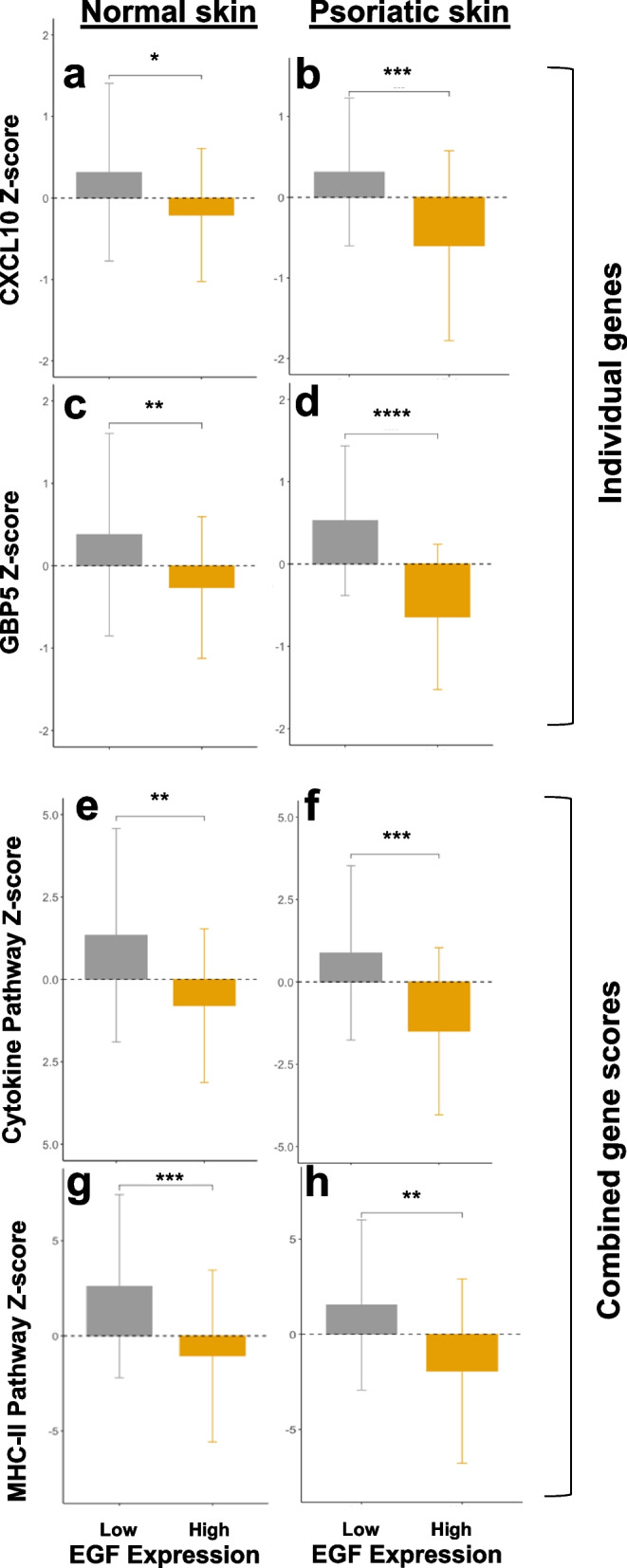
Results: Of the 2,792 differentially expressed genes following IFN-γ treatment, 2,083 (75%) were no longer differentially expressed when EGF was added. IFN-γ-induced genes with significantly lower expression in the presence of EGF included CXCL10, IL-6, IL-1 A, HLA-DMA, and GBP5 (activator of the NLRP3 inflammasome); the top enriched biologic processes and pathways were related to MHC-class II antigen presentation (GO:0019886) and cytokine signaling (KEGG:04060). Consistent with our in vitro findings, the expression of CXCL10 and GBP5, as well as the combined expression z-scores of genes in the enriched MHC-class II and cytokine signaling pathways, were significantly lower in skin biopsies with higher EGF expression compared to those with lower EGF expression among individuals with psoriasis.
Conclusions: Our findings suggest that the pro-inflammatory IFN-γ-induced transcriptome may be globally attenuated by EGF in keratinocytes, supporting an immunomodulatory role of EGF in the skin. These studies provide insights for the non-canonical immunomodulatory role of EGF signaling and why blocking EGFR signaling (e.g., with EGFRIs) can cause cutaneous inflammation.
期刊介绍:
BMC Genomics is an open access, peer-reviewed journal that considers articles on all aspects of genome-scale analysis, functional genomics, and proteomics.
BMC Genomics is part of the BMC series which publishes subject-specific journals focused on the needs of individual research communities across all areas of biology and medicine. We offer an efficient, fair and friendly peer review service, and are committed to publishing all sound science, provided that there is some advance in knowledge presented by the work.






 京公网安备 11010802042870号
京ICP备2023020795号-1
京公网安备 11010802042870号
京ICP备2023020795号-1

 分享
分享
 求助内容:
求助内容: 应助结果提醒方式:
 扫码关注我们
