Shu Li, Genki Terashi, Zicong Zhang, Daisuke Kihara
{"title":"Advancing structure modeling from cryo-EM maps with deep learning.","authors":"Shu Li, Genki Terashi, Zicong Zhang, Daisuke Kihara","doi":"10.1042/BST20240784","DOIUrl":null,"url":null,"abstract":"<p><p>Cryo-electron microscopy (cryo-EM) has revolutionized structural biology by enabling the determination of biomolecular structures that are challenging to resolve using conventional methods. Interpreting a cryo-EM map requires accurate modeling of the structures of underlying biomolecules. Here, we concisely discuss the evolution and current state of automatic structure modeling from cryo-EM density maps. We classify modeling methods into two categories: de novo modeling methods from high-resolution maps (better than 5 Å) and methods that model by fitting individual structures of component proteins to maps at lower resolution (worse than 5 Å). Special attention is given to the role of deep learning in the modeling process, highlighting how AI-driven approaches are transformative in cryo-EM structure modeling. We conclude by discussing future directions in the field.</p>","PeriodicalId":8841,"journal":{"name":"Biochemical Society transactions","volume":"53 1","pages":""},"PeriodicalIF":4.3000,"publicationDate":"2025-02-07","publicationTypes":"Journal Article","fieldsOfStudy":null,"isOpenAccess":false,"openAccessPdf":"https://www.ncbi.nlm.nih.gov/pmc/articles/PMC12224893/pdf/","citationCount":"0","resultStr":null,"platform":"Semanticscholar","paperid":null,"PeriodicalName":"Biochemical Society transactions","FirstCategoryId":"99","ListUrlMain":"https://doi.org/10.1042/BST20240784","RegionNum":3,"RegionCategory":"生物学","ArticlePicture":[],"TitleCN":null,"AbstractTextCN":null,"PMCID":null,"EPubDate":"","PubModel":"","JCR":"Q2","JCRName":"BIOCHEMISTRY & MOLECULAR BIOLOGY","Score":null,"Total":0}
引用次数: 0
Abstract
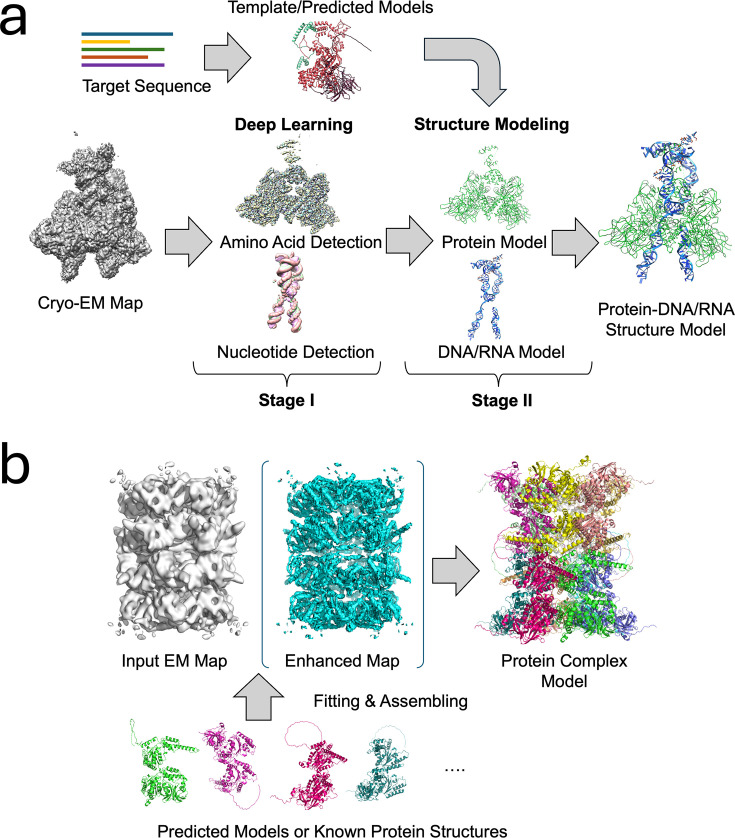
Cryo-electron microscopy (cryo-EM) has revolutionized structural biology by enabling the determination of biomolecular structures that are challenging to resolve using conventional methods. Interpreting a cryo-EM map requires accurate modeling of the structures of underlying biomolecules. Here, we concisely discuss the evolution and current state of automatic structure modeling from cryo-EM density maps. We classify modeling methods into two categories: de novo modeling methods from high-resolution maps (better than 5 Å) and methods that model by fitting individual structures of component proteins to maps at lower resolution (worse than 5 Å). Special attention is given to the role of deep learning in the modeling process, highlighting how AI-driven approaches are transformative in cryo-EM structure modeling. We conclude by discussing future directions in the field.
期刊介绍:
Biochemical Society Transactions is the reviews journal of the Biochemical Society. Publishing concise reviews written by experts in the field, providing a timely snapshot of the latest developments across all areas of the molecular and cellular biosciences.
Elevating our authors’ ideas and expertise, each review includes a perspectives section where authors offer comment on the latest advances, a glimpse of future challenges and highlighting the importance of associated research areas in far broader contexts.




 京公网安备 11010802042870号
京ICP备2023020795号-1
京公网安备 11010802042870号
京ICP备2023020795号-1

 分享
分享
 求助内容:
求助内容: 应助结果提醒方式:
 扫码关注我们
