Ahmed Tawheed, Alaa Ismail, Mohab S Amer, Osama Elnahas, Tawhid Mowafy
{"title":"Capsule endoscopy: Do we still need it after 24 years of clinical use?","authors":"Ahmed Tawheed, Alaa Ismail, Mohab S Amer, Osama Elnahas, Tawhid Mowafy","doi":"10.3748/wjg.v31.i5.102692","DOIUrl":null,"url":null,"abstract":"<p><p>In this letter, we comment on a recent article published in the <i>World Journal of Gastroenterology</i> by Xiao <i>et al</i>, where the authors aimed to use a deep learning model to automatically detect gastrointestinal lesions during capsule endoscopy (CE). CE was first presented in 2000 and was approved by the Food and Drug Administration in 2001. The indications of CE overlap with those of regular diagnostic endoscopy. However, in clinical practice, CE is usually used to detect lesions in areas inaccessible to standard endoscopies or in cases of bleeding that might be missed during conventional endoscopy. Since the emergence of CE, many physiological and technical challenges have been faced and addressed. In this letter, we summarize the current challenges and briefly mention the proposed methods to overcome these challenges to answer a central question: Do we still need CE?</p>","PeriodicalId":23778,"journal":{"name":"World Journal of Gastroenterology","volume":"31 5","pages":"102692"},"PeriodicalIF":5.4000,"publicationDate":"2025-02-07","publicationTypes":"Journal Article","fieldsOfStudy":null,"isOpenAccess":false,"openAccessPdf":"https://www.ncbi.nlm.nih.gov/pmc/articles/PMC11718605/pdf/","citationCount":"0","resultStr":null,"platform":"Semanticscholar","paperid":null,"PeriodicalName":"World Journal of Gastroenterology","FirstCategoryId":"3","ListUrlMain":"https://doi.org/10.3748/wjg.v31.i5.102692","RegionNum":3,"RegionCategory":"医学","ArticlePicture":[],"TitleCN":null,"AbstractTextCN":null,"PMCID":null,"EPubDate":"","PubModel":"","JCR":"Q1","JCRName":"GASTROENTEROLOGY & HEPATOLOGY","Score":null,"Total":0}
引用次数: 0
Abstract
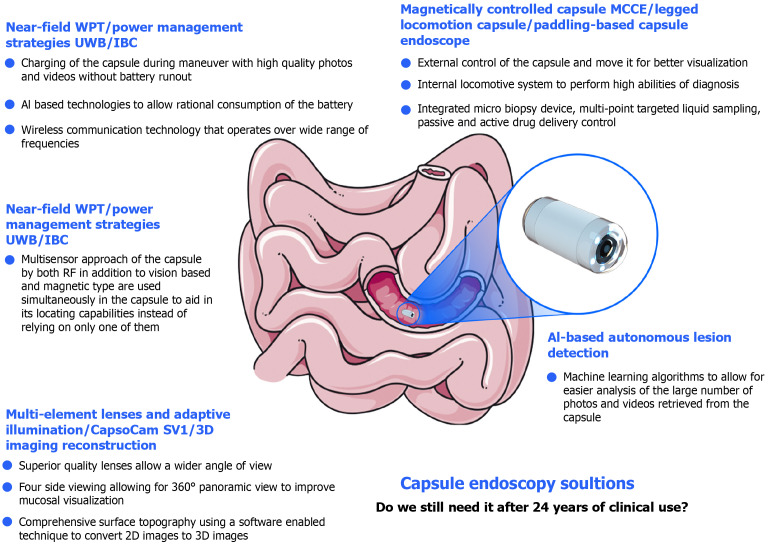
In this letter, we comment on a recent article published in the World Journal of Gastroenterology by Xiao et al, where the authors aimed to use a deep learning model to automatically detect gastrointestinal lesions during capsule endoscopy (CE). CE was first presented in 2000 and was approved by the Food and Drug Administration in 2001. The indications of CE overlap with those of regular diagnostic endoscopy. However, in clinical practice, CE is usually used to detect lesions in areas inaccessible to standard endoscopies or in cases of bleeding that might be missed during conventional endoscopy. Since the emergence of CE, many physiological and technical challenges have been faced and addressed. In this letter, we summarize the current challenges and briefly mention the proposed methods to overcome these challenges to answer a central question: Do we still need CE?
期刊介绍:
The primary aims of the WJG are to improve diagnostic, therapeutic and preventive modalities and the skills of clinicians and to guide clinical practice in gastroenterology and hepatology.




 京公网安备 11010802042870号
京ICP备2023020795号-1
京公网安备 11010802042870号
京ICP备2023020795号-1

 分享
分享
 求助内容:
求助内容: 应助结果提醒方式:
 扫码关注我们
