{"title":"Panic disorder and suicide.","authors":"Shih-Jen Tsai, Chih-Ming Cheng, Wen-Han Chang, Ya-Mei Bai, Tung-Ping Su, Tzeng-Ji Chen, Mu-Hong Chen","doi":"10.1017/S0033291724003441","DOIUrl":null,"url":null,"abstract":"<p><strong>Background: </strong>Panic disorder (PD) may increase the likelihood of suicidal ideation and behaviors because of psychiatric comorbidities such as major depressive disorder (MDD). However, research has yet to demonstrate a direct relationship between PD and suicide mortality.</p><p><strong>Method: </strong>Using data from Taiwan's National Health Insurance Research Database, we identified 171,737 individuals with PD and 686,948 age- and sex-matched individuals without PD during 2003-2017. We assessed the risk of suicide within the same period. Psychiatric comorbidities such as schizophrenia, bipolar disorder, MDD, obsessive-compulsive disorder (OCD), autism, alcohol use disorder (AUD), and substance use disorder (SUD) were also evaluated. Time-dependent Cox regression models were used to compare the risk of suicide in different groups after adjustment for demographic data and psychiatric comorbidities.</p><p><strong>Results: </strong>Our Cox regression model revealed that PD was an independent risk factor for suicide (hazard ratio [HR] = 1.85, 95% confidence interval [CI] = 1.59-2.14), regardless of psychiatric comorbidities. Among all comorbidities, MDD with PD was associated with the highest risk of suicide (HR = 6.08, 95% CI = 5.48-6.74), followed by autism (HR = 4.52, 95% CI = 1.66-12.29), schizophrenia (HR = 3.34, 95% CI = 2.7-4.13), bipolar disorder (HR = 3.20, 95% CI = 2.71-3.79), AUD (HR = 2.99, 95% CI = 2.41-3.72), SUD (HR = 2.82, 95% CI = 2.28-3.47), and OCD (HR = 2.10, 95% CI = 1.64-2.67).</p><p><strong>Discussion: </strong>PD is an independent risk factor for suicide. Psychiatric comorbidities (i.e. schizophrenia, bipolar disorder, MDD, OCD, AUD, SUD, and autism) with PD increase the risk of suicide.</p>","PeriodicalId":20891,"journal":{"name":"Psychological Medicine","volume":"55 ","pages":"e38"},"PeriodicalIF":5.5000,"publicationDate":"2025-02-10","publicationTypes":"Journal Article","fieldsOfStudy":null,"isOpenAccess":false,"openAccessPdf":"https://www.ncbi.nlm.nih.gov/pmc/articles/PMC12017358/pdf/","citationCount":"0","resultStr":null,"platform":"Semanticscholar","paperid":null,"PeriodicalName":"Psychological Medicine","FirstCategoryId":"3","ListUrlMain":"https://doi.org/10.1017/S0033291724003441","RegionNum":2,"RegionCategory":"医学","ArticlePicture":[],"TitleCN":null,"AbstractTextCN":null,"PMCID":null,"EPubDate":"","PubModel":"","JCR":"Q1","JCRName":"PSYCHIATRY","Score":null,"Total":0}
引用次数: 0
Abstract
Background: Panic disorder (PD) may increase the likelihood of suicidal ideation and behaviors because of psychiatric comorbidities such as major depressive disorder (MDD). However, research has yet to demonstrate a direct relationship between PD and suicide mortality.
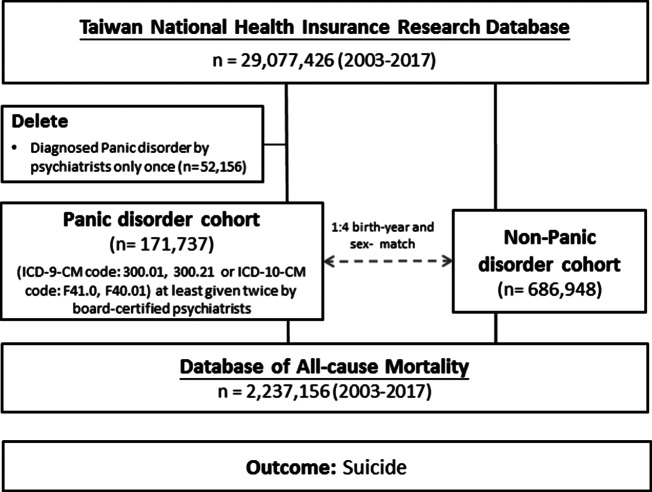
Method: Using data from Taiwan's National Health Insurance Research Database, we identified 171,737 individuals with PD and 686,948 age- and sex-matched individuals without PD during 2003-2017. We assessed the risk of suicide within the same period. Psychiatric comorbidities such as schizophrenia, bipolar disorder, MDD, obsessive-compulsive disorder (OCD), autism, alcohol use disorder (AUD), and substance use disorder (SUD) were also evaluated. Time-dependent Cox regression models were used to compare the risk of suicide in different groups after adjustment for demographic data and psychiatric comorbidities.
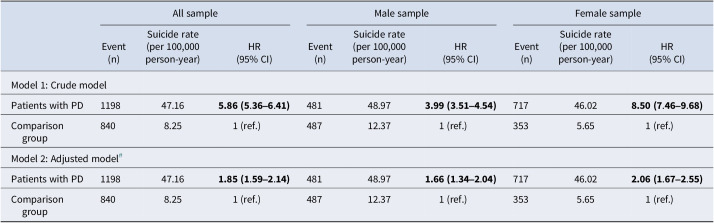
Results: Our Cox regression model revealed that PD was an independent risk factor for suicide (hazard ratio [HR] = 1.85, 95% confidence interval [CI] = 1.59-2.14), regardless of psychiatric comorbidities. Among all comorbidities, MDD with PD was associated with the highest risk of suicide (HR = 6.08, 95% CI = 5.48-6.74), followed by autism (HR = 4.52, 95% CI = 1.66-12.29), schizophrenia (HR = 3.34, 95% CI = 2.7-4.13), bipolar disorder (HR = 3.20, 95% CI = 2.71-3.79), AUD (HR = 2.99, 95% CI = 2.41-3.72), SUD (HR = 2.82, 95% CI = 2.28-3.47), and OCD (HR = 2.10, 95% CI = 1.64-2.67).
Discussion: PD is an independent risk factor for suicide. Psychiatric comorbidities (i.e. schizophrenia, bipolar disorder, MDD, OCD, AUD, SUD, and autism) with PD increase the risk of suicide.
期刊介绍:
Now in its fifth decade of publication, Psychological Medicine is a leading international journal in the fields of psychiatry, related aspects of psychology and basic sciences. From 2014, there are 16 issues a year, each featuring original articles reporting key research being undertaken worldwide, together with shorter editorials by distinguished scholars and an important book review section. The journal''s success is clearly demonstrated by a consistently high impact factor.




 京公网安备 11010802042870号
京ICP备2023020795号-1
京公网安备 11010802042870号
京ICP备2023020795号-1

 分享
分享
 求助内容:
求助内容: 应助结果提醒方式:
 扫码关注我们
