Solmaz Surano, Erik Faergemann, Gabriel Granåsen, Jonatan Salzer
{"title":"The reliability and validity of the Swedish translation of the Vertigo Symptom Scale - short form in a cohort with acute vestibular syndrome.","authors":"Solmaz Surano, Erik Faergemann, Gabriel Granåsen, Jonatan Salzer","doi":"10.1080/07853890.2025.2457517","DOIUrl":null,"url":null,"abstract":"<p><strong>Background: </strong>The Vertigo Symptom Scale - short form (VSS-SF) is commonly used to measure dizziness and vertigo over the past month. This study aimed to (1) adapt the VSS-SF for the Swedish population and assess its psychometric properties, and (2) develop a modified version for measuring symptoms in the acute phase of acute vestibular syndrome (AVS).</p><p><strong>Methods: </strong>The VSS-SF was translated into Swedish and adapted cross-culturally. Its psychometric properties were evaluated in 86 AVS patients, both in the acute stage (1-7 days from symptom onset) with a modified acute version, and after six weeks of vestibular rehabilitation using the standard VSS-SF. Factor structure, convergent and discriminant validity, and internal consistency were analyzed. Test-retest reliability was assessed at six weeks. Participants were also evaluated with the Dizziness Handicap Inventory (DHI) and balance tests. Controls included 54 healthy participants.</p><p><strong>Results: </strong>Exploratory factor analysis revealed a two-factor structure for both versions, corresponding to vertigo-balance (VSS-V) and autonomic-anxiety (VSS-A) subscales. Both versions demonstrated strong factor structures with adequate loadings. Internal consistency was high for the standard version (Cronbach's alpha 0.76 to 0.87) and for the total and VSS-V subscale of the acute version (0.82 and 0.85, respectively), but poor for the acute VSS-A subscale (0.50). Convergent validity was supported by Spearman's rank correlations. The discriminative ability was excellent for the acute VSS-SF and VSS-V (AUC 0.98 and 0.99), and acceptable for VSS-A (AUC 0.77). After six weeks, discriminative ability decreased but remained above 0.5. Test-retest reliability at six weeks was excellent for all scales (ICC 0.94, 0.93, and 0.93 for VSS-SF, VSS-V, and VSS-A).</p><p><strong>Conclusions: </strong>The VSS-SF was successfully adapted for the Swedish population, including an acute version for early dizziness assessment. Both versions confirmed a robust two-factor structure, with the acute version showing excellent early discriminative ability, particularly for the vertigo-balance dimension. However, the autonomic-anxiety subscale showed weaker psychometric properties, suggesting limited suitability for AVS patients. The adapted scales show promise for clinical use in diagnosing and evaluating dizziness and vertigo in the Swedish population.</p><p><strong>Trial registration: </strong>Clinicaltrials.gov Identifier NCT05056324, September 24, 2021. https://clinicaltrials.gov/ct2/show/NCT05056324.</p>","PeriodicalId":93874,"journal":{"name":"Annals of medicine","volume":"57 1","pages":"2457517"},"PeriodicalIF":4.3000,"publicationDate":"2025-12-01","publicationTypes":"Journal Article","fieldsOfStudy":null,"isOpenAccess":false,"openAccessPdf":"https://www.ncbi.nlm.nih.gov/pmc/articles/PMC11812103/pdf/","citationCount":"0","resultStr":null,"platform":"Semanticscholar","paperid":null,"PeriodicalName":"Annals of medicine","FirstCategoryId":"1085","ListUrlMain":"https://doi.org/10.1080/07853890.2025.2457517","RegionNum":0,"RegionCategory":null,"ArticlePicture":[],"TitleCN":null,"AbstractTextCN":null,"PMCID":null,"EPubDate":"2025/2/10 0:00:00","PubModel":"Epub","JCR":"","JCRName":"","Score":null,"Total":0}
引用次数: 0
Abstract
Background: The Vertigo Symptom Scale - short form (VSS-SF) is commonly used to measure dizziness and vertigo over the past month. This study aimed to (1) adapt the VSS-SF for the Swedish population and assess its psychometric properties, and (2) develop a modified version for measuring symptoms in the acute phase of acute vestibular syndrome (AVS).
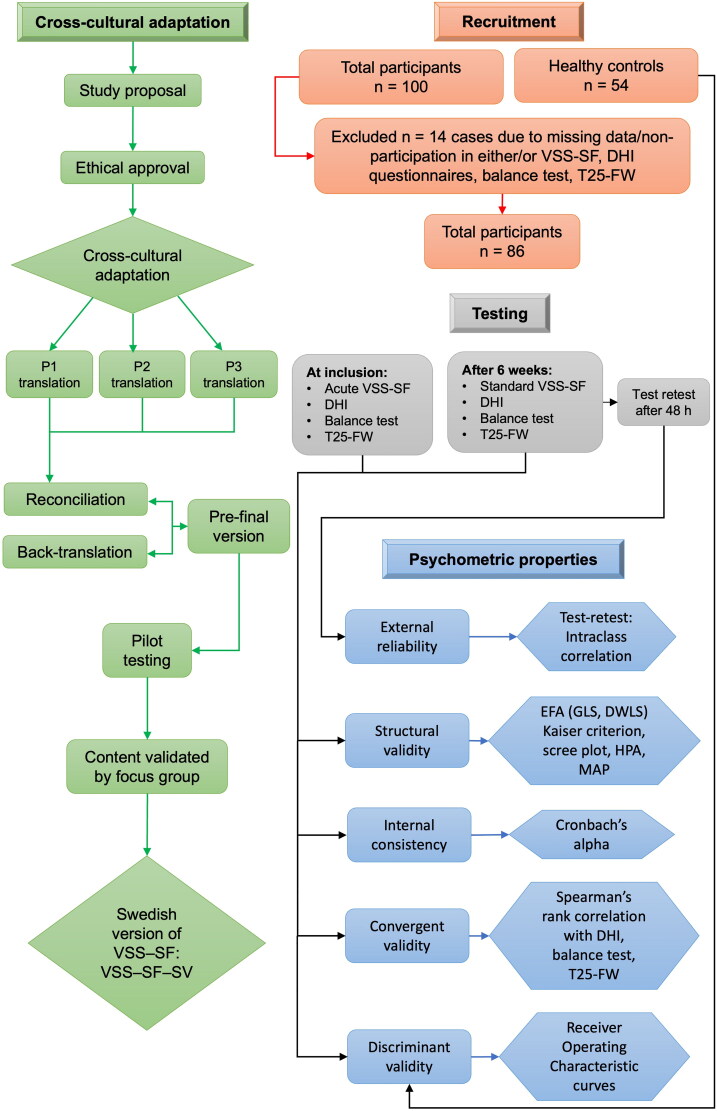
Methods: The VSS-SF was translated into Swedish and adapted cross-culturally. Its psychometric properties were evaluated in 86 AVS patients, both in the acute stage (1-7 days from symptom onset) with a modified acute version, and after six weeks of vestibular rehabilitation using the standard VSS-SF. Factor structure, convergent and discriminant validity, and internal consistency were analyzed. Test-retest reliability was assessed at six weeks. Participants were also evaluated with the Dizziness Handicap Inventory (DHI) and balance tests. Controls included 54 healthy participants.
Results: Exploratory factor analysis revealed a two-factor structure for both versions, corresponding to vertigo-balance (VSS-V) and autonomic-anxiety (VSS-A) subscales. Both versions demonstrated strong factor structures with adequate loadings. Internal consistency was high for the standard version (Cronbach's alpha 0.76 to 0.87) and for the total and VSS-V subscale of the acute version (0.82 and 0.85, respectively), but poor for the acute VSS-A subscale (0.50). Convergent validity was supported by Spearman's rank correlations. The discriminative ability was excellent for the acute VSS-SF and VSS-V (AUC 0.98 and 0.99), and acceptable for VSS-A (AUC 0.77). After six weeks, discriminative ability decreased but remained above 0.5. Test-retest reliability at six weeks was excellent for all scales (ICC 0.94, 0.93, and 0.93 for VSS-SF, VSS-V, and VSS-A).
Conclusions: The VSS-SF was successfully adapted for the Swedish population, including an acute version for early dizziness assessment. Both versions confirmed a robust two-factor structure, with the acute version showing excellent early discriminative ability, particularly for the vertigo-balance dimension. However, the autonomic-anxiety subscale showed weaker psychometric properties, suggesting limited suitability for AVS patients. The adapted scales show promise for clinical use in diagnosing and evaluating dizziness and vertigo in the Swedish population.
Trial registration: Clinicaltrials.gov Identifier NCT05056324, September 24, 2021. https://clinicaltrials.gov/ct2/show/NCT05056324.





 京公网安备 11010802042870号
京ICP备2023020795号-1
京公网安备 11010802042870号
京ICP备2023020795号-1

 分享
分享

 求助内容:
求助内容: 应助结果提醒方式:
 扫码关注我们
