Development and effectiveness evaluation of an interactive e-learning environment to enhance digital health literacy in cancer patients: study protocol for a randomized controlled trial.
Lukas Lange-Drenth, Hellena Willemer, Mirjam Banse, Anke Ernst, Anne Daubmann, Anja Holz, Christiane Bleich, Susanne Weg-Remers, Holger Schulz
{"title":"Development and effectiveness evaluation of an interactive e-learning environment to enhance digital health literacy in cancer patients: study protocol for a randomized controlled trial.","authors":"Lukas Lange-Drenth, Hellena Willemer, Mirjam Banse, Anke Ernst, Anne Daubmann, Anja Holz, Christiane Bleich, Susanne Weg-Remers, Holger Schulz","doi":"10.3389/fdgth.2025.1455143","DOIUrl":null,"url":null,"abstract":"<p><strong>Background: </strong>The Internet allows cancer patients to access information about their disease at any time. However, the quality of online information varies widely and is often inaccurate or does not provide all the details patients need to make informed decisions. Additionally, patients' often limited ability to find and evaluate cancer-related online information can lead to misinformation.</p><p><strong>Objective: </strong>An interactive e-learning environment to promote digital health literacy will be developed and evaluated for effectiveness.</p><p><strong>Primary hypothesis: </strong>Cancer patients who use the e-learning environment (IG1.1-IG1.3) or the content of the environment as a non-interactive PDF file (IG2) will show greater improvement in their digital health literacy from baseline to 8 weeks after baseline compared to patients who receive no such intervention, but are referred to a standard information brochure.</p><p><strong>Methods: </strong>The hypothesis will be tested in a stratified randomized controlled superiority trial with five parallel groups and the primary endpoint of digital health literacy. In an e-learning environment, patients will learn strategies to use when searching for reliable cancer-related online information. During development, a prototype will be refined through focus groups and tested for usability by experts and patients. 660 cancer patients will be recruited using convenience sampling and randomly assigned in a 3:1:1 ratio to IG1.1-IG1.3 (three variants of the environment), IG2, or the control group. Two thirds of the 660 participants will be recruited through the German Cancer Information Service (CIS) and one third through non-CIS routes. Allocation will follow stratified randomization, accounting for recruitment route (CIS vs. non-CIS) and cancer type (breast cancer vs. other cancers), with variable block length. The primary outcome, digital health literacy, will be measured at baseline, 2 weeks, and 8 weeks after baseline.</p><p><strong>Conclusion: </strong>If the results support the primary hypothesis, then the e-learning environment could empower patients to retrieve more reliable information about their disease. Concerns about the generalizability of the results, since a disproportionate number of inquiries to the CIS come from breast cancer patients, are addressed by a proportionally stratified randomization strategy and diversified recruitment routes.</p>","PeriodicalId":73078,"journal":{"name":"Frontiers in digital health","volume":"7 ","pages":"1455143"},"PeriodicalIF":3.2000,"publicationDate":"2025-01-24","publicationTypes":"Journal Article","fieldsOfStudy":null,"isOpenAccess":false,"openAccessPdf":"https://www.ncbi.nlm.nih.gov/pmc/articles/PMC11802532/pdf/","citationCount":"0","resultStr":null,"platform":"Semanticscholar","paperid":null,"PeriodicalName":"Frontiers in digital health","FirstCategoryId":"1085","ListUrlMain":"https://doi.org/10.3389/fdgth.2025.1455143","RegionNum":0,"RegionCategory":null,"ArticlePicture":[],"TitleCN":null,"AbstractTextCN":null,"PMCID":null,"EPubDate":"2025/1/1 0:00:00","PubModel":"eCollection","JCR":"Q1","JCRName":"HEALTH CARE SCIENCES & SERVICES","Score":null,"Total":0}
引用次数: 0
Abstract
Background: The Internet allows cancer patients to access information about their disease at any time. However, the quality of online information varies widely and is often inaccurate or does not provide all the details patients need to make informed decisions. Additionally, patients' often limited ability to find and evaluate cancer-related online information can lead to misinformation.
Objective: An interactive e-learning environment to promote digital health literacy will be developed and evaluated for effectiveness.
Primary hypothesis: Cancer patients who use the e-learning environment (IG1.1-IG1.3) or the content of the environment as a non-interactive PDF file (IG2) will show greater improvement in their digital health literacy from baseline to 8 weeks after baseline compared to patients who receive no such intervention, but are referred to a standard information brochure.
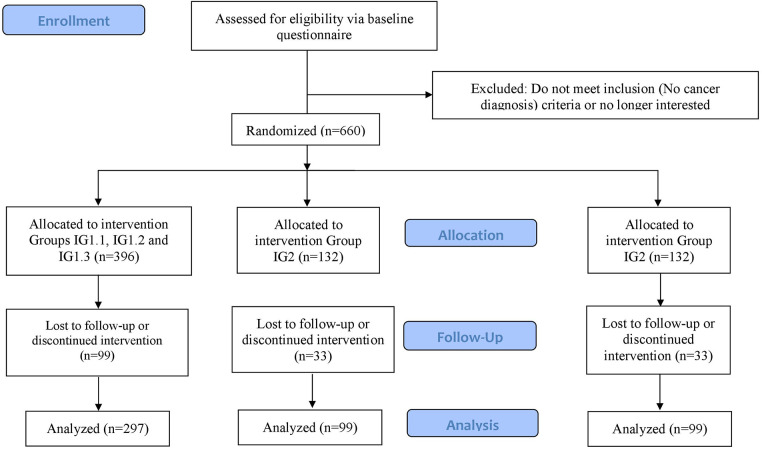
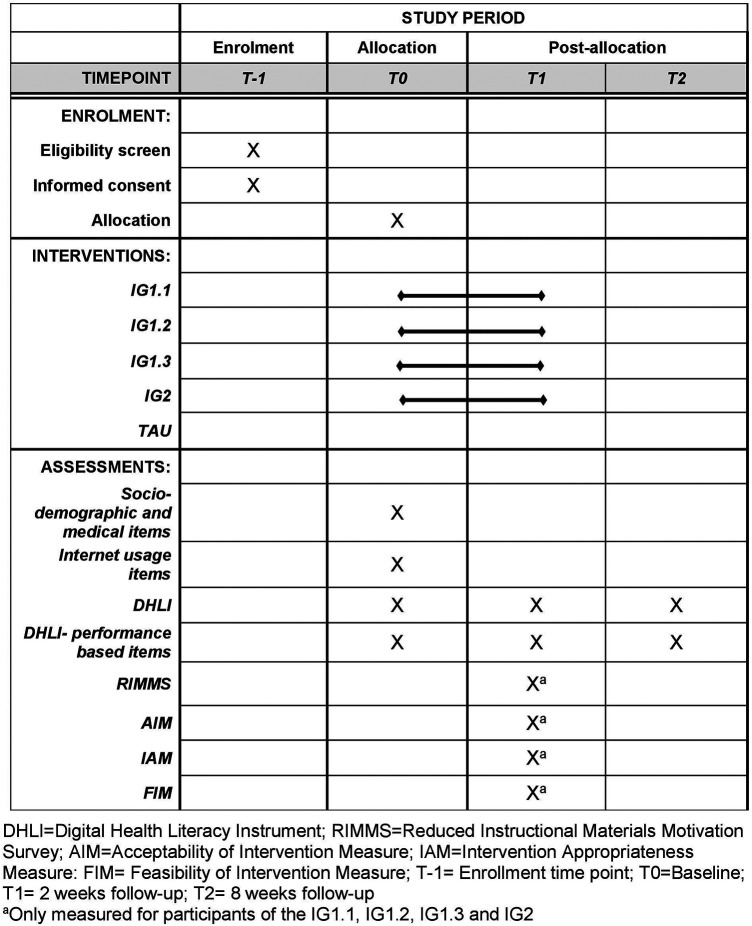
Methods: The hypothesis will be tested in a stratified randomized controlled superiority trial with five parallel groups and the primary endpoint of digital health literacy. In an e-learning environment, patients will learn strategies to use when searching for reliable cancer-related online information. During development, a prototype will be refined through focus groups and tested for usability by experts and patients. 660 cancer patients will be recruited using convenience sampling and randomly assigned in a 3:1:1 ratio to IG1.1-IG1.3 (three variants of the environment), IG2, or the control group. Two thirds of the 660 participants will be recruited through the German Cancer Information Service (CIS) and one third through non-CIS routes. Allocation will follow stratified randomization, accounting for recruitment route (CIS vs. non-CIS) and cancer type (breast cancer vs. other cancers), with variable block length. The primary outcome, digital health literacy, will be measured at baseline, 2 weeks, and 8 weeks after baseline.
Conclusion: If the results support the primary hypothesis, then the e-learning environment could empower patients to retrieve more reliable information about their disease. Concerns about the generalizability of the results, since a disproportionate number of inquiries to the CIS come from breast cancer patients, are addressed by a proportionally stratified randomization strategy and diversified recruitment routes.



 京公网安备 11010802042870号
京ICP备2023020795号-1
京公网安备 11010802042870号
京ICP备2023020795号-1

 分享
分享

 求助内容:
求助内容: 应助结果提醒方式:
 扫码关注我们
