{"title":"Bone cement versus bone flap replacement: A comparative meta-analysis of posterior fossa craniotomy complications.","authors":"Ryan Neill, Peter Harris, Lekhaj Chand Daggubati","doi":"10.25259/SNI_789_2024","DOIUrl":null,"url":null,"abstract":"<p><strong>Background: </strong>Posterior fossa surgeries are often performed to treat infratentorial pathologies, such as tumors that increase intracranial pressure. Posterior fossa craniotomy has been shown to decrease the incidence of postoperative complications and morbidity compared to craniectomy. More recently, the use of bone cement in posterior fossa craniotomies has been implemented, but there is limited comparative postoperative data of this technique to more commonly used bone flap replacement. This study aims to address this information gap through a meta-analysis comparing the incidence of postoperative cerebrospinal fluid leakage and other complications when utilizing bone cement versus bone flap replacement in posterior fossa craniotomies.</p><p><strong>Methods: </strong>Following a literature review, search parameters for a systematic review were identified and relevant studies were sorted based on selection criteria to be included in the meta-analysis. Data analysis was performed in R studio and Microsoft Excel software. Targeted complications for analysis include cerebrospinal fluid (CSF) leakage, pseudomeningocele formation, and infection. Pooled estimates and odds ratios for dichotomous outcomes were calculated with corresponding 95% confidence intervals, and findings were translated into illustrative tables and figures.</p><p><strong>Results: </strong>Twenty-one articles were included in a systematic review, nine studies using bone cement and thirteen using bone flap (two studies reported data for both groups). With bone flap replacement, CSF leakage was 8.36% (95% confidence interval [CI] 5.89-10.86%), pseudomeningocele formation was 9.22% (95% CI 4.82-13.62%), and infection was 6.85% (95% CI 4.05-9.65%). With bone cement usage, CSF leakage was 3.47% (95% CI 2.37-4.57%), pseudomeningocele formation was 2.43% (95% CI 1.23-3.63%), and infection was 1.85% (95% CI 0.75-2.95%). The odds ratio of CSF leak, pseudomeningocele formation, and infection was 0.39 (95% CI 0.229-0.559), 0.25 (95% CI 0.137-0.353), and 0.26 (95% CI 0.149-0.363), respectively, with the use of bone cement compared to craniotomy.</p><p><strong>Conclusion: </strong>Outcomes demonstrated in this meta-analysis revealed an overall decreased incidence of postoperative complications rates of CSF leak, pseudomeningocele formation, and infection when using bone cement compared to bone flap in posterior fossa craniotomies. Our study suggests that bone cement use is safe and effective in posterior fossa surgery. Future studies should further assess the comparative outcomes of these techniques.</p>","PeriodicalId":94217,"journal":{"name":"Surgical neurology international","volume":"16 ","pages":"25"},"PeriodicalIF":0.0000,"publicationDate":"2025-01-31","publicationTypes":"Journal Article","fieldsOfStudy":null,"isOpenAccess":false,"openAccessPdf":"https://www.ncbi.nlm.nih.gov/pmc/articles/PMC11799687/pdf/","citationCount":"0","resultStr":null,"platform":"Semanticscholar","paperid":null,"PeriodicalName":"Surgical neurology international","FirstCategoryId":"1085","ListUrlMain":"https://doi.org/10.25259/SNI_789_2024","RegionNum":0,"RegionCategory":null,"ArticlePicture":[],"TitleCN":null,"AbstractTextCN":null,"PMCID":null,"EPubDate":"2025/1/1 0:00:00","PubModel":"eCollection","JCR":"","JCRName":"","Score":null,"Total":0}
引用次数: 0
Abstract
Background: Posterior fossa surgeries are often performed to treat infratentorial pathologies, such as tumors that increase intracranial pressure. Posterior fossa craniotomy has been shown to decrease the incidence of postoperative complications and morbidity compared to craniectomy. More recently, the use of bone cement in posterior fossa craniotomies has been implemented, but there is limited comparative postoperative data of this technique to more commonly used bone flap replacement. This study aims to address this information gap through a meta-analysis comparing the incidence of postoperative cerebrospinal fluid leakage and other complications when utilizing bone cement versus bone flap replacement in posterior fossa craniotomies.
Methods: Following a literature review, search parameters for a systematic review were identified and relevant studies were sorted based on selection criteria to be included in the meta-analysis. Data analysis was performed in R studio and Microsoft Excel software. Targeted complications for analysis include cerebrospinal fluid (CSF) leakage, pseudomeningocele formation, and infection. Pooled estimates and odds ratios for dichotomous outcomes were calculated with corresponding 95% confidence intervals, and findings were translated into illustrative tables and figures.
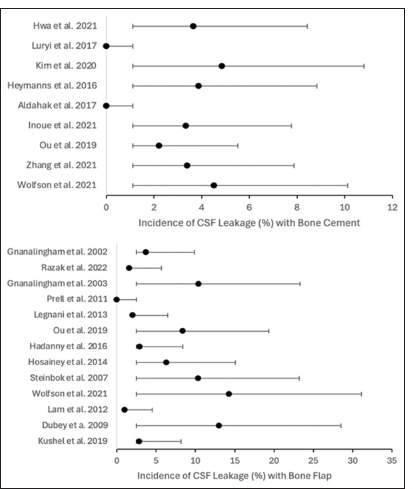
Results: Twenty-one articles were included in a systematic review, nine studies using bone cement and thirteen using bone flap (two studies reported data for both groups). With bone flap replacement, CSF leakage was 8.36% (95% confidence interval [CI] 5.89-10.86%), pseudomeningocele formation was 9.22% (95% CI 4.82-13.62%), and infection was 6.85% (95% CI 4.05-9.65%). With bone cement usage, CSF leakage was 3.47% (95% CI 2.37-4.57%), pseudomeningocele formation was 2.43% (95% CI 1.23-3.63%), and infection was 1.85% (95% CI 0.75-2.95%). The odds ratio of CSF leak, pseudomeningocele formation, and infection was 0.39 (95% CI 0.229-0.559), 0.25 (95% CI 0.137-0.353), and 0.26 (95% CI 0.149-0.363), respectively, with the use of bone cement compared to craniotomy.
Conclusion: Outcomes demonstrated in this meta-analysis revealed an overall decreased incidence of postoperative complications rates of CSF leak, pseudomeningocele formation, and infection when using bone cement compared to bone flap in posterior fossa craniotomies. Our study suggests that bone cement use is safe and effective in posterior fossa surgery. Future studies should further assess the comparative outcomes of these techniques.
背景:后窝手术常用于治疗幕下病变,如颅内压增高的肿瘤。与开颅术相比,后颅窝开颅术可以降低术后并发症的发生率和发病率。最近,骨水泥在后颅窝开颅术中的应用已经实施,但该技术与更常用的骨瓣置换术的术后比较数据有限。本研究旨在通过一项荟萃分析,比较骨水泥与骨瓣置换术在后颅窝开颅手术中术后脑脊液漏及其他并发症的发生率,来解决这一信息缺口。方法:通过文献综述,确定系统评价的检索参数,并根据纳入meta分析的选择标准对相关研究进行排序。数据分析在R studio和Microsoft Excel软件中进行。分析的目标并发症包括脑脊液(CSF)渗漏、假性脑膜膨出形成和感染。用相应的95%置信区间计算二分类结果的汇总估计值和比值比,并将结果转化为说明性表格和图表。结果:21篇文章被纳入系统综述,9篇研究使用骨水泥,13篇研究使用骨瓣(2篇研究报告了两组的数据)。骨瓣置换术后,脑脊液渗漏率为8.36%(95%可信区间[CI] 5.89-10.86%),假性脑膜膨出率为9.22% (95% CI 4.82-13.62%),感染率为6.85% (95% CI 4.05-9.65%)。使用骨水泥后,脑脊液渗漏为3.47% (95% CI 2.37-4.57%),假性脑膜膨出形成为2.43% (95% CI 1.23-3.63%),感染为1.85% (95% CI 0.75-2.95%)。与开颅手术相比,使用骨水泥发生脑脊液泄漏、假性脑膜膨出和感染的比值比分别为0.39 (95% CI 0.229-0.559)、0.25 (95% CI 0.137-0.353)和0.26 (95% CI 0.149-0.363)。结论:本荟萃分析的结果显示,与骨瓣后颅窝开颅术相比,骨水泥的术后并发症(脑脊液泄漏、假性脑膜膨出形成和感染)发生率总体降低。我们的研究表明骨水泥在后颅窝手术中使用是安全有效的。未来的研究应进一步评估这些技术的比较结果。





 京公网安备 11010802042870号
京ICP备2023020795号-1
京公网安备 11010802042870号
京ICP备2023020795号-1

 分享
分享

 求助内容:
求助内容: 应助结果提醒方式:
 扫码关注我们
