Héctor Sánchez-Herrero, Álvaro Solaz-García, Alejandro Pinilla-González, Elena Vanessa Martínez-Sánchez, Patricia Santágueda-Balader, María Cernada-Badía
{"title":"Epidemiological characteristics of antimicrobial use in Primary Care in Spain: a nationwide study.","authors":"Héctor Sánchez-Herrero, Álvaro Solaz-García, Alejandro Pinilla-González, Elena Vanessa Martínez-Sánchez, Patricia Santágueda-Balader, María Cernada-Badía","doi":"10.37201/req/120.2024","DOIUrl":null,"url":null,"abstract":"<p><strong>Introduction: </strong>This study aims to describe antimicrobial use in primary care across Spain by analyzing the prescriptions dispensed in pharmacies. Antimicrobials were categorized into therapeutic action groups based on the ATC-2 classification: antibacterials (J01), antimycotics (J02), antimycobacterials (J04), and antivirals (J05). Additionally, the study explores epidemiological patterns of use.</p><p><strong>Methods: </strong>A retrospective observational study was conducted using data from the Primary Care Clinical Database (BDCAP) for 2023. The analysis focused on defined daily doses (DDD) per 1,000 persons/day (DHD), and the number of individuals with at least one antimicrobial prescription in primary care. Data were stratified by age, sex, municipality size, income level, country of birth, and employment status. Changes in prescriptions percentages in 2017 and 2023, as well as variations by age group and sex were compared.</p><p><strong>Results: </strong>An overall upward temporal trend in the antimicrobial DHD was observed from 2017 to 2023 (increase of 20.2%), with a decrease in usage during 2020 and 2021. Women exhibited higher DHD for antibacterials, antimycotics, and antivirals, whereas men demonstrated higher DHD for antimycobacterials. Notably, antimycobacterial agents had higher DHD in municipalities with populations exceeding 100,000 inhabitants and among foreign-born individuals. Out of 46,762,487 people assigned to primary care, 14,056,450 received prescribed antimicrobials in 2023.</p><p><strong>Conclusions: </strong>These findings indicate a rising trend in antimicrobial use in primary care, underscoring the need for targeted interventions to encourage the rational use of antimicrobials, particularly in high-use groups.</p>","PeriodicalId":94198,"journal":{"name":"Revista espanola de quimioterapia : publicacion oficial de la Sociedad Espanola de Quimioterapia","volume":"38 2","pages":"115-125"},"PeriodicalIF":2.2000,"publicationDate":"2025-03-03","publicationTypes":"Journal Article","fieldsOfStudy":null,"isOpenAccess":false,"openAccessPdf":"https://www.ncbi.nlm.nih.gov/pmc/articles/PMC11894558/pdf/","citationCount":"0","resultStr":null,"platform":"Semanticscholar","paperid":null,"PeriodicalName":"Revista espanola de quimioterapia : publicacion oficial de la Sociedad Espanola de Quimioterapia","FirstCategoryId":"1085","ListUrlMain":"https://doi.org/10.37201/req/120.2024","RegionNum":0,"RegionCategory":null,"ArticlePicture":[],"TitleCN":null,"AbstractTextCN":null,"PMCID":null,"EPubDate":"2025/2/6 0:00:00","PubModel":"Epub","JCR":"","JCRName":"","Score":null,"Total":0}
引用次数: 0
Abstract
Introduction: This study aims to describe antimicrobial use in primary care across Spain by analyzing the prescriptions dispensed in pharmacies. Antimicrobials were categorized into therapeutic action groups based on the ATC-2 classification: antibacterials (J01), antimycotics (J02), antimycobacterials (J04), and antivirals (J05). Additionally, the study explores epidemiological patterns of use.
Methods: A retrospective observational study was conducted using data from the Primary Care Clinical Database (BDCAP) for 2023. The analysis focused on defined daily doses (DDD) per 1,000 persons/day (DHD), and the number of individuals with at least one antimicrobial prescription in primary care. Data were stratified by age, sex, municipality size, income level, country of birth, and employment status. Changes in prescriptions percentages in 2017 and 2023, as well as variations by age group and sex were compared.
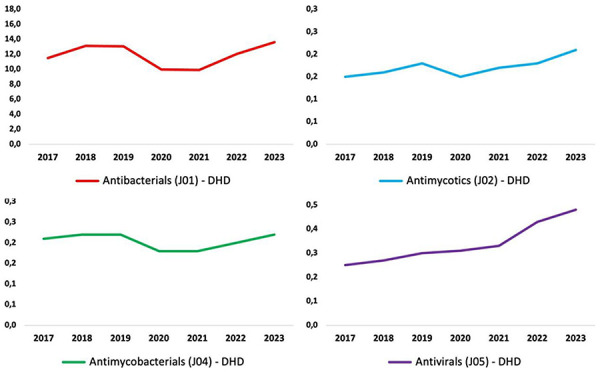
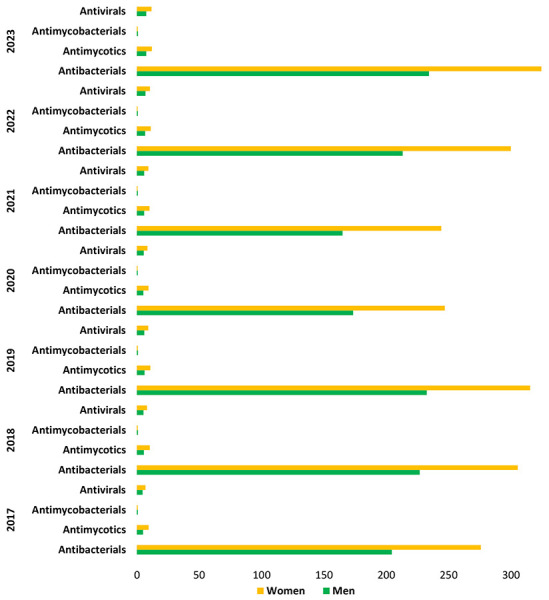
Results: An overall upward temporal trend in the antimicrobial DHD was observed from 2017 to 2023 (increase of 20.2%), with a decrease in usage during 2020 and 2021. Women exhibited higher DHD for antibacterials, antimycotics, and antivirals, whereas men demonstrated higher DHD for antimycobacterials. Notably, antimycobacterial agents had higher DHD in municipalities with populations exceeding 100,000 inhabitants and among foreign-born individuals. Out of 46,762,487 people assigned to primary care, 14,056,450 received prescribed antimicrobials in 2023.
Conclusions: These findings indicate a rising trend in antimicrobial use in primary care, underscoring the need for targeted interventions to encourage the rational use of antimicrobials, particularly in high-use groups.



 京公网安备 11010802042870号
京ICP备2023020795号-1
京公网安备 11010802042870号
京ICP备2023020795号-1

 分享
分享

 求助内容:
求助内容: 应助结果提醒方式:
 扫码关注我们
