Structural Reconstruction via Carbon Nanotube Spatially Confined Metal Catalysis: A Morphology-Controlled Approach to Convert Polycyclic Aromatic Hydrocarbon into Carbon Nanofibers for Highly Active Anodes in Li-Ion Batteries
Ming Chen, Ming-Yang Zhao, Ke Liu, Feng-Ming Liu, Zhong-Yong Yuan, Xing Qian, Rong Wan, Chun-Sheng Li, Ai-Xiang Ding
{"title":"Structural Reconstruction via Carbon Nanotube Spatially Confined Metal Catalysis: A Morphology-Controlled Approach to Convert Polycyclic Aromatic Hydrocarbon into Carbon Nanofibers for Highly Active Anodes in Li-Ion Batteries","authors":"Ming Chen, Ming-Yang Zhao, Ke Liu, Feng-Ming Liu, Zhong-Yong Yuan, Xing Qian, Rong Wan, Chun-Sheng Li, Ai-Xiang Ding","doi":"10.1021/acs.inorgchem.4c05514","DOIUrl":null,"url":null,"abstract":"By a carbon nanotube (CNT) spatially confined metal-catalyzed structural reconstruction, carbon nanofibers (CNFs) with a hollow, hollow-solid, solid graphite core, and CNT shell are prepared using nitrogen heterocycle (NHC) and polycyclic aromatic hydrocarbon (PAH) as carbon sources. The formation mechanism of CNFs with oriented graphene layers and enlarged intergraphene spacing is studied by X-ray diffraction, scanning electron microscopy, transmission electron microscopy, and selected area electron diffraction analysis. It revealed that this one-dimensional nanoconfined metal-catalyzed carbon rearrangement is totally different from the reported spatially localized metal-catalyzed graphitization of electrospun polymer and nanocasted carbohydrate nanofibers, as the graphene orientation, cavity volume, and interlayer distance of CNFs can be controlled by the carbon concentration-related competitive metal-catalyzed tip growth of latitudinal and longitudinal graphene layers from NHC and PAH. The unique CNF structure renders good electronic/ionic conductivity, abundant Li<sup>+</sup> storage interlayer gaps, and robust mechanical durability, resulting in outstanding electrochemical properties as anodes in lithium-ion batteries. The optimum CNF anode delivers a stable discharge capacity of 475 mA h g<sup>–1</sup> at 0.1 C, an extraordinary rate capability of 303 mA h g<sup>–1</sup> at 5 C, and a remarkable long-term cycling stability of 378 mA h g<sup>-1</sup> after 600 cycles at 1 C. This 1D nanoconfined metal catalysis synthesis could be useful for the development of efficient CNF anodes in many electrochemical reactions with a potential for industrial applications.","PeriodicalId":40,"journal":{"name":"Inorganic Chemistry","volume":"79 5 Pt 1 1","pages":""},"PeriodicalIF":4.7000,"publicationDate":"2025-02-11","publicationTypes":"Journal Article","fieldsOfStudy":null,"isOpenAccess":false,"openAccessPdf":"","citationCount":"0","resultStr":null,"platform":"Semanticscholar","paperid":null,"PeriodicalName":"Inorganic Chemistry","FirstCategoryId":"92","ListUrlMain":"https://doi.org/10.1021/acs.inorgchem.4c05514","RegionNum":2,"RegionCategory":"化学","ArticlePicture":[],"TitleCN":null,"AbstractTextCN":null,"PMCID":null,"EPubDate":"","PubModel":"","JCR":"Q1","JCRName":"CHEMISTRY, INORGANIC & NUCLEAR","Score":null,"Total":0}
引用次数: 0
Abstract
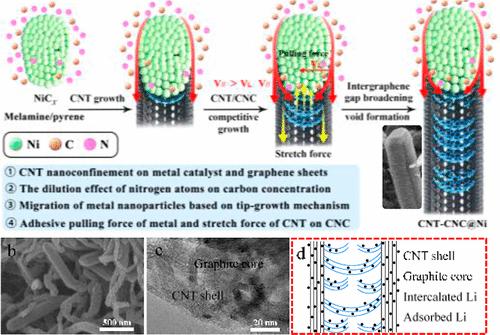
By a carbon nanotube (CNT) spatially confined metal-catalyzed structural reconstruction, carbon nanofibers (CNFs) with a hollow, hollow-solid, solid graphite core, and CNT shell are prepared using nitrogen heterocycle (NHC) and polycyclic aromatic hydrocarbon (PAH) as carbon sources. The formation mechanism of CNFs with oriented graphene layers and enlarged intergraphene spacing is studied by X-ray diffraction, scanning electron microscopy, transmission electron microscopy, and selected area electron diffraction analysis. It revealed that this one-dimensional nanoconfined metal-catalyzed carbon rearrangement is totally different from the reported spatially localized metal-catalyzed graphitization of electrospun polymer and nanocasted carbohydrate nanofibers, as the graphene orientation, cavity volume, and interlayer distance of CNFs can be controlled by the carbon concentration-related competitive metal-catalyzed tip growth of latitudinal and longitudinal graphene layers from NHC and PAH. The unique CNF structure renders good electronic/ionic conductivity, abundant Li+ storage interlayer gaps, and robust mechanical durability, resulting in outstanding electrochemical properties as anodes in lithium-ion batteries. The optimum CNF anode delivers a stable discharge capacity of 475 mA h g–1 at 0.1 C, an extraordinary rate capability of 303 mA h g–1 at 5 C, and a remarkable long-term cycling stability of 378 mA h g-1 after 600 cycles at 1 C. This 1D nanoconfined metal catalysis synthesis could be useful for the development of efficient CNF anodes in many electrochemical reactions with a potential for industrial applications.
以氮杂环烃(NHC)和多环芳烃(PAH)为碳源,通过金属催化碳纳米管(CNT)的空间约束结构重构,制备了具有中空、空心固体、固体石墨芯和碳纳米管壳的碳纳米纤维(CNFs)。通过x射线衍射、扫描电镜、透射电镜和选择区电子衍射分析,研究了石墨烯取向层和石墨烯间距扩大的CNFs的形成机理。结果表明,这种一维纳米限制金属催化的碳重排与已有报道的电纺聚合物和纳米碳水化合物纳米纤维的空间定位金属催化石墨化完全不同,CNFs的石墨烯取向、空腔体积和层间距离可以通过碳浓度相关的竞争金属催化的纬向和纵向石墨烯层的顶端生长来控制。独特的CNF结构使其具有良好的电子/离子导电性,丰富的Li+存储层间隙,以及强大的机械耐久性,从而成为锂离子电池阳极的优异电化学性能。最佳的CNF阳极在0.1℃下具有475 mA h g-1的稳定放电容量,在5℃下具有303 mA h g-1的非凡速率能力,在1℃下循环600次后具有378 mA h g-1的显著长期循环稳定性。这种一维纳米限制金属催化合成可以用于开发高效的CNF阳极,在许多电化学反应中具有工业应用潜力。
期刊介绍:
Inorganic Chemistry publishes fundamental studies in all phases of inorganic chemistry. Coverage includes experimental and theoretical reports on quantitative studies of structure and thermodynamics, kinetics, mechanisms of inorganic reactions, bioinorganic chemistry, and relevant aspects of organometallic chemistry, solid-state phenomena, and chemical bonding theory. Emphasis is placed on the synthesis, structure, thermodynamics, reactivity, spectroscopy, and bonding properties of significant new and known compounds.



 京公网安备 11010802042870号
京ICP备2023020795号-1
京公网安备 11010802042870号
京ICP备2023020795号-1

 分享
分享
 求助内容:
求助内容: 应助结果提醒方式:
 扫码关注我们
