Ramprasath Rajagopal, Koustav Kundu, Tianhong Ouyang, Akilesh Nalluri, Gwen Liu, Lawrence D. Ziegler, Shyamsunder Erramilli, Björn M. Reinhard
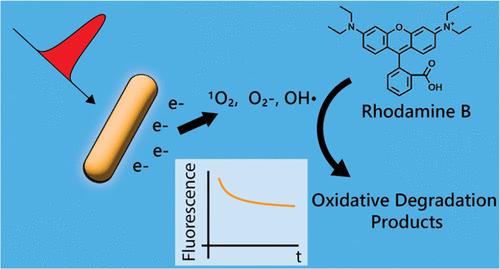
{"title":"Unraveling Plasmon-Enhanced Reactive Oxygen Species Generation through Ultrafast Light","authors":"Ramprasath Rajagopal, Koustav Kundu, Tianhong Ouyang, Akilesh Nalluri, Gwen Liu, Lawrence D. Ziegler, Shyamsunder Erramilli, Björn M. Reinhard","doi":"10.1021/acs.jpcc.4c08071","DOIUrl":null,"url":null,"abstract":"Reactive oxygen species (ROS) generation through gold nanorods (AuNRs) excited by 812 nm centered, 85 fs (fs)-pulsed laser irradiation was investigated through a rhodamine B degradation assay. The initial rate of rhodamine B fluorescence intensity degradation is determined by the rate of ROS generation, but at later time points, the laser irradiation-induced deformation of AuNRs reduces the rate of rhodamine B degradation. For different AuNR preparations that all had a localized surface plasmon resonance (LSPR) mode at around 800 nm but differed in size, the initial rate of rhodamine B fluorescence intensity decrease follows a trend predicted by the simulated peak near-field intensities and absorption efficiencies, except for the smallest AuNRs with dimensions of 30 nm × 7 nm. The initial rate of ROS generation exhibits a power law dependence on the fluence. The reshaping of the AuNRs on longer time scales also depends on the fluence. For 2.3 mJ/cm<sup>2</sup>, the establishment of a stable regime is observed, where an initial reshaping of the AuNRs decreases the spectral overlap between longitudinal plasmon resonance and excitation wavelength so that the absorbed energy is insufficient to induce further structural changes but still allows for ROS generation. For a fluence of 3.9 mJ/cm<sup>2</sup>, the AuNR plasmon spectrum almost completely detunes from the excitation wavelength, resulting in a further reduction of ROS generation. AuNR reshaping and ROS generation also depend on the surface passivation of the AuNRs. Intriguingly, a lipid coating was observed to provide a relative stabilization of the AuNRs when compared with poly(ethylene glycol) (PEG) or cetyltrimethylammonium (CTAB) surface chemistries and still allow for ROS generation.","PeriodicalId":61,"journal":{"name":"The Journal of Physical Chemistry C","volume":"41 1","pages":""},"PeriodicalIF":3.2000,"publicationDate":"2025-02-11","publicationTypes":"Journal Article","fieldsOfStudy":null,"isOpenAccess":false,"openAccessPdf":"","citationCount":"0","resultStr":null,"platform":"Semanticscholar","paperid":null,"PeriodicalName":"The Journal of Physical Chemistry C","FirstCategoryId":"1","ListUrlMain":"https://doi.org/10.1021/acs.jpcc.4c08071","RegionNum":3,"RegionCategory":"化学","ArticlePicture":[],"TitleCN":null,"AbstractTextCN":null,"PMCID":null,"EPubDate":"","PubModel":"","JCR":"Q2","JCRName":"CHEMISTRY, PHYSICAL","Score":null,"Total":0}
引用次数: 0
Abstract
Reactive oxygen species (ROS) generation through gold nanorods (AuNRs) excited by 812 nm centered, 85 fs (fs)-pulsed laser irradiation was investigated through a rhodamine B degradation assay. The initial rate of rhodamine B fluorescence intensity degradation is determined by the rate of ROS generation, but at later time points, the laser irradiation-induced deformation of AuNRs reduces the rate of rhodamine B degradation. For different AuNR preparations that all had a localized surface plasmon resonance (LSPR) mode at around 800 nm but differed in size, the initial rate of rhodamine B fluorescence intensity decrease follows a trend predicted by the simulated peak near-field intensities and absorption efficiencies, except for the smallest AuNRs with dimensions of 30 nm × 7 nm. The initial rate of ROS generation exhibits a power law dependence on the fluence. The reshaping of the AuNRs on longer time scales also depends on the fluence. For 2.3 mJ/cm2, the establishment of a stable regime is observed, where an initial reshaping of the AuNRs decreases the spectral overlap between longitudinal plasmon resonance and excitation wavelength so that the absorbed energy is insufficient to induce further structural changes but still allows for ROS generation. For a fluence of 3.9 mJ/cm2, the AuNR plasmon spectrum almost completely detunes from the excitation wavelength, resulting in a further reduction of ROS generation. AuNR reshaping and ROS generation also depend on the surface passivation of the AuNRs. Intriguingly, a lipid coating was observed to provide a relative stabilization of the AuNRs when compared with poly(ethylene glycol) (PEG) or cetyltrimethylammonium (CTAB) surface chemistries and still allow for ROS generation.
期刊介绍:
The Journal of Physical Chemistry A/B/C is devoted to reporting new and original experimental and theoretical basic research of interest to physical chemists, biophysical chemists, and chemical physicists.



 京公网安备 11010802042870号
京ICP备2023020795号-1
京公网安备 11010802042870号
京ICP备2023020795号-1

 分享
分享
 求助内容:
求助内容: 应助结果提醒方式:
 扫码关注我们
