{"title":"Triterpenoid saponins in tea plants: A spatial and metabolic analysis using UPLC-QTOFMS, molecular networking, and DESI-MSI","authors":"Zhenghua Du , Ying Zhou , Shuang Guo , Yonghui Dong , Yongquan Xu , Xiaomin Yu","doi":"10.1016/j.foodchem.2025.143323","DOIUrl":null,"url":null,"abstract":"<div><div>Triterpenoid saponins, bioactive compounds with pharmaceutical relevance and functional food potential, are abundant in tea plants (<em>Camellia sinensis</em>), yet their structural diversity and tissue-specific distribution remain insufficiently explored. Using high-resolution mass spectrometry, Feature-based Molecular Networking, and imaging mass spectrometry (IMS), we profiled 52 tea saponins, including two novel trisaccharide saponins with unique glycosylation patterns. Aerial tissues, particularly buds and leaves, were enriched with cinnamoyl-decorated tetrasaccharide saponins, whereas roots predominantly accumulated di- and trisaccharide saponins, with significant cultivar-specific variation. IMS further revealed a compartmentalized root distribution, with di- and trisaccharide saponins localized in the epidermis and cortex, while tetrasaccharide saponins were concentrated in the stele. These findings advance understanding of the structural complexity and spatial accumulation of tea saponins, offering insights for bioactive compound extraction and informing breeding strategies to enhance saponin yield and diversity.</div></div>","PeriodicalId":318,"journal":{"name":"Food Chemistry","volume":"475 ","pages":"Article 143323"},"PeriodicalIF":9.8000,"publicationDate":"2025-05-30","publicationTypes":"Journal Article","fieldsOfStudy":null,"isOpenAccess":false,"openAccessPdf":"","citationCount":"0","resultStr":null,"platform":"Semanticscholar","paperid":null,"PeriodicalName":"Food Chemistry","FirstCategoryId":"97","ListUrlMain":"https://www.sciencedirect.com/science/article/pii/S0308814625005746","RegionNum":1,"RegionCategory":"农林科学","ArticlePicture":[],"TitleCN":null,"AbstractTextCN":null,"PMCID":null,"EPubDate":"2025/2/10 0:00:00","PubModel":"Epub","JCR":"Q1","JCRName":"CHEMISTRY, APPLIED","Score":null,"Total":0}
引用次数: 0
Abstract
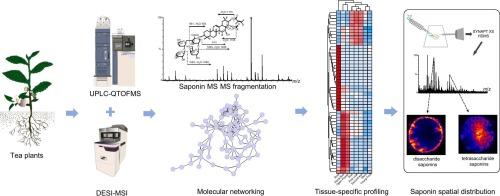
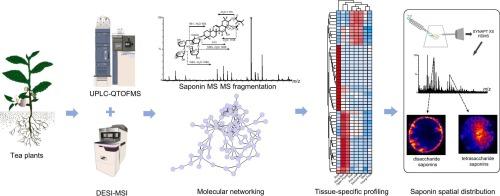
Triterpenoid saponins, bioactive compounds with pharmaceutical relevance and functional food potential, are abundant in tea plants (Camellia sinensis), yet their structural diversity and tissue-specific distribution remain insufficiently explored. Using high-resolution mass spectrometry, Feature-based Molecular Networking, and imaging mass spectrometry (IMS), we profiled 52 tea saponins, including two novel trisaccharide saponins with unique glycosylation patterns. Aerial tissues, particularly buds and leaves, were enriched with cinnamoyl-decorated tetrasaccharide saponins, whereas roots predominantly accumulated di- and trisaccharide saponins, with significant cultivar-specific variation. IMS further revealed a compartmentalized root distribution, with di- and trisaccharide saponins localized in the epidermis and cortex, while tetrasaccharide saponins were concentrated in the stele. These findings advance understanding of the structural complexity and spatial accumulation of tea saponins, offering insights for bioactive compound extraction and informing breeding strategies to enhance saponin yield and diversity.
期刊介绍:
Food Chemistry publishes original research papers dealing with the advancement of the chemistry and biochemistry of foods or the analytical methods/ approach used. All papers should focus on the novelty of the research carried out.




 京公网安备 11010802042870号
京ICP备2023020795号-1
京公网安备 11010802042870号
京ICP备2023020795号-1

 分享
分享
 求助内容:
求助内容: 应助结果提醒方式:
 扫码关注我们
