Min Li, Mariam Maisuradze, Zulkarnaen Paputungan, Reinhard Denecke, Jasper Rikkert Plaisier, Giuliana Aquilanti, Giovanni Agostini and Marco Giorgetti
{"title":"Excess of Zn to relieve the structural distortion of manganese hexacyanoferrate in aqueous Zn-ion battery†","authors":"Min Li, Mariam Maisuradze, Zulkarnaen Paputungan, Reinhard Denecke, Jasper Rikkert Plaisier, Giuliana Aquilanti, Giovanni Agostini and Marco Giorgetti","doi":"10.1039/D4TA08889A","DOIUrl":null,"url":null,"abstract":"<p >The electrochemical performance and reaction mechanism of manganese hexacyanoferrate (MnHCF) in aqueous rechargeable Zn-ion batteries (AZIBs) have been widely studied. A consistent compositional and structural change in MnHCF due to the irreversible intercalation of Zn<small><sup>2+</sup></small> has been reported. In this article, a series of (3%, 10% and 35%) Zn-substituted MnHCF samples was synthesized. Their electrochemical responses were evaluated, and the effect of Zn substitution on the electrochemical performance and structure stability of MnHCF was comprehensively investigated using <em>operando</em> and <em>ex situ</em> synchrotron X-ray diffraction (XRD) and X-ray absorption spectroscopy (XAS) techniques. After Zn substitution, the long-range crystal structure of MnHCF and the local structural environment of Mn were found to be modified. Although Zn-substituted samples exhibited lower specific capacity in AZIBs than the MnHCF sample, higher cycling stability was observed, notably in the 10% ZnMnHCF sample. The study of the working mechanism of the 10% ZnMnHCF electrode demonstrated that a new MnO<small><sub>6</sub></small> local structural unit was formed and remained stable after the first charging cycle. This rapid and steady modification of the Mn site could partially explain the higher cycling stability of the 10% ZnMnHCF AZIB upon cycling. The local structural environment of Zn changes upon the insertion/release of Zn<small><sup>2+</sup></small> in the initial cycles, but after 20 cycles, a tetrahedrally coordinated Zn unit was detected, corresponding to the cubic ZnHCF phase, which was observed for all Zn-substituted electrodes after 100 cycles.</p>","PeriodicalId":82,"journal":{"name":"Journal of Materials Chemistry A","volume":" 16","pages":" 11314-11322"},"PeriodicalIF":9.5000,"publicationDate":"2025-02-11","publicationTypes":"Journal Article","fieldsOfStudy":null,"isOpenAccess":false,"openAccessPdf":"https://pubs.rsc.org/en/content/articlepdf/2025/ta/d4ta08889a?page=search","citationCount":"0","resultStr":null,"platform":"Semanticscholar","paperid":null,"PeriodicalName":"Journal of Materials Chemistry A","FirstCategoryId":"88","ListUrlMain":"https://pubs.rsc.org/en/content/articlelanding/2025/ta/d4ta08889a","RegionNum":2,"RegionCategory":"材料科学","ArticlePicture":[],"TitleCN":null,"AbstractTextCN":null,"PMCID":null,"EPubDate":"","PubModel":"","JCR":"Q1","JCRName":"CHEMISTRY, PHYSICAL","Score":null,"Total":0}
引用次数: 0
Abstract
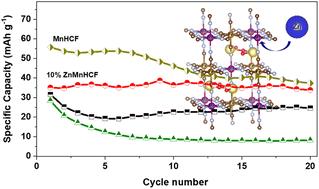
The electrochemical performance and reaction mechanism of manganese hexacyanoferrate (MnHCF) in aqueous rechargeable Zn-ion batteries (AZIBs) have been widely studied. A consistent compositional and structural change in MnHCF due to the irreversible intercalation of Zn2+ has been reported. In this article, a series of (3%, 10% and 35%) Zn-substituted MnHCF samples was synthesized. Their electrochemical responses were evaluated, and the effect of Zn substitution on the electrochemical performance and structure stability of MnHCF was comprehensively investigated using operando and ex situ synchrotron X-ray diffraction (XRD) and X-ray absorption spectroscopy (XAS) techniques. After Zn substitution, the long-range crystal structure of MnHCF and the local structural environment of Mn were found to be modified. Although Zn-substituted samples exhibited lower specific capacity in AZIBs than the MnHCF sample, higher cycling stability was observed, notably in the 10% ZnMnHCF sample. The study of the working mechanism of the 10% ZnMnHCF electrode demonstrated that a new MnO6 local structural unit was formed and remained stable after the first charging cycle. This rapid and steady modification of the Mn site could partially explain the higher cycling stability of the 10% ZnMnHCF AZIB upon cycling. The local structural environment of Zn changes upon the insertion/release of Zn2+ in the initial cycles, but after 20 cycles, a tetrahedrally coordinated Zn unit was detected, corresponding to the cubic ZnHCF phase, which was observed for all Zn-substituted electrodes after 100 cycles.
期刊介绍:
The Journal of Materials Chemistry A, B & C covers a wide range of high-quality studies in the field of materials chemistry, with each section focusing on specific applications of the materials studied. Journal of Materials Chemistry A emphasizes applications in energy and sustainability, including topics such as artificial photosynthesis, batteries, and fuel cells. Journal of Materials Chemistry B focuses on applications in biology and medicine, while Journal of Materials Chemistry C covers applications in optical, magnetic, and electronic devices. Example topic areas within the scope of Journal of Materials Chemistry A include catalysis, green/sustainable materials, sensors, and water treatment, among others.



 京公网安备 11010802042870号
京ICP备2023020795号-1
京公网安备 11010802042870号
京ICP备2023020795号-1

 分享
分享
 求助内容:
求助内容: 应助结果提醒方式:
 扫码关注我们
