{"title":"Establishment of a machine learning model for predicting splenic hilar lymph node metastasis","authors":"Kenichi Ishizu, Satoshi Takahashi, Nobuji Kouno, Ken Takasawa, Katsuji Takeda, Kota Matsui, Masashi Nishino, Tsutomu Hayashi, Yukinori Yamagata, Shigeyuki Matsui, Takaki Yoshikawa, Ryuji Hamamoto","doi":"10.1038/s41746-025-01480-x","DOIUrl":null,"url":null,"abstract":"<p>Upper gastrointestinal cancer (UGC) sometimes metastasizes to the splenic hilum lymph node (SHLN). However, surgical removal of SHLN is technically difficult, and the risk of postoperative complications is high. Although there are models that predict SHLN metastasis, they usually only provide point estimates of risk, and there is a lack of sufficient information. To address this issue, we aimed to develop a Bayesian logistic regression model called Bayes-SHLNM. The performance of the models was compared with that of the frequentist logistic regression (FLR) model as a benchmark, and the posterior probability distribution (PPD) was shown individually. The performance of Bayes-SHLNM was equivalent to that of the FLR model, and the PPD for each case was visualized as the uncertainty. These results indicate that the Bayes-SHLNM model has the potential to be used as a decision support system in clinical settings where uncertainty is high.</p>","PeriodicalId":19349,"journal":{"name":"NPJ Digital Medicine","volume":"13 1","pages":""},"PeriodicalIF":15.1000,"publicationDate":"2025-02-11","publicationTypes":"Journal Article","fieldsOfStudy":null,"isOpenAccess":false,"openAccessPdf":"","citationCount":"0","resultStr":null,"platform":"Semanticscholar","paperid":null,"PeriodicalName":"NPJ Digital Medicine","FirstCategoryId":"3","ListUrlMain":"https://doi.org/10.1038/s41746-025-01480-x","RegionNum":1,"RegionCategory":"医学","ArticlePicture":[],"TitleCN":null,"AbstractTextCN":null,"PMCID":null,"EPubDate":"","PubModel":"","JCR":"Q1","JCRName":"HEALTH CARE SCIENCES & SERVICES","Score":null,"Total":0}
引用次数: 0
Abstract
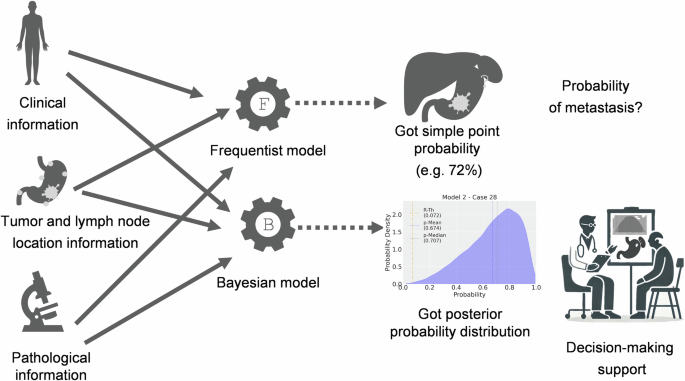
Upper gastrointestinal cancer (UGC) sometimes metastasizes to the splenic hilum lymph node (SHLN). However, surgical removal of SHLN is technically difficult, and the risk of postoperative complications is high. Although there are models that predict SHLN metastasis, they usually only provide point estimates of risk, and there is a lack of sufficient information. To address this issue, we aimed to develop a Bayesian logistic regression model called Bayes-SHLNM. The performance of the models was compared with that of the frequentist logistic regression (FLR) model as a benchmark, and the posterior probability distribution (PPD) was shown individually. The performance of Bayes-SHLNM was equivalent to that of the FLR model, and the PPD for each case was visualized as the uncertainty. These results indicate that the Bayes-SHLNM model has the potential to be used as a decision support system in clinical settings where uncertainty is high.
期刊介绍:
npj Digital Medicine is an online open-access journal that focuses on publishing peer-reviewed research in the field of digital medicine. The journal covers various aspects of digital medicine, including the application and implementation of digital and mobile technologies in clinical settings, virtual healthcare, and the use of artificial intelligence and informatics.
The primary goal of the journal is to support innovation and the advancement of healthcare through the integration of new digital and mobile technologies. When determining if a manuscript is suitable for publication, the journal considers four important criteria: novelty, clinical relevance, scientific rigor, and digital innovation.




 京公网安备 11010802042870号
京ICP备2023020795号-1
京公网安备 11010802042870号
京ICP备2023020795号-1

 分享
分享
 求助内容:
求助内容: 应助结果提醒方式:
 扫码关注我们
