Yolimar Gil, María Mar Quesada-Moreno, María A. Palacios, Silvia Gómez-Coca, Enrique Colacio, Eliseo Ruiz and Daniel Aravena
{"title":"Determining the zero-field cooling/field cooling blocking temperature from AC susceptibility data for single-molecule magnets†‡","authors":"Yolimar Gil, María Mar Quesada-Moreno, María A. Palacios, Silvia Gómez-Coca, Enrique Colacio, Eliseo Ruiz and Daniel Aravena","doi":"10.1039/D4QI03259D","DOIUrl":null,"url":null,"abstract":"<p >We present a general relationship between the magnetisation blocking temperature (<em>T</em><small><sub>B</sub></small>) measured using the zero-field cooling/field cooling technique (ZFC/FC) and the temperature-dependent spin relaxation time obtained from AC susceptibility and magnetisation decay measurements. The presented mathematical approach supplies ZFC/FC blocking temperatures at any heating rate (<em>R</em><small><sub>H</sub></small>), providing comparable values to those obtained experimentally, as demonstrated by testing 107 examples for reported single-molecule magnets (SMMs) where the ZFC/FC curve has been measured. This procedure is examined in further detail for a new single-molecule magnet, [Dy(OPAd<small><sub>2</sub></small>Bz)<small><sub>2</sub></small>(H<small><sub>2</sub></small>O)<small><sub>4</sub></small>Br]Br<small><sub>2</sub></small>·4THF (<strong>1</strong>) (OPAd<small><sub>2</sub></small>Bz: di(1-adamantyl)benzylphosphine oxide). For this compound, ZFC/FC measurements were made over a broad range of heating rates (0.01–5 K min<small><sup>−1</sup></small>), which agreed with the general behaviour predicted from AC susceptibility data. We discuss how the demagnetisation mechanism determines the sensitivity of <em>T</em><small><sub>B</sub></small> with respect to the heating rate: <em>T</em><small><sub>B</sub></small> is mostly insensitive to <em>R</em><small><sub>H</sub></small> for Orbach relaxation, while there is a larger sensitivity for Raman-limited systems. Our conclusions provide a clear physical interpretation of ZFC/FC blocking temperatures, aiding in the proper contextualization of this figure of merit.</p>","PeriodicalId":79,"journal":{"name":"Inorganic Chemistry Frontiers","volume":" 7","pages":" 2856-2871"},"PeriodicalIF":6.4000,"publicationDate":"2025-02-11","publicationTypes":"Journal Article","fieldsOfStudy":null,"isOpenAccess":false,"openAccessPdf":"https://pubs.rsc.org/en/content/articlepdf/2025/qi/d4qi03259d?page=search","citationCount":"0","resultStr":null,"platform":"Semanticscholar","paperid":null,"PeriodicalName":"Inorganic Chemistry Frontiers","FirstCategoryId":"92","ListUrlMain":"https://pubs.rsc.org/en/content/articlelanding/2025/qi/d4qi03259d","RegionNum":1,"RegionCategory":"化学","ArticlePicture":[],"TitleCN":null,"AbstractTextCN":null,"PMCID":null,"EPubDate":"","PubModel":"","JCR":"Q1","JCRName":"CHEMISTRY, INORGANIC & NUCLEAR","Score":null,"Total":0}
引用次数: 0
Abstract
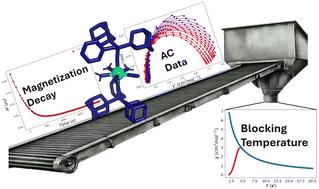
We present a general relationship between the magnetisation blocking temperature (TB) measured using the zero-field cooling/field cooling technique (ZFC/FC) and the temperature-dependent spin relaxation time obtained from AC susceptibility and magnetisation decay measurements. The presented mathematical approach supplies ZFC/FC blocking temperatures at any heating rate (RH), providing comparable values to those obtained experimentally, as demonstrated by testing 107 examples for reported single-molecule magnets (SMMs) where the ZFC/FC curve has been measured. This procedure is examined in further detail for a new single-molecule magnet, [Dy(OPAd2Bz)2(H2O)4Br]Br2·4THF (1) (OPAd2Bz: di(1-adamantyl)benzylphosphine oxide). For this compound, ZFC/FC measurements were made over a broad range of heating rates (0.01–5 K min−1), which agreed with the general behaviour predicted from AC susceptibility data. We discuss how the demagnetisation mechanism determines the sensitivity of TB with respect to the heating rate: TB is mostly insensitive to RH for Orbach relaxation, while there is a larger sensitivity for Raman-limited systems. Our conclusions provide a clear physical interpretation of ZFC/FC blocking temperatures, aiding in the proper contextualization of this figure of merit.




 京公网安备 11010802042870号
京ICP备2023020795号-1
京公网安备 11010802042870号
京ICP备2023020795号-1

 分享
分享
 求助内容:
求助内容: 应助结果提醒方式:
 扫码关注我们
