Utilizing fundus images captured by two ultra-wide field imaging systems to measure diagnostic indicators and assess the grade of diabetic retinopathy.
Yaoyao Sun, Xiuju Chen, Zongming Song, Tingting Liu, Ye Tao, Tinglan Lai, Yanru Chen, Minghan Li, Jinfeng Qu, Xiaoxin Li
{"title":"Utilizing fundus images captured by two ultra-wide field imaging systems to measure diagnostic indicators and assess the grade of diabetic retinopathy.","authors":"Yaoyao Sun, Xiuju Chen, Zongming Song, Tingting Liu, Ye Tao, Tinglan Lai, Yanru Chen, Minghan Li, Jinfeng Qu, Xiaoxin Li","doi":"10.1186/s12886-024-03835-6","DOIUrl":null,"url":null,"abstract":"<p><strong>Background: </strong>This study compared the effectiveness of different ultrawide field fundus imaging systems (Clarus™ 500 and Optos<sup>®</sup>) in diagnosing diabetic retinopathy (DR).</p><p><strong>Methods: </strong>This was a prospective, multicentre study. Retinal photographs were captured at four eye centres utilizing both the Clarus™ 500 and Optos<sup>®</sup> imaging systems. The image quality and the effective retinal area were compared. Then the consistency in diagnosing the severity of DR by two distinct imaging systems was compared according to three separate grading criteria (the International Council of Ophthalmology, the Early Treatment Diabetic Retinopathy Study [ETDRS] grading diagnostic criteria, and the Chinese Clinical Diagnosis and Treatment Guidelines for Diabetic Retinopathy [2014]) were analysed.</p><p><strong>Results: </strong>A total of 113 patients, 201 eyes and 402 images were included in this study. 39 images were excluded due to the poor image quality and 363 images were finally analyzed. The Clarus™ imaging system demonstrated better image quality than the Optos<sup>®</sup> imaging system (κ = 0.195). The mean effective retinal area was 490.03 ± 112.33 Disc area(DA) in the Clarus™ group and 410.41 ± 92.12 DA in the Optos<sup>®</sup> group (P = 0.000). The κ values were 0.812 for ETDRS DR severity, 0.787 for ICO DR severity, and 0.790 for the Chinese guidelines, indicating substantial agreement between the two imaging systems. However, Clarus™ indicated higher DR severity than the Optos<sup>®</sup> imaging system, with a higher detection rate of intraretinal microvascular abnormalities (IRMAs) and neovascularization.</p><p><strong>Conclusion: </strong>Clarus<sup>™</sup> and Optos<sup>®</sup> exhibit strong concordance in the identification of DR. Clarus<sup>™</sup> offers better image quality and IRMA recognition than Optos<sup>®</sup> and better identifies patients who need treatment.</p>","PeriodicalId":9058,"journal":{"name":"BMC Ophthalmology","volume":"25 1","pages":"72"},"PeriodicalIF":1.7000,"publicationDate":"2025-02-10","publicationTypes":"Journal Article","fieldsOfStudy":null,"isOpenAccess":false,"openAccessPdf":"https://www.ncbi.nlm.nih.gov/pmc/articles/PMC11812173/pdf/","citationCount":"0","resultStr":null,"platform":"Semanticscholar","paperid":null,"PeriodicalName":"BMC Ophthalmology","FirstCategoryId":"3","ListUrlMain":"https://doi.org/10.1186/s12886-024-03835-6","RegionNum":4,"RegionCategory":"医学","ArticlePicture":[],"TitleCN":null,"AbstractTextCN":null,"PMCID":null,"EPubDate":"","PubModel":"","JCR":"Q3","JCRName":"OPHTHALMOLOGY","Score":null,"Total":0}
引用次数: 0
Abstract
Background: This study compared the effectiveness of different ultrawide field fundus imaging systems (Clarus™ 500 and Optos®) in diagnosing diabetic retinopathy (DR).
Methods: This was a prospective, multicentre study. Retinal photographs were captured at four eye centres utilizing both the Clarus™ 500 and Optos® imaging systems. The image quality and the effective retinal area were compared. Then the consistency in diagnosing the severity of DR by two distinct imaging systems was compared according to three separate grading criteria (the International Council of Ophthalmology, the Early Treatment Diabetic Retinopathy Study [ETDRS] grading diagnostic criteria, and the Chinese Clinical Diagnosis and Treatment Guidelines for Diabetic Retinopathy [2014]) were analysed.
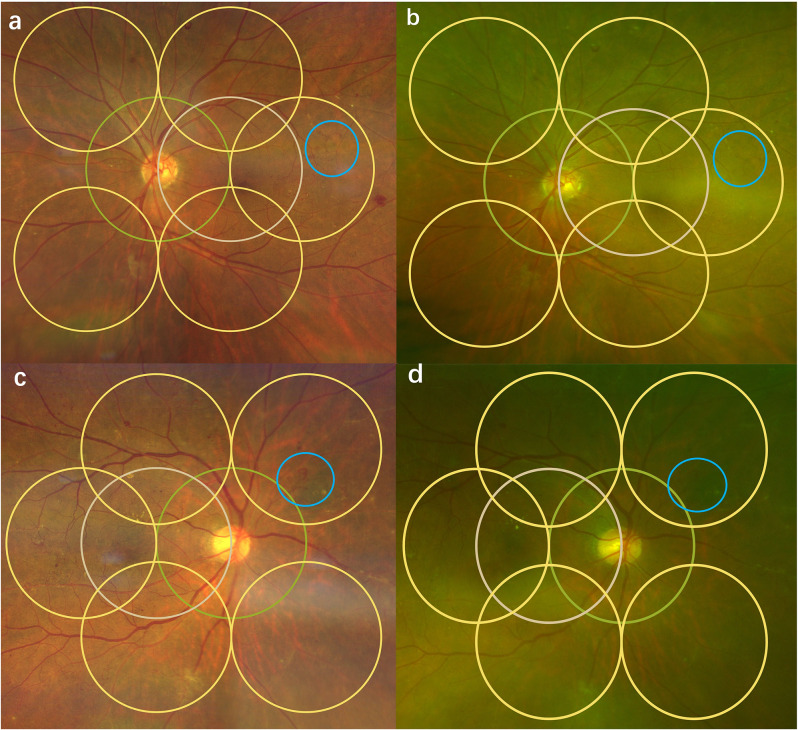
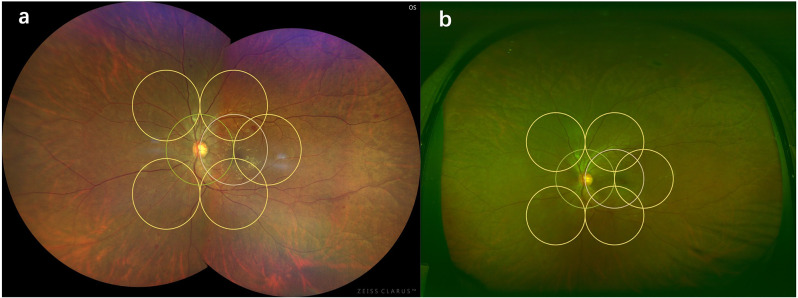
Results: A total of 113 patients, 201 eyes and 402 images were included in this study. 39 images were excluded due to the poor image quality and 363 images were finally analyzed. The Clarus™ imaging system demonstrated better image quality than the Optos® imaging system (κ = 0.195). The mean effective retinal area was 490.03 ± 112.33 Disc area(DA) in the Clarus™ group and 410.41 ± 92.12 DA in the Optos® group (P = 0.000). The κ values were 0.812 for ETDRS DR severity, 0.787 for ICO DR severity, and 0.790 for the Chinese guidelines, indicating substantial agreement between the two imaging systems. However, Clarus™ indicated higher DR severity than the Optos® imaging system, with a higher detection rate of intraretinal microvascular abnormalities (IRMAs) and neovascularization.
Conclusion: Clarus™ and Optos® exhibit strong concordance in the identification of DR. Clarus™ offers better image quality and IRMA recognition than Optos® and better identifies patients who need treatment.
期刊介绍:
BMC Ophthalmology is an open access, peer-reviewed journal that considers articles on all aspects of the prevention, diagnosis and management of eye disorders, as well as related molecular genetics, pathophysiology, and epidemiology.





 京公网安备 11010802042870号
京ICP备2023020795号-1
京公网安备 11010802042870号
京ICP备2023020795号-1

 分享
分享
 求助内容:
求助内容: 应助结果提醒方式:
 扫码关注我们
